
Qalandiya Checkpoint, Wednesday, 13.4,2011 pm
 Qalandiya
We arrived at 16:00 at the familiar sight of heavy traffic, pollution and dirt everywhere possible.
Three “sleeves” (1, 2 and 4) are open, but nevertheless all are crowded with between 15 and 30 people at each. From the distance we also saw a long line at the crossing for blue ID cards. Immediately the soldier in the watchtower and the security personnel along the line snap into their usual effort to move us away from our vantage point through the fence of the parking lot and, as always, the event dies down when we don’t react.
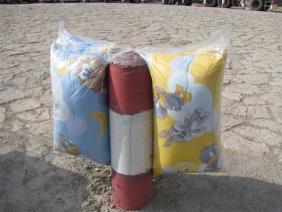
The little marketplace where everyone tries to sell is today offering pillows for children’s rooms – a blatant absurdity in this external environment.
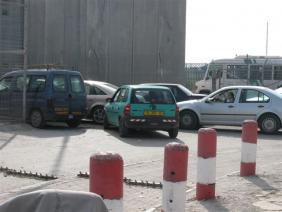
A small green car succeeds in threading through the posts that block the traffic circle in an attempt to bypass the line. A young woman stands on her rights and gives the weaving driver an exercise in education.
At 16:30 we join the lines in the pedestrian crossing, where the route begins with a 20 minute wait in a cage.
16:50 sleeves 1 and 2 – meanwhile a woman with pram and two children, aged three and one, is trying to go back through the turnstile – a complex operation while the female soldier doesn’t exactly understand that it is possible to open the humanitarian gate for her.
In the turnstiles, throughout the whole of the last month, transit is especially slow, as people are allowed through in threes, each group only being released as its predecessor finishes the check. It took us about 20 minutes. Together with the cage, a total of 40 minutes.
View of the pedestrians from the side
most of those crossing to Jerusalem are students and workers from the other side of the checkpoint. Conversely those returning in the direction of Palestinian life are our “hewers of wood and drawers of water.” All wretched laborers rushing home after a day’s work that certainly began very early in the morning at this embittering checkpoint.
And, finally, the blue police arrive to do a round of writing tickets before returning home safely. The haul – three tickets at the north crossing, the first for stopping for a moment to let a woman out. The driver, a woman from the American consulate, says that “the 250 shekels is not much but the humiliation is hard!”
An extremely vulgar woman soldier is managing matters. The drivers know her since she was previously a guard at Atarot. Her promotion has granted her power, of course employed for evil.
The second ticket is given to the driver of a Transit which overheated. He drove up, for a moment, onto a traffic island to check the engine and, unluckily for him, the police chose that moment to appear.
The third traffic report was given to a young driver who, in making a turn, had two wheels up on the edge of the roundabout.
And so, in 25 minutes the Israel Police demonstrated their power over the weak, while on the right side of existence they would not even stick their heads out of the patrol car’s window. As for the fines to be paid, see the report Guide for the Confused into Israel Police Behavior in the Occupied Territories!
Next week the beginning of closures for the Jewish holidays.
Qalandiya Checkpoint / Atarot Pass (Jerusalem)
See all reports for this place-
Click here to watch a video from Qalandiya checkpoint up to mid 2019 Three kilometers south of Ramallah, in the heart of Palestinian population. Integrates into "Jerusalem Envelope" as part of Wall that separates between northern suburbs that were annexed to Jerusalem in 1967: Kafr Aqab, Semiramis and Qalandiya, and the villages of Ar-Ram and Bir Nabala, also north of Jerusalem, and the city itself. Some residents of Kafr Aqab, Semiramis and Qalandiya have Jerusalem ID cards. A terminal operated by Israel Police has functioned since early 2006. As of August 2006, northbound pedestrians are not checked. Southbound Palestinians must carry Jerusalem IDs; holders of Palestinian Authority IDs cannot pass without special permits. Vehicular traffic from Ramallah to other West Bank areas runs to the north of Qalandiya. In February 2019, the new facility of the checkpoint was inaugurated aiming to make it like a "border crossing". The bars and barbed wire fences were replaced with walls of perforated metal panels. The check is now performed at multiple stations for face recognition and the transfer of an e-card. The rate of passage has improved and its density has generally decreased, but lack of manpower and malfunctions cause periods of stress. The development and paving of the roads has not yet been completed, the traffic of cars and pedestrians is dangerous, and t the entire vicinity of the checkpoint is filthy. In 2020 a huge pedestrian bridge was built over the vehicle crossing with severe mobility restrictions (steep stairs, long and winding route). The pedestrian access from public transport to the checkpoint from the north (Ramallah direction) is unclear, and there have been cases of people, especially people with disabilities, who accidentally reached the vehicle crossing and were shot by the soldiers at the checkpoint. In the summer of 2021, work began on a new, sunken entrance road from Qalandiya that will lead directly to Road 443 towards Jerusalem and Tel Aviv. At the same time, the runways of the old Atarot airport were demolished and infrastructure was prepared for a large bus terminal. (updated October 2021)
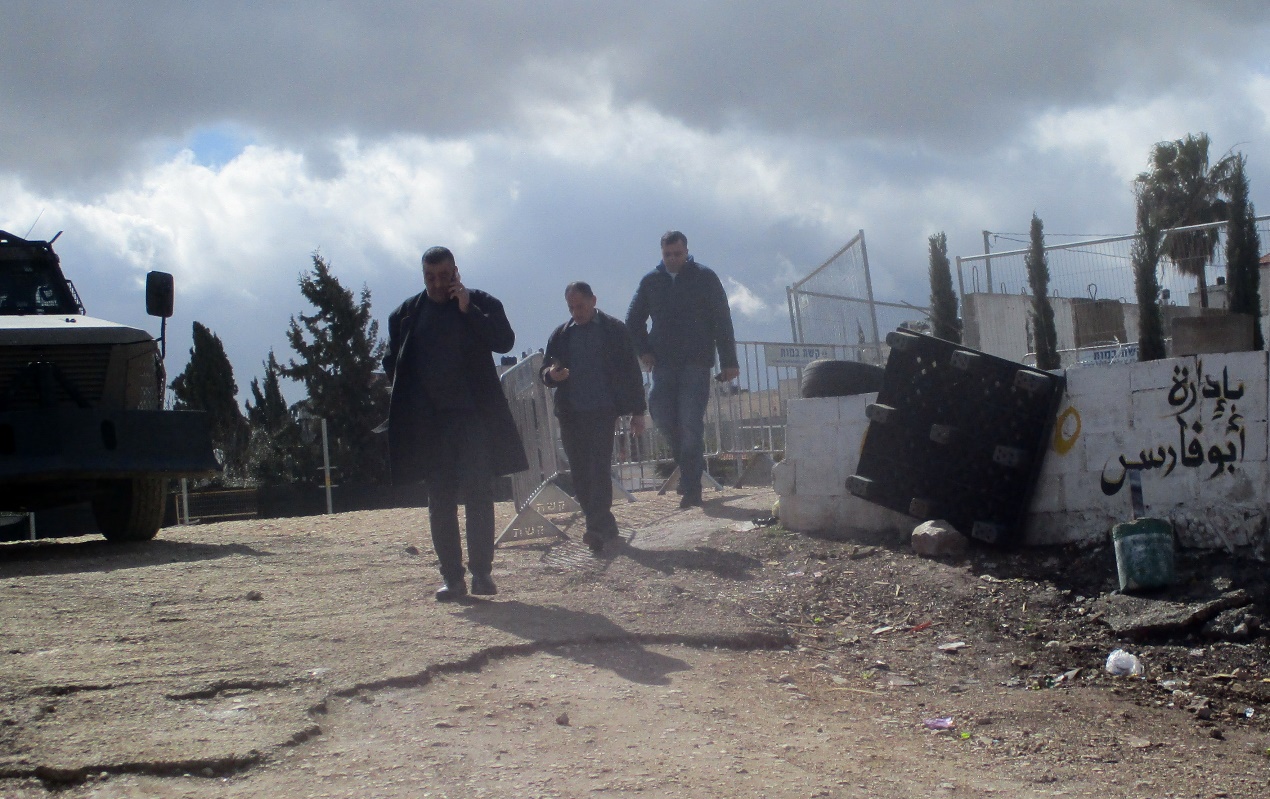 Tamar FleishmanFeb-27-2026Qalandiya: On the way to prayer
-