
Qalandiya - fourth Ramadan Friday
What happened in Qalandiya on the last Ramadan Friday was similar to all the previous Fridays, only more so.
More people crowded at the checkpoint entrance, more people had to turn back and go home, more armed people pointed their guns at the people who came to pray, more women and men turned to the only Jewish woman around, pleading with her: “Speak with them…”
For those who came this was their last chance of the year, perhaps the last chance in a lifetime, to take part in the traditionally special prayer at the Al Aqsa Mosque.
Here are two examples out of many:
The disappointment of those refused entry was extreme, and obvious on the faces of four women from Nablus and Tul Karem who had already passed their fiftieth year. None of them know what an ‘app’ is, let alone how to use one. So although they meet the criteria set for them by the regime, did not hold the passage permit to prayer.
They all handed me the certificate showing their age and begged me, “Talk with the soldiers”.

They were there for over an hour, distressed, then took leave and each proceeded home.
At the outer gate of the checkpoint compound, paced an acquaintance who had taken care ahead of time to obtain the necessary permit, passed all the inspections, came to pray at Al Aqsa, and happily went home. That evening, he was called by a GSS operative who asked him, “Where are you?” “Home” answered the man, and only then remembered that he had forgotten to place his magnetic card for reading at the machines of the entrance to Qalandiya Checkpoint. “Not true, you are in Jerusalem” the GSS man said crossly, and notified him that he who had until now been “clean” was now “blacklisted”.
Now the guy was traipsing between here and there, hoping to mend things. He too asked: “Perhaps you could talk to them?”
Talk to whom? I asked.
To the men (in the picture) who point their guns at the people coming to the checkpoint? To those trying to get rid of me, too?


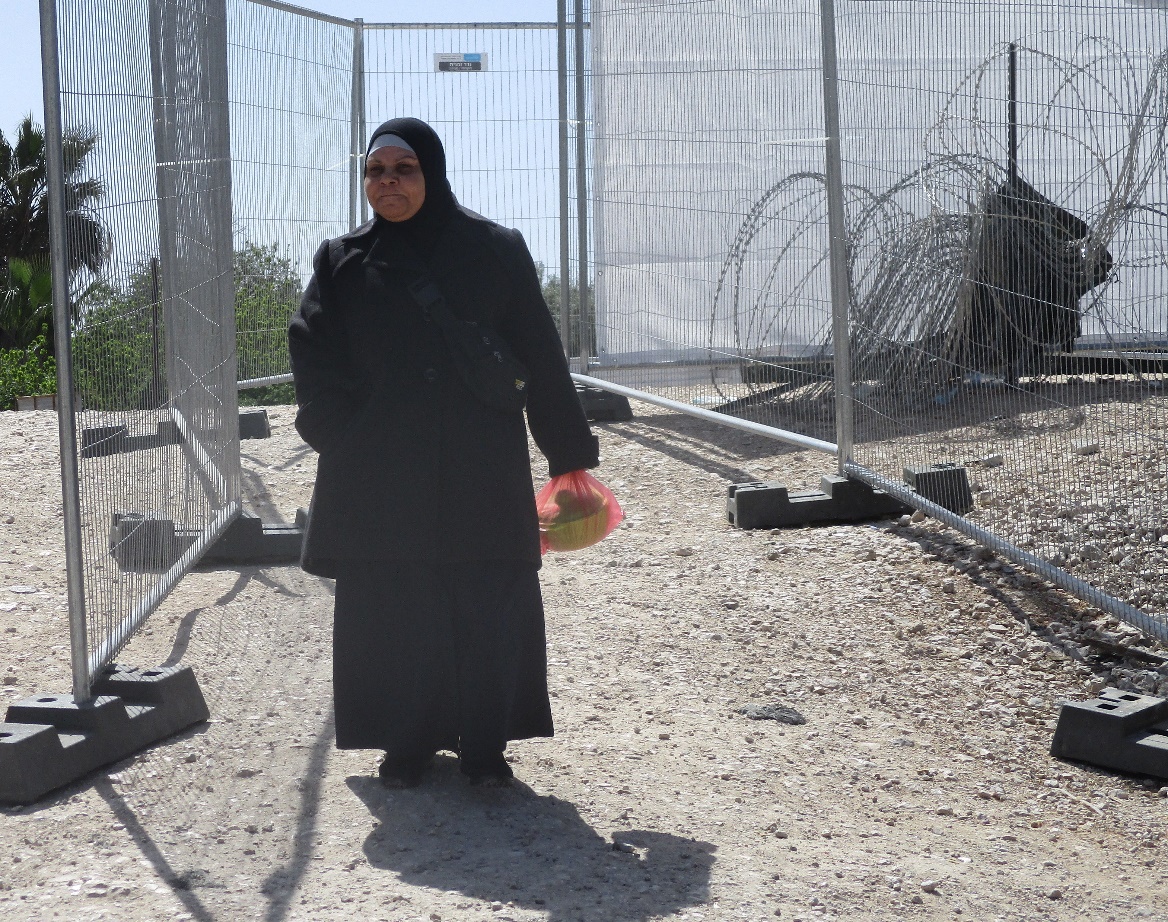
In the photo, the track of those sent back:
On my way back, going through the corals, through the fence on the border of the facility I noticed an elderly woman supported by the young Palestinian first-aid workers who seated her in a wheelchair and led her out of the compound. The whole time, an armed soldier stood there, guarding.
Guarding from what? From the woman who cannot even stand on her own feet without help? How pathetic the sight, as others.

In hindsight, I was hit by the realization that not only should one speak of what is present here – one must write about what there isn’t. It’s the ‘isn’t’ that is most marked here, shouting: There are no children here.
I returned Primo Levy, specialist of memory, who wrote:
“On the threshold of consciousness, many people, even entire peoples, feel that ‘any foreigner is a foe’. This belief is usually well-hidden in the depths of one’s soul as a chronic infection.”*
*Ecce Homo, translated into English from the Hebrew translation
Qalandiya Checkpoint / Atarot Pass (Jerusalem)
See all reports for this place-
Click here to watch a video from Qalandiya checkpoint up to mid 2019 Three kilometers south of Ramallah, in the heart of Palestinian population. Integrates into "Jerusalem Envelope" as part of Wall that separates between northern suburbs that were annexed to Jerusalem in 1967: Kafr Aqab, Semiramis and Qalandiya, and the villages of Ar-Ram and Bir Nabala, also north of Jerusalem, and the city itself. Some residents of Kafr Aqab, Semiramis and Qalandiya have Jerusalem ID cards. A terminal operated by Israel Police has functioned since early 2006. As of August 2006, northbound pedestrians are not checked. Southbound Palestinians must carry Jerusalem IDs; holders of Palestinian Authority IDs cannot pass without special permits. Vehicular traffic from Ramallah to other West Bank areas runs to the north of Qalandiya. In February 2019, the new facility of the checkpoint was inaugurated aiming to make it like a "border crossing". The bars and barbed wire fences were replaced with walls of perforated metal panels. The check is now performed at multiple stations for face recognition and the transfer of an e-card. The rate of passage has improved and its density has generally decreased, but lack of manpower and malfunctions cause periods of stress. The development and paving of the roads has not yet been completed, the traffic of cars and pedestrians is dangerous, and t the entire vicinity of the checkpoint is filthy. In 2020 a huge pedestrian bridge was built over the vehicle crossing with severe mobility restrictions (steep stairs, long and winding route). The pedestrian access from public transport to the checkpoint from the north (Ramallah direction) is unclear, and there have been cases of people, especially people with disabilities, who accidentally reached the vehicle crossing and were shot by the soldiers at the checkpoint. In the summer of 2021, work began on a new, sunken entrance road from Qalandiya that will lead directly to Road 443 towards Jerusalem and Tel Aviv. At the same time, the runways of the old Atarot airport were demolished and infrastructure was prepared for a large bus terminal. (updated October 2021)
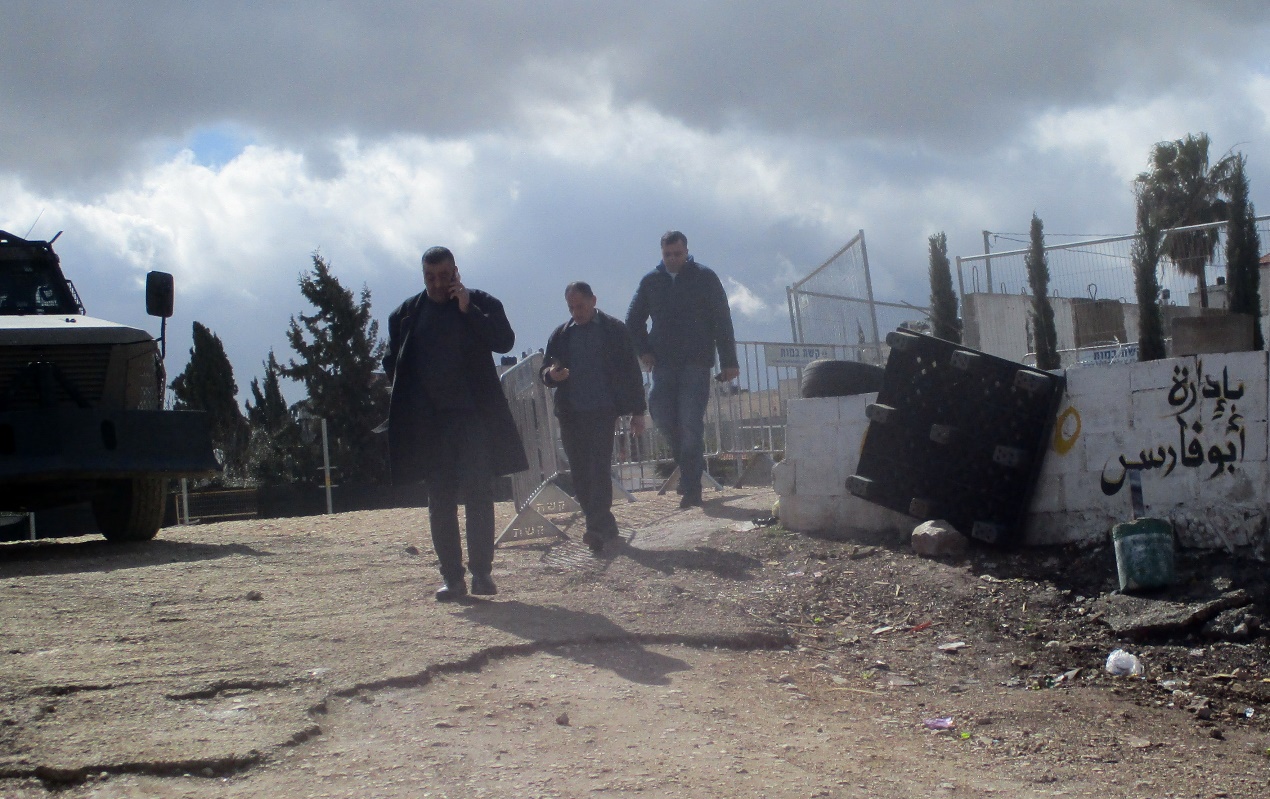 Tamar FleishmanFeb-27-2026Qalandiya: On the way to prayer
-