
Qalandiya, Jaba
For our morning shift in Qalandiya we continue to park on the Palestinian side because due to the works on the Israeli side there is no place to park there. Eliezer Yaari joined us. He wants to make a film about Machsomwatch at the checkpoints, and we understood that he had already filmed one of the sea days and also some of the members. This time he chose to accompany Chana going on duty in Qalandiya.
Always when a guest comes we expand on the explanations, telling what was here in the days of the old checkpoint, and more. The reactions of the guests make us come back and remember the many injustices that happen here. We, to our shame, have already gotten a little used to it…
We arrived around a quarter to six. We met our friend Abu Ramzi, the beigel seller, standing near the entrance to the checkpoint compound, we talked with him a bit and we all also bought beigels from him. The kiosk is already open, and the food stand is also active frying falafel and chips there in the morning. But they also still sell bags with fresh vegetables for those interested, salads and more. Already last time we saw that inside the checkpoint complex there was a seller of packaged cakes located on the ramp. Today there was also another one under the shed. In front of them is a hat seller, who we also saw last time. Everyone is trying to earn a few pennies in any way possible.
Fog covers most of the city this morning and here, too. You don’t notice all the tall buildings in the refugee camp beyond the wall, as the crow flies no more than 100-200 meters from us. But the ugly concrete towers of the army are very visible and from time to time we also hear instructions being sprayed from there towards those passing through the vehicle checkpoint.
When we got to the checkpoint itself there were no queues. Around 6 o’clock, people came and entered quite quickly at one of the three entrances. But in a short time only one of the three entrances remained open (the green/red light above the entrance indicates whether the carousel at the end of the slalom is open or closed). The queues started to accumulate. A few more minutes passed and again all 3 entrances were opened and the queues got shorter and shorter.

When the queues shortened again, we proceeded to the closed entrance to the checkpoint complex from the direction of Qalandiya. Last time we were here we found out that they had dismantled the entire upper part of the blue fence in the part near the closed gate. The dismantled metal was tossed aside. This time we saw that they put it back in place and connected it with chains, and added a wire coil on top. But not Palestinians were undaunted. They moved the coil that was probably also at the end and at least the young guys climb over it easily. Some ask us not to photograph them, others are happy to be photographed and even encourage us to photograph them. To this day we cannot understand why they closed the gate that here that was open before. Eliezer is shocked by the situation, is enthusiastic about the colorful mural and talks to the coffee seller who is stationed on the concrete barriers that separate the traffic lanes. Another way to make a living – selling coffee and other things to drivers who get stuck in traffic in front of the car barrier.


We turned and made a long way round to reach the exit from the checkpoint complex on the open eastern side, and from there we returned along the road. Through the barbed wire fence and the fog we saw that there were queues again at the checkpoint itself.

We crossed to the other side of the road, near the place from where you should not proceed on foot towards the vehicle barrier, to reach the entrance to Qalandiya.
A sign warns that it is forbidden to proceed from here. We remind our guest that there were those who approached and were shot and killed. Although there were also cases in which the security guards exercised discretion and managed, miraculously, to neutralize those approaching without shooting, or at least without killing…

We made our way between the cars in the traffic and showed Eliezer the wall from the Palestinian side with paintings of Arafat and Barghouti and more. Barghouti’s face is no longer visible at all, it is completely covered in soot. The entire area at the foot of the wall is burned, probably as a result of conflicts that occur here from time to time and grenades of various kinds that are thrown during them. We told him what Tamar had reported about how the business owners in the area had been fined various fines recently, and the fruit and vegetable stalls that were opened near the checkpoint during the lunch hours were also destroyed many times and reports were given to the peddlers. It is a shame that the Jerusalem Municipality does not invest a little more in cleaning the area and providing basic services in the areas that are its responsibility. We returned to the checkpoint and on our way back we saw that the queues had thinned again and the fog was also beginning to dissipate.
By the time we got back to the checkpoint there were no queues at all. Towards 7, Eliezer and I entered the middle line. The carousel at the end of it closed a little before it was our turn to go through and remained closed even when we could see that the hall inside, which was initially full, was less crowded. Most of the people who were in front of us left this line and went to the other entrances, where the line did move forward. After a while, they opened the carousel for us as well. Inside the hall, the door that connects the central section, where we were, and the western section, was closed and we could not see what the situation was there. On the eastern side the door was open and we could see that only one of the 2 positions for checking objects was open. In the central section where we were, the 2 positions were open and worked quickly. In a few moments we finished checking belongings and moved on to checking the documents. The Palestinians go through the electronic positions and we are at the manned position. I went through immediately and from Eliezer the soldier took his ID card and wrote down the number where she entered on the computer. But she didn’t ask questions and didn’t delay us beyond that. I wondered to myself if it was because they saw on the cameras that there was an unknown person filming around…
In total, the crossing took us less than fifteen minutes, despite the delay at the beginning. At the last stage, at the last turnstiles before exiting the bridge, we saw a disabled man who was using crutches to walk, and a security guard came with him and opened the gate next to the turnstiles for him. After that, he also opened a gate in the fence that allows one to avoid going up on the bridge. I showed Eliezer how they have raised the fences and added a bar between the concrete of the bridge and the covering roof to stop young men from climbing over the fence to help themselves shorten the way to the bridge.
Then we went onto the bridge to see the vehicle checkpoint and the refugee camp on one side (the large buildings were still hidden in fog), and the building works in progress on the other side. Young men see Eliezer photographing and ask to be photographed posing. After this we turned back, went off the bridge and passed on foot to the Palestinian side.
Chana waits here since she has had a pacemaker, so as not to cause unnecessary delay to the workers rushing to work.
We drove back via Ar-ram towards the Jaba (Adam) junction. Before the junction was a temporary checkpoint with a long line of cars waiting. From time to time soldiers checked passengers and photographed identity cards, but not all cars with Palestinian number plates. We don’t know how the soldiers decide whom to check. At the junction we turned towards Jerusalem via Hizmeh. Today was the last day of school summer vacation and maybe this was the reason for the relatively light traffic to Hizmeh checkpoint, to Pisgat Zeev and to town.
After visiting Qalandiya we went to Chana’s home for coffee and cake. Eliezer wanted to photograph her again for the film he is making. Who knows how much of all this will be included!
Jaba' (Lil)
See all reports for this place-
Jaba' (Lil) In fact, the Jaba checkpoint is east of the Qalandiya checkpoint. Its declared purpose is the prevention of Israeli citizens from entering Area A. A road checkpoint for vehicles, located on Road 65, borders the southern fence of Kfar Jaba, about three kilometers east of the Qalandiya checkpoint, on the road leading to the settlement of Adam on Road 60. Archaeological excavations within the village found the remains of a cloth house from the First Temple period. The events that led to the construction of the checkpoint are precisely here: on the day of the abduction of Gilad Shalit and before the outbreak of the Second Lebanon War, a 17-year-old man from one of the settlements was abducted by a Palestinian cell. His body was found several days later at the entrances to Ramallah. A military investigation revealed that his abductors had taken him along this route. The checkpoint was set up to prevent future kidnappings and to warn settlers from traveling to Ramallah and entering Area A (which is forbidden for Israelis). The checkpoint that operates around the clock. Usually only vehicles traveling in the direction of Ramallah are inspected. (November 2016): Every morning, when the settlers en masse travel to Jerusalem on Route 60 and every afternoon they return from Jerusalem on Route 60, the army initiates a traffic jam at the entrance to the Jaba checkpoint and stops the movement of Palestinians traveling toward Route 60. (February 2020): In the last two years the checkpoint has not always been manned. Sometimes the soldiers come and just stand, sometimes they come and stop and check those who enter the village, sometimes they patrol the alleys of the village, sometimes they fire stun grenades and gas and sometimes they invade houses and stop young people, say those passing through the Hazma checkpoint. (Updated February 2020)
-
Qalandiya Checkpoint / Atarot Pass (Jerusalem)
See all reports for this place-
Click here to watch a video from Qalandiya checkpoint up to mid 2019 Three kilometers south of Ramallah, in the heart of Palestinian population. Integrates into "Jerusalem Envelope" as part of Wall that separates between northern suburbs that were annexed to Jerusalem in 1967: Kafr Aqab, Semiramis and Qalandiya, and the villages of Ar-Ram and Bir Nabala, also north of Jerusalem, and the city itself. Some residents of Kafr Aqab, Semiramis and Qalandiya have Jerusalem ID cards. A terminal operated by Israel Police has functioned since early 2006. As of August 2006, northbound pedestrians are not checked. Southbound Palestinians must carry Jerusalem IDs; holders of Palestinian Authority IDs cannot pass without special permits. Vehicular traffic from Ramallah to other West Bank areas runs to the north of Qalandiya. In February 2019, the new facility of the checkpoint was inaugurated aiming to make it like a "border crossing". The bars and barbed wire fences were replaced with walls of perforated metal panels. The check is now performed at multiple stations for face recognition and the transfer of an e-card. The rate of passage has improved and its density has generally decreased, but lack of manpower and malfunctions cause periods of stress. The development and paving of the roads has not yet been completed, the traffic of cars and pedestrians is dangerous, and t the entire vicinity of the checkpoint is filthy. In 2020 a huge pedestrian bridge was built over the vehicle crossing with severe mobility restrictions (steep stairs, long and winding route). The pedestrian access from public transport to the checkpoint from the north (Ramallah direction) is unclear, and there have been cases of people, especially people with disabilities, who accidentally reached the vehicle crossing and were shot by the soldiers at the checkpoint. In the summer of 2021, work began on a new, sunken entrance road from Qalandiya that will lead directly to Road 443 towards Jerusalem and Tel Aviv. At the same time, the runways of the old Atarot airport were demolished and infrastructure was prepared for a large bus terminal. (updated October 2021)
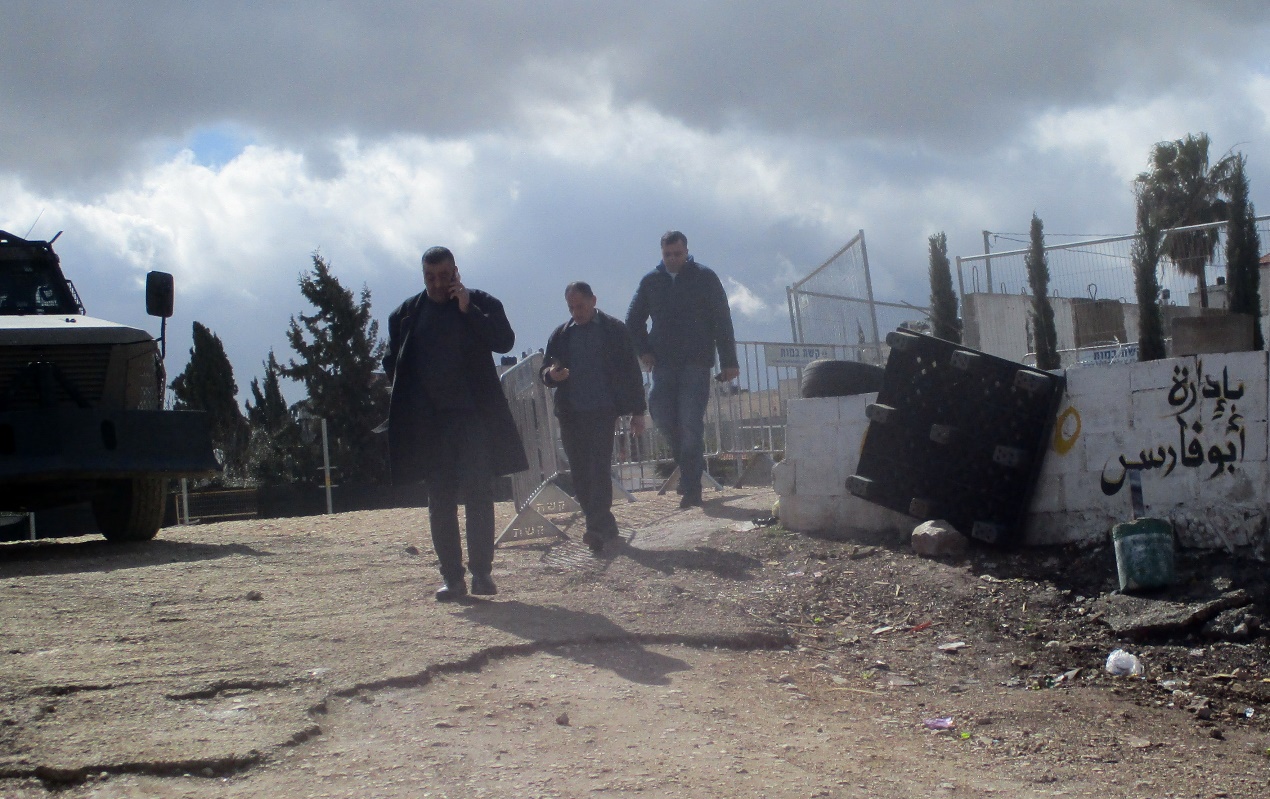 Tamar FleishmanFeb-27-2026Qalandiya: On the way to prayer
-