
Qalandiya - Moving from Mukassed Hospital in East Jerusalem to Gaza

Looking at this 10-month old who had just been released from Muqassad Hospital in East Jerusalem and was on his way home to Gaza, something felt heavily upset.
Perhaps it was the sadness in the mother’s face, or the baby’s strange sleepiness and his body’s slackness – even when shaken from his mother’s shoulder to her knees and back, he did not open his eyes.
He has a problem in his throat, explained the doctor who sat in the Gazan patients’ transport, delayed at the side of the checkpoint along with its seven passengers.
The doctor, a resident of East Jerusalem, was on his way to visit his family in Gaza. He had applied in time for a permit to travel there, and his application was accepted, but the occupation’s bureaucracy has its own rules.
In real Time, just before boarding the designated transport to Gaza, as his papers were being checked, something was missing.
Perhaps some paper, or a signature. What to do? – Wait, and wait some more.
Luckily for the doctor and the others, three ill patients and three accompaniers, this time the matter ended well and eventually the delay ended and the transport was allowed to proceed.
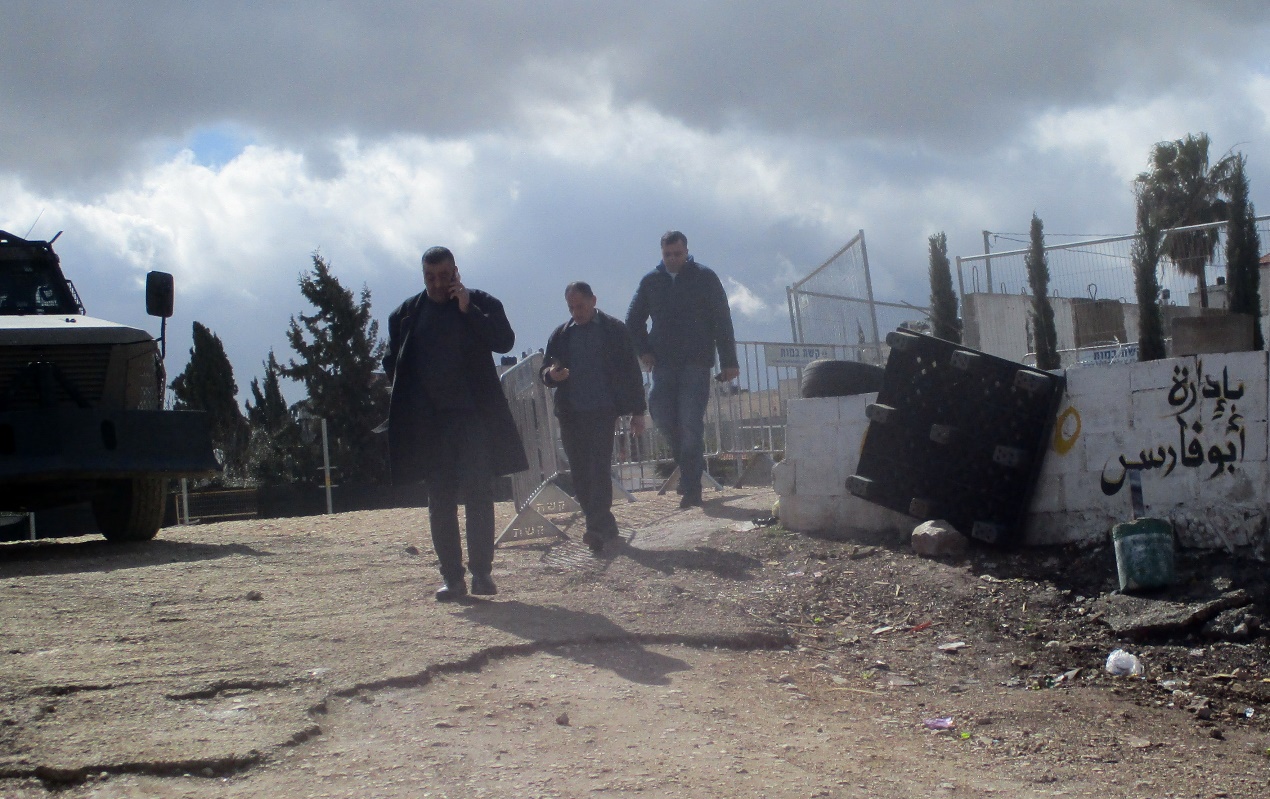
Further on, near the Qalandiya refugee camp, I met an old acquaintance who was waiting for someone and showed me a scar from a wound he had received several weeks ago by a rifle-butt blow inflicted by a soldier, when the young man couldn’t hold his tongue, seeing the soldier pushing a young Palestinian woman entering A-Ram and shouting to her: “Go away, slut!”
The young man did not know the young woman, and in spite of being aware that this might end very badly for him, he confronted the soldier with words, which made the soldier beat him in the ribs and inflict a bleeding wound on him.
As our talk continued about life under Israeli military occupation, he told me that at the age of 13 he had been in prison. Just then, as I was inquiring about the details, the person whom he had been waiting for appeared, so we concluded that next time we meet we’d continue, and the man disappeared inside the car waiting for him now.
Qalandiya Checkpoint / Atarot Pass (Jerusalem)
See all reports for this place-
Click here to watch a video from Qalandiya checkpoint up to mid 2019 Three kilometers south of Ramallah, in the heart of Palestinian population. Integrates into "Jerusalem Envelope" as part of Wall that separates between northern suburbs that were annexed to Jerusalem in 1967: Kafr Aqab, Semiramis and Qalandiya, and the villages of Ar-Ram and Bir Nabala, also north of Jerusalem, and the city itself. Some residents of Kafr Aqab, Semiramis and Qalandiya have Jerusalem ID cards. A terminal operated by Israel Police has functioned since early 2006. As of August 2006, northbound pedestrians are not checked. Southbound Palestinians must carry Jerusalem IDs; holders of Palestinian Authority IDs cannot pass without special permits. Vehicular traffic from Ramallah to other West Bank areas runs to the north of Qalandiya. In February 2019, the new facility of the checkpoint was inaugurated aiming to make it like a "border crossing". The bars and barbed wire fences were replaced with walls of perforated metal panels. The check is now performed at multiple stations for face recognition and the transfer of an e-card. The rate of passage has improved and its density has generally decreased, but lack of manpower and malfunctions cause periods of stress. The development and paving of the roads has not yet been completed, the traffic of cars and pedestrians is dangerous, and t the entire vicinity of the checkpoint is filthy. In 2020 a huge pedestrian bridge was built over the vehicle crossing with severe mobility restrictions (steep stairs, long and winding route). The pedestrian access from public transport to the checkpoint from the north (Ramallah direction) is unclear, and there have been cases of people, especially people with disabilities, who accidentally reached the vehicle crossing and were shot by the soldiers at the checkpoint. In the summer of 2021, work began on a new, sunken entrance road from Qalandiya that will lead directly to Road 443 towards Jerusalem and Tel Aviv. At the same time, the runways of the old Atarot airport were demolished and infrastructure was prepared for a large bus terminal. (updated October 2021)
 Tamar FleishmanFeb-27-2026Qalandiya: On the way to prayer
-