
Qalandiya, Sun 13.4.08, Afternoon
On a chair that was brought by the cab drivers, sat a detached man who
was panting heavily; His shirt was wide open and his chest was wrapped in white
bandages, their color were in complete contrast to his complexion which I
thought resembled the color of an old vellum, the same complexion my father had
when I was asked to identify him at the cemetery.
On the back of his hand was a bandage that was attached with a plaster-
a sign that the infusion had just been removed.
The man (A'), a Gaza resident, that was escorted by
his brother (S'), had been released from a hospital in Nablus
that morning, after going through heart surgery. His permits had expired four
days before. As it often happens, his hospitalization had prolonged more then
was expected.
The two brothers had been walking back and forth from one DCO office at
the West Bank to another. Each time they were told that
they had to go to a different place, that maybe tomorrow or on the day after
that, they would receive a permit.
They finally ended up at Qalandiya. There was no sense or end in that
act, apart for the fact that this is the checkpoint that behind which begun their way home. As though this
place would bring their home closer.
It was apparent that they didn't think it would be possible. They were
both exhausted and in despair. The cab drivers that gathered around them talked
for them. Had there not been one person who had a previous acquaintance with
Ronni and therefore called for us, there is no telling how their day would have
ended. Walking was also very hard for A', one of his legs was covered with abscess
cause by his diabetes; he dragged his leg when walking and spread it forward
when sitting.
The DCO offices were closed. The key to this
situation was handed to us by Dalya B' (The DCO health coordinator), who in
five minutes from the moment we had contacted her, gave an order to the DCO at
Qalandiya to prepare a permit for the two brothers, as they "had nothing on
them" and that have already passed the hazardous age.
At
this point a new saga began. The four of us made our way to the DCO offices.
But it was just then that the lane through which we were to pass was being
cleaned and that the x-ray machine in it was going through reparations. We
stood behind the bars and waited. A' was about to collapse so we improvised a chair
for him by using a bin.
The
guard that was making sure we were secure from the other side of the bars,
tried engaging in a conversation with the brothers while expressing his
contempt towards their culture and blaming them for the collective situation in
Gaza. The suffering expression on their faces became even gloomier.
When
I asked him to treat them respectfully, as human beings, he said that they were
unrespectable people. S' started apologizing, saying that he and his brother
had never caused any harm to anyone, that all they wished was to live in peace
and support their family.- That’s how things go in our region, an Arab
always has to apologize, always has to denounce, always has to promise that he
isn't plotting anything.
When
the brothers received their permit, fifty five minutes after Dalya had approved
their passage, we had to return to the inspection lanes. It didn't help us when
we said that just a few moments ago we and our language had been inspected.
We
had then become to release that in the long line in front of the only
inspection post that was activated, there was no movement. "It's the
soldier's dinner time", said Itai the checkpoint commander.
It wasn't hard to convince the
Palestinians that were crowded at the beginning of the line to let the brothers
pass before them. You didn't need a medical diploma to see that A' was in great
despair, that every movement caused him pain and that each breath was a
terrible effort.
It
was hard to look in their grateful eyes when we separated and sent them on
their way. As though passing to the other side of the checkpoint was in itself
the actual remedy.
(Four
hours after we separated S' called to inform us that they had arrived at home)
At
the vehicle checkpoint was a Red Crescent ambulance, in it was a woman from Nablus that was on her way
back from Mokased where she went through a series of examinations after
suffering a stroke. The medical crew that escorted her said that they had been
waiting for thirty minutes for the arrival of an ambulance that was making it's
way from the occupied territories, so that they could pass the woman in the
"Back-To-Back" system and send her home. It didn't take long until
the ambulance appeared from the west, the most distant side of the checkpoint. But
it wasn't allowed to pass from there. No one of the people from the Jerusalem medical crew
couldn't understand the reason for this delay, after all every detail had been
coordinated in advance. After waiting for a long time, we saw that the
ambulance was making a u-turn and heading back to the northern square at the
checkpoint.
We
later learned that the ambulance had arrived with a baby of only a month and
half that had a deficient heart; he was escorted by his mother. The two were on
their way to east Jerusalem so that the baby could go through surgery.
But their paper, their papers weren't valid.
mother and her son got out of the ambulance, entered a privet vehicle and
headed back to their home in Jenin.
Qalandiya Checkpoint / Atarot Pass (Jerusalem)
See all reports for this place-
Click here to watch a video from Qalandiya checkpoint up to mid 2019 Three kilometers south of Ramallah, in the heart of Palestinian population. Integrates into "Jerusalem Envelope" as part of Wall that separates between northern suburbs that were annexed to Jerusalem in 1967: Kafr Aqab, Semiramis and Qalandiya, and the villages of Ar-Ram and Bir Nabala, also north of Jerusalem, and the city itself. Some residents of Kafr Aqab, Semiramis and Qalandiya have Jerusalem ID cards. A terminal operated by Israel Police has functioned since early 2006. As of August 2006, northbound pedestrians are not checked. Southbound Palestinians must carry Jerusalem IDs; holders of Palestinian Authority IDs cannot pass without special permits. Vehicular traffic from Ramallah to other West Bank areas runs to the north of Qalandiya. In February 2019, the new facility of the checkpoint was inaugurated aiming to make it like a "border crossing". The bars and barbed wire fences were replaced with walls of perforated metal panels. The check is now performed at multiple stations for face recognition and the transfer of an e-card. The rate of passage has improved and its density has generally decreased, but lack of manpower and malfunctions cause periods of stress. The development and paving of the roads has not yet been completed, the traffic of cars and pedestrians is dangerous, and t the entire vicinity of the checkpoint is filthy. In 2020 a huge pedestrian bridge was built over the vehicle crossing with severe mobility restrictions (steep stairs, long and winding route). The pedestrian access from public transport to the checkpoint from the north (Ramallah direction) is unclear, and there have been cases of people, especially people with disabilities, who accidentally reached the vehicle crossing and were shot by the soldiers at the checkpoint. In the summer of 2021, work began on a new, sunken entrance road from Qalandiya that will lead directly to Road 443 towards Jerusalem and Tel Aviv. At the same time, the runways of the old Atarot airport were demolished and infrastructure was prepared for a large bus terminal. (updated October 2021)
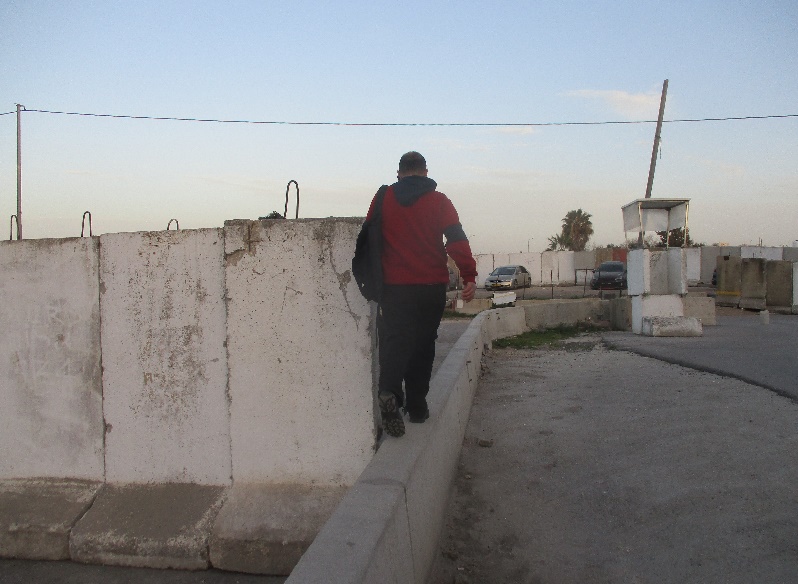 Tamar FleishmanFeb-16-2026Qalandiya CP: shortcut
-