
Qalandiya, Sun 30.9.12, Afternoon
Translating: Ruth Fleishman
Pictures:
1. The agenda in Qalandiya
2. Freedom fighters
3. A Leukemia patient from Jenin transferred to a hospital in East Jerusalem
“This is what’s on the agenda now at Qalandiya”, a Palestinian man rightly said. For over two weeks the place has been burning.
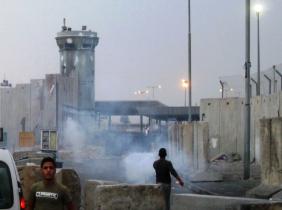 . זה הסדר יום במחסום קלנדיה
2. לוחמי מחירות ארצם
3. פמיניזם
4. חולת לוקמיה מועברת מאמבולנס שהביאה מג’נין לאמבולנס שיקח אותה לבית חולים במזרח ירושלים
On the week of the 12th anniversary of the outburst of the El-Aqsa Intifada, on the day of the murder of the child Muhammad A-Dura, during the days that mark the October 2000 Events, the situation at Qalandiya seems to be on the verge of explosion.
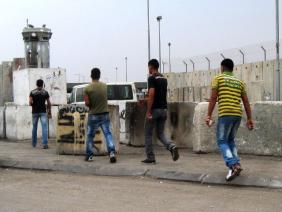
I talked about the symbolism of these dates with a friend that in a comradely gesture offered me help by handing a cloth soaked with alcohol, so as to ease the burning sensation from the gas fumes. He said he thought the youngsters weren’t aware of this coincidence. I don’t know, but I saw their faces and they were raging and their body language spoke of determination and they acted with defiance when throwing stone at the checkpoint which is the symbol of occupation. The teenagers were no longer afraid of being hunted down in the middle of the night and didn’t cover their faces.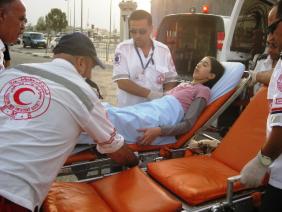
In what another manner can a person who doesn’t hold his own future in his hands be frightened off, a person whose rights had been trampled on and who had his freedom taken away? They know that the cameras document everyone and every movement, and know that the nightly hunters might today or tomorrow or on some other unexpected occasion, burst the door of their houses open and take them to prison.
On the opposite side of these teenagers, a military force came out of the checkpoint. At first two, after whom came many, wearing helmets, protected by vests and armed with rifles, stun grenades and gas grenades. A female soldier led the force and was the first to shoot.
The gas fumes had an indiscriminating effect on all those who had arrived at the place on that afternoon; hundreds of vehicles couldn’t drive on and were stuck there.
A man whose young children that sat inside the vehicle were wheezing and coughing, got out with anger, approached an officer to complain that the gas was being aimed at people who weren’t involved.
I couldn’t hear the conversation, but I saw the officer stretching his arm, grabbing the man’s shoulder, pushing him away and turning his back to him.
And again the peddlers hurried to close their businesses and disappear from the fire line of stones and grenades, and again people hurried to cross the danger zone while squatting and clinging to the wall, and a female soldier with a rifle stood inside a niche in the wall, a sniper’s post, and making sure that none of the teenagers sneak up and come from behind the shooters.
And as though in a parallel universe the checkpoint made an effort to maintain the usual bad routine. An ambulance from Jenin was transferring a thirteen-year-old girl with leukemia who had to be put inside to an ambulance from East Jerusalem for treatment at Augusta Victoria hospital. And the policeman at the checkpoint was angry at the sight to the camera, and the person driving the ambulance from the occupied territories tried to calm him down by saying: “Mr. officer, we don’t mind having our pictures taken…”- “You, be quiet!” was the answer.
And one of the cab drivers said that in the morning at Hizme checkpoint (a checkpoint that is meant to serve the settlers and only Palestinians are inspected there and residents of east Jerusalem are the only ones allowed to pass through it), a border policeman demanded that all the passengers, all Palestinians of course, get out of the vehicle for inspections. One of the passengers had a broken leg and asked to stay in the cab. The BP man insisted that she step outside with the others. The cab driver tried pleading with him, but as punishment for this attempt he was detained for three hours by the side of the checkpoint: “I don’t even know her, I just tried to explain to him, so he might take pity, so he understand she was in pain…” he completed his story.
Because in the occupied territories the rules and laws aren’t determined by justice but by force alone.
Qalandiya Checkpoint / Atarot Pass (Jerusalem)
See all reports for this place-
Click here to watch a video from Qalandiya checkpoint up to mid 2019 Three kilometers south of Ramallah, in the heart of Palestinian population. Integrates into "Jerusalem Envelope" as part of Wall that separates between northern suburbs that were annexed to Jerusalem in 1967: Kafr Aqab, Semiramis and Qalandiya, and the villages of Ar-Ram and Bir Nabala, also north of Jerusalem, and the city itself. Some residents of Kafr Aqab, Semiramis and Qalandiya have Jerusalem ID cards. A terminal operated by Israel Police has functioned since early 2006. As of August 2006, northbound pedestrians are not checked. Southbound Palestinians must carry Jerusalem IDs; holders of Palestinian Authority IDs cannot pass without special permits. Vehicular traffic from Ramallah to other West Bank areas runs to the north of Qalandiya. In February 2019, the new facility of the checkpoint was inaugurated aiming to make it like a "border crossing". The bars and barbed wire fences were replaced with walls of perforated metal panels. The check is now performed at multiple stations for face recognition and the transfer of an e-card. The rate of passage has improved and its density has generally decreased, but lack of manpower and malfunctions cause periods of stress. The development and paving of the roads has not yet been completed, the traffic of cars and pedestrians is dangerous, and t the entire vicinity of the checkpoint is filthy. In 2020 a huge pedestrian bridge was built over the vehicle crossing with severe mobility restrictions (steep stairs, long and winding route). The pedestrian access from public transport to the checkpoint from the north (Ramallah direction) is unclear, and there have been cases of people, especially people with disabilities, who accidentally reached the vehicle crossing and were shot by the soldiers at the checkpoint. In the summer of 2021, work began on a new, sunken entrance road from Qalandiya that will lead directly to Road 443 towards Jerusalem and Tel Aviv. At the same time, the runways of the old Atarot airport were demolished and infrastructure was prepared for a large bus terminal. (updated October 2021)
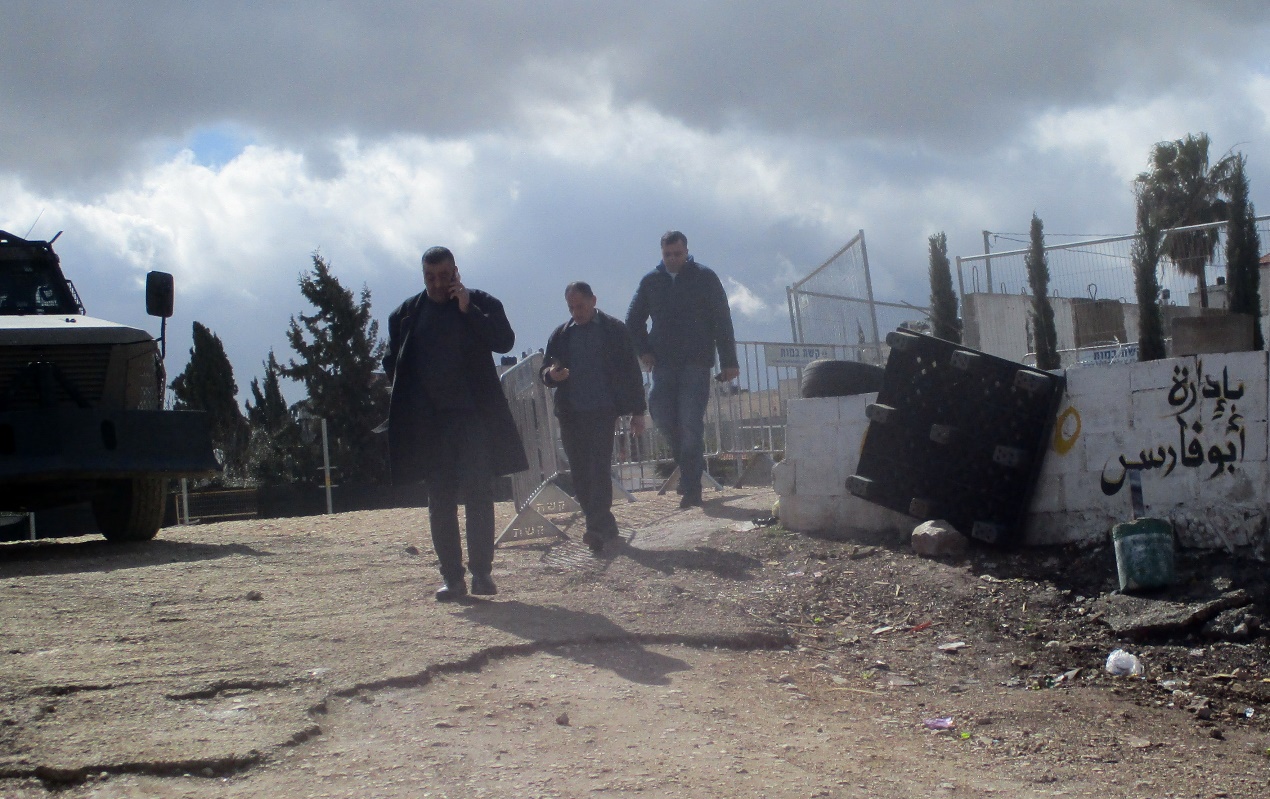 Tamar FleishmanFeb-27-2026Qalandiya: On the way to prayer
-