
Qalandiya, Sun 6.5.12, Afternoon
Translating: Ruth Fleishman
A man who was missing an arm stood and looked over through the fence at a police car.
"Stand away from the fence!- don't come near the fence!- don't you understand Hebrew?!…" the tower yelled. The man who was missing an arm stayed by the fence, supported by a traffic sign indicating of a parking spot reserved for invalids alone, and waited. He didn't seem sad or miserable. He just stood there and waited.
Two days earlier, when he was returning with his daughter from the Friday prayers at El-Aqsa, a police officer took his identity card from him. On that day he came back. Perhaps, and he didn't actually know how or by whose hands, they would him his ID back.
"That's him, over there, behind the fence, the man who is missing an arm, over there… "We explained to Moti the police officer. "He could be also missing a foot", said the BP officer guarding officer Moti as he was handing out traffic tickets to those heading out of Palestine.
Moti listened, he spoke on the phone with Nadim Asi who had his ID taken from him by the policeman, and concluded that they wanted to punish him because his daughter did have her Kushan (=birth certificate). But he, said Moti, couldn't help, it might be at the police station behind the checkpoint, maybe at the border police base in Atarot, or maybe at the police station in Nave Ilan or perhaps they simply shoved into one of those boxes… (he was referring to the complaint boxes on the side of the winding roads of Qalandiya passage).
We followed his advice and headed to the military entrance. Avi the police officer came towards us, he wrote all the details, and then he went away and came back, he said that the ID wasn't there, at the police station. He said that Nadim should go to the DCL on the next day to ask whether they had a solution to this problem.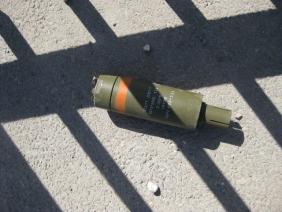
Nadim, the man who was missing an arm, was probably an innocent victim of the overreaction of the security forces to the demonstration supporting the hunger strike of the administrative detainees that was held on the Palestinian side of the checkpoint. The remains of the tear gas still stung in the eyes, steaming fumes of sickening stenches from the skunk machine, rose from the puddles that had accumulated inside potholes on the defective roads and as remains of the fire that had been shot, on the ground laid the empty casing of a: grenade that is used against protesters known as a RARNAG, it is place on top of the rifle's barrel and shot with a blank cartridge that thrusts the content of the "can" with grate force forward. The can contains small metal balls that are covered with rubber, there are strict orders regarding the use of this weapon. *
*I received this information from an interviewer from Breaking the Silence.
Qalandiya Checkpoint / Atarot Pass (Jerusalem)
See all reports for this place-
Click here to watch a video from Qalandiya checkpoint up to mid 2019 Three kilometers south of Ramallah, in the heart of Palestinian population. Integrates into "Jerusalem Envelope" as part of Wall that separates between northern suburbs that were annexed to Jerusalem in 1967: Kafr Aqab, Semiramis and Qalandiya, and the villages of Ar-Ram and Bir Nabala, also north of Jerusalem, and the city itself. Some residents of Kafr Aqab, Semiramis and Qalandiya have Jerusalem ID cards. A terminal operated by Israel Police has functioned since early 2006. As of August 2006, northbound pedestrians are not checked. Southbound Palestinians must carry Jerusalem IDs; holders of Palestinian Authority IDs cannot pass without special permits. Vehicular traffic from Ramallah to other West Bank areas runs to the north of Qalandiya. In February 2019, the new facility of the checkpoint was inaugurated aiming to make it like a "border crossing". The bars and barbed wire fences were replaced with walls of perforated metal panels. The check is now performed at multiple stations for face recognition and the transfer of an e-card. The rate of passage has improved and its density has generally decreased, but lack of manpower and malfunctions cause periods of stress. The development and paving of the roads has not yet been completed, the traffic of cars and pedestrians is dangerous, and t the entire vicinity of the checkpoint is filthy. In 2020 a huge pedestrian bridge was built over the vehicle crossing with severe mobility restrictions (steep stairs, long and winding route). The pedestrian access from public transport to the checkpoint from the north (Ramallah direction) is unclear, and there have been cases of people, especially people with disabilities, who accidentally reached the vehicle crossing and were shot by the soldiers at the checkpoint. In the summer of 2021, work began on a new, sunken entrance road from Qalandiya that will lead directly to Road 443 towards Jerusalem and Tel Aviv. At the same time, the runways of the old Atarot airport were demolished and infrastructure was prepared for a large bus terminal. (updated October 2021)
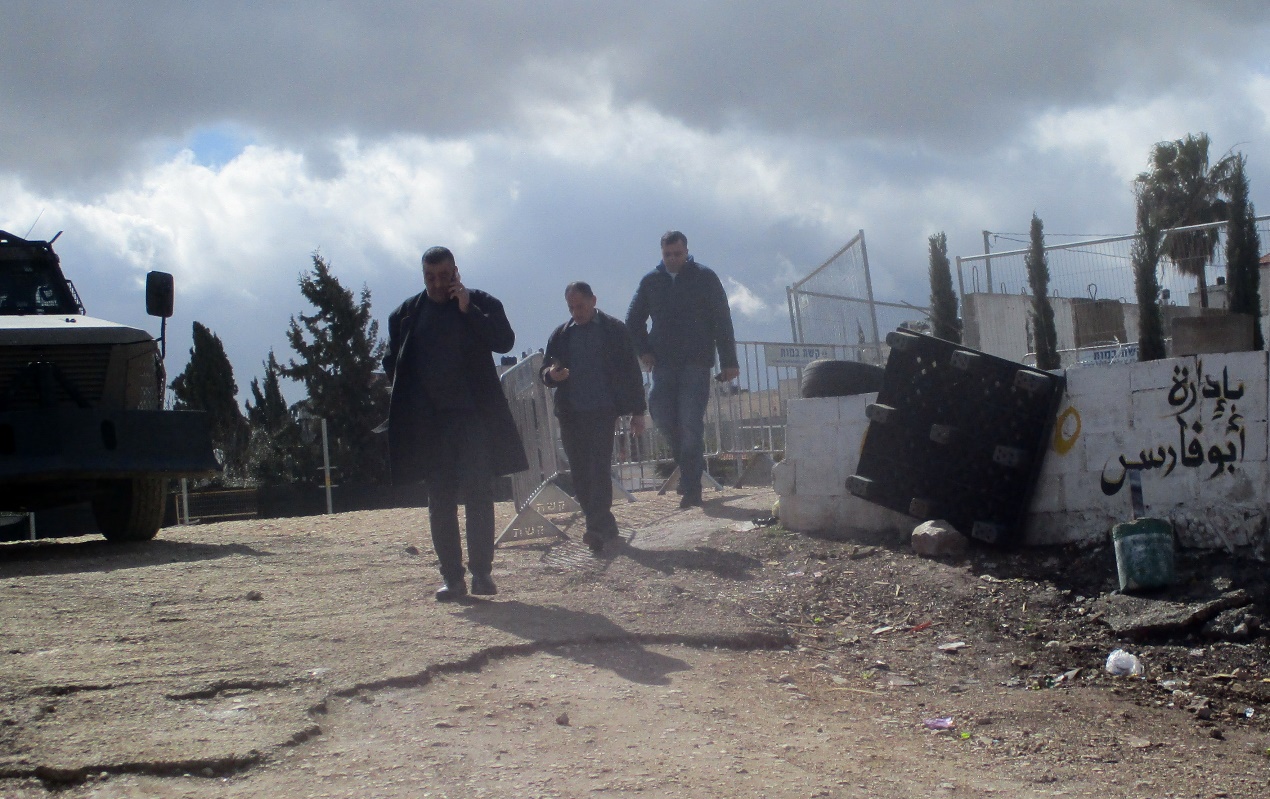 Tamar FleishmanFeb-27-2026Qalandiya: On the way to prayer
-