
Qalandiya - The bridge to the checkpoint turned a simple short walk into a winding, steep, never-ending corridor unsheltered and open to wind and rain in winter.
I went with Ronit who was meeting with a Palestinian after many months of not being at Qalandiya. I had read Ronit’s report and seen the pictures of the bridge but had found it very hard to visualize.
“Last night I went to Manderley again”. I don’t know why that sentence came into my head as I saw the bridge which has been built at Qalandiya. I think because the sentence had immediately inspired a feeling of dread. I had not been there for many months. I only know one thing. The first day that I ever went out with Machsomwatch…hard to believe it was nearly 20 years ago, was a rainy miserable day and we went to Qalandiya. I was completely bewildered. It was filthy, the traffic like the wild west, rubbish all over, people rushing trying to make their way through the confusion and mud and two small army posts for people to go through. But it was still better than the monstrosity I saw today. In fact, I think that, even at its worst, at that time the checkpoint was more humane than it is today.
I am not referring to the new building even though I feel that that too is only camouflage for the underlying evil of the whole concept.
I write here about the bridge and the only word that I can find for whoever built this bridge, which is supposed to make life easier for Palestinians, is malevolence.
I understand the fact as Sami, one of my old acquaintances whom we met, said to me that it was better than trying to cross the road. But he is a relatively young and fit man. On the other hand yesterday a Palestinian friend said that she has only had to go through it once as she lives on the Israeli side. She said she hopes never to have to do so again but her middle-aged sister who has to make the crossing every day into Israel and uses the buses said that she gets to work on the Israeli side completely exhausted. Personally I never found crossing the road so difficult. I find it hard to understand how a walk of a few meters to enter the checkpoint of old has been converted into a winding, steep, convoluted, unfriendly cement ramp, of the never-ending corridor… I wonder what will happen in the winter when the wind and rain will drive into this unsheltered bridge.
I myself am handicapped by a bad leg and walk between 5-7 kilometers each day and I found it very difficult. I do not understand how anyone in a wheelchair, electric or other, how a woman with a pram or children can possibly deal with the steep ascents as the corridors wind round and round. Maybe those who understand the purpose of this bridge will not agree with what I write but I write it as someone who is looking at it completely from the outside. I can only be thankful I do not have to cross it every day.
Qalandiya Checkpoint / Atarot Pass (Jerusalem)
See all reports for this place-
Click here to watch a video from Qalandiya checkpoint up to mid 2019 Three kilometers south of Ramallah, in the heart of Palestinian population. Integrates into "Jerusalem Envelope" as part of Wall that separates between northern suburbs that were annexed to Jerusalem in 1967: Kafr Aqab, Semiramis and Qalandiya, and the villages of Ar-Ram and Bir Nabala, also north of Jerusalem, and the city itself. Some residents of Kafr Aqab, Semiramis and Qalandiya have Jerusalem ID cards. A terminal operated by Israel Police has functioned since early 2006. As of August 2006, northbound pedestrians are not checked. Southbound Palestinians must carry Jerusalem IDs; holders of Palestinian Authority IDs cannot pass without special permits. Vehicular traffic from Ramallah to other West Bank areas runs to the north of Qalandiya. In February 2019, the new facility of the checkpoint was inaugurated aiming to make it like a "border crossing". The bars and barbed wire fences were replaced with walls of perforated metal panels. The check is now performed at multiple stations for face recognition and the transfer of an e-card. The rate of passage has improved and its density has generally decreased, but lack of manpower and malfunctions cause periods of stress. The development and paving of the roads has not yet been completed, the traffic of cars and pedestrians is dangerous, and t the entire vicinity of the checkpoint is filthy. In 2020 a huge pedestrian bridge was built over the vehicle crossing with severe mobility restrictions (steep stairs, long and winding route). The pedestrian access from public transport to the checkpoint from the north (Ramallah direction) is unclear, and there have been cases of people, especially people with disabilities, who accidentally reached the vehicle crossing and were shot by the soldiers at the checkpoint. In the summer of 2021, work began on a new, sunken entrance road from Qalandiya that will lead directly to Road 443 towards Jerusalem and Tel Aviv. At the same time, the runways of the old Atarot airport were demolished and infrastructure was prepared for a large bus terminal. (updated October 2021)
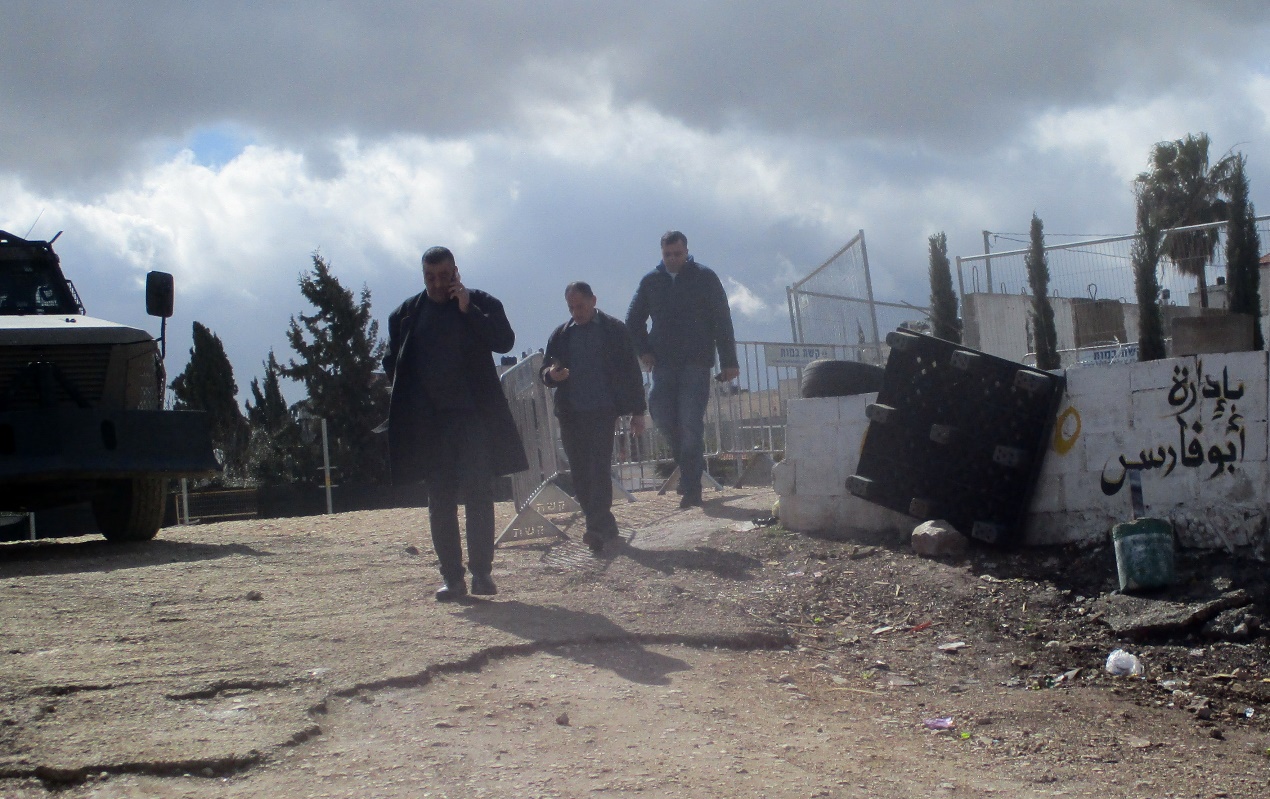 Tamar FleishmanFeb-27-2026Qalandiya: On the way to prayer
-