
Qalandiya - the DCO closes at 3 pm

Since I have been seeing the DCO only through its metal fences for months now, I decided to enter it and came early before it was closed.
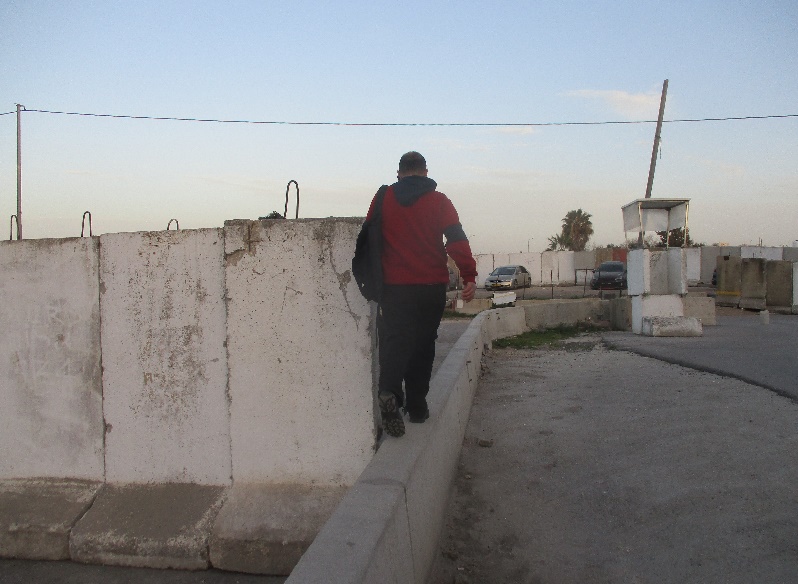
I walked the length of the bridge, crossed the metal detector at the checkpoint, came out to the back yard, climbed two staircases and went down two staircases, walked along a narrow path in between a concrete wall and a tin one, and reached the shed in front of the offices. I was welcomed by empty rows of benches and locked doors.
I was forced to go back. Once again, made my way between concrete and tin, climbing up two staircases and down two staircases.
If my reader finds this description long and tedious, I assure you the way Palestinians need to make, as he who said “ask the soldiers”.
There were two active soldier posts. I turned to the first one – a soldier wrapped in a prayer shawl was sitting there and praying. I, who am intent on not disturbing a person communicating with his god, turned to the other, the distant post. From its soldier I heard that 3 o’clock is closing time. Perhaps new, maybe old – he has no idea.
The person who gave order in the chaos was a young Palestinian who sat helpless and desperate on the outer steps and said:
Don’t you know they do whatever they please?
They are the law. They gave me a permit and when I came to cross the checkpoint, suddenly there’s no permit.
The law is in the offices where those who sit control the lives of so many people in whichever way they please.
On the other side I met a security guard and when I asked why the DCO is closed before 4 p.m., he said they closed at 3.

Exiting towards the refugee camp, a billboard struck me, inviting one to the enjoyment park. The board stood on legs planted in potholes and filth and the rubble of demolished houses, its top in the sky, as though promising some virtual reality.
The sign has one advantage: child vendors who crowd by it from time to time find a short-lived shelter from the seething sun and from the reality of their life.
Among other things I met an old friend who talked about how hard life is in Palestine. He who recalls nearly 50 years back cannot remember a good time. It has always been just bad.
But a few weeks ago he had a satisfying day, when managing to drive his own car in spite of all the dangers and prohibitions, a car bearing Palestinian license plates – to the Tel Aviv beach. For reassurance, he showed me photos of that day – of that beach.
I was glad for him, for his daring and pleasure, and for his trust – not at all obvious – he has in me.
On my way there as well as back, in this closed space called a checkpoint, I was the only person wearing a mask.
Qalandiya Checkpoint / Atarot Pass (Jerusalem)
See all reports for this place-
Click here to watch a video from Qalandiya checkpoint up to mid 2019 Three kilometers south of Ramallah, in the heart of Palestinian population. Integrates into "Jerusalem Envelope" as part of Wall that separates between northern suburbs that were annexed to Jerusalem in 1967: Kafr Aqab, Semiramis and Qalandiya, and the villages of Ar-Ram and Bir Nabala, also north of Jerusalem, and the city itself. Some residents of Kafr Aqab, Semiramis and Qalandiya have Jerusalem ID cards. A terminal operated by Israel Police has functioned since early 2006. As of August 2006, northbound pedestrians are not checked. Southbound Palestinians must carry Jerusalem IDs; holders of Palestinian Authority IDs cannot pass without special permits. Vehicular traffic from Ramallah to other West Bank areas runs to the north of Qalandiya. In February 2019, the new facility of the checkpoint was inaugurated aiming to make it like a "border crossing". The bars and barbed wire fences were replaced with walls of perforated metal panels. The check is now performed at multiple stations for face recognition and the transfer of an e-card. The rate of passage has improved and its density has generally decreased, but lack of manpower and malfunctions cause periods of stress. The development and paving of the roads has not yet been completed, the traffic of cars and pedestrians is dangerous, and t the entire vicinity of the checkpoint is filthy. In 2020 a huge pedestrian bridge was built over the vehicle crossing with severe mobility restrictions (steep stairs, long and winding route). The pedestrian access from public transport to the checkpoint from the north (Ramallah direction) is unclear, and there have been cases of people, especially people with disabilities, who accidentally reached the vehicle crossing and were shot by the soldiers at the checkpoint. In the summer of 2021, work began on a new, sunken entrance road from Qalandiya that will lead directly to Road 443 towards Jerusalem and Tel Aviv. At the same time, the runways of the old Atarot airport were demolished and infrastructure was prepared for a large bus terminal. (updated October 2021)
 Tamar FleishmanFeb-16-2026Qalandiya CP: shortcut
-