
Qalandiya - The New Via Dolorosa
The New Via Dolorosa
We arrived shortly after 6 a.m. and it took us a while to figure out how to reach the entrance to the new bridge built over the vehicle checkpoint, which is now the only way to enter or leave the pedestrian checkpoint. Apparently the Occupation has a logic unique to it, which has only a weak resemblance to humane logic. It turns out, as was reported here two weeks back, that in order to access the bridge by foot from East Jerusalem–that is, reach either the steps or the ramp leading to and from it–one must first pass through an unpaved area that in winter will turn into a sea of mud. The same is true for people approaching the bridge from or on their way to the stations for buses and taxis. But let’s assume, for now, that the reason this is so, is because work here has simply not been completed and there’s a plan to plant grass, flowers, and trees and pave paths among them lined with benches. That still doesn’t solve the serious problem that exists for the handicapped. It turns out that the ramp built for their needs is on a rather steep slope, with a 180-degree turn in the middle, and Lord help those advancing in a wheelchair or pushing a wheelchair up it. If there is an alternate possibility enabling the handicapped to reach the checkpoint, we will be glad to hear about it.
At the entrance to the pedestrian checkpoint, we immediately saw that those entering it wear masks only when they reach the area inside manned by soldiers. Neither do they maintain an appropriate (or any) distance while standing on the lines that are created by the way in which the checkpoint is being managed. That is, instead of enabling a constant stream of people into the building, as in the past, the soldiers in charge of the flow locked the turnstiles leading into the checking area every 5-8 minutes or so, thereby creating static lines both outside (for the sake of argument, bearable) and inside (very problematic).
According to people regularly selling their wares near the checkpoint entrance, this situation began at the start of the week (two days earlier) and may be due to a new team of soldiers who are unfamiliar with the system. This phenomenon, of a change in arrangements for the worse, was common at the old checkpoint after almost every changing of the guard (every few months) placing new soldiers in charge. Now, however, the repercussions are more serious given the health demands.
When the stream of newcomers greatly reduced toward 7:30, and the lines outside the checkpoint had disappeared, we too entered to pass through. To our regret, however, we chose a line inside that was very short when we joined it but, because the turnstile into the checking area wasn’t opened for more than 5 minutes, it grew long by the time we could enter. From there the transit was perfectly normal. We did note, however, that the security guards standing about a meter away from the checking machines were not wearing masks. Not a great example for the rest.
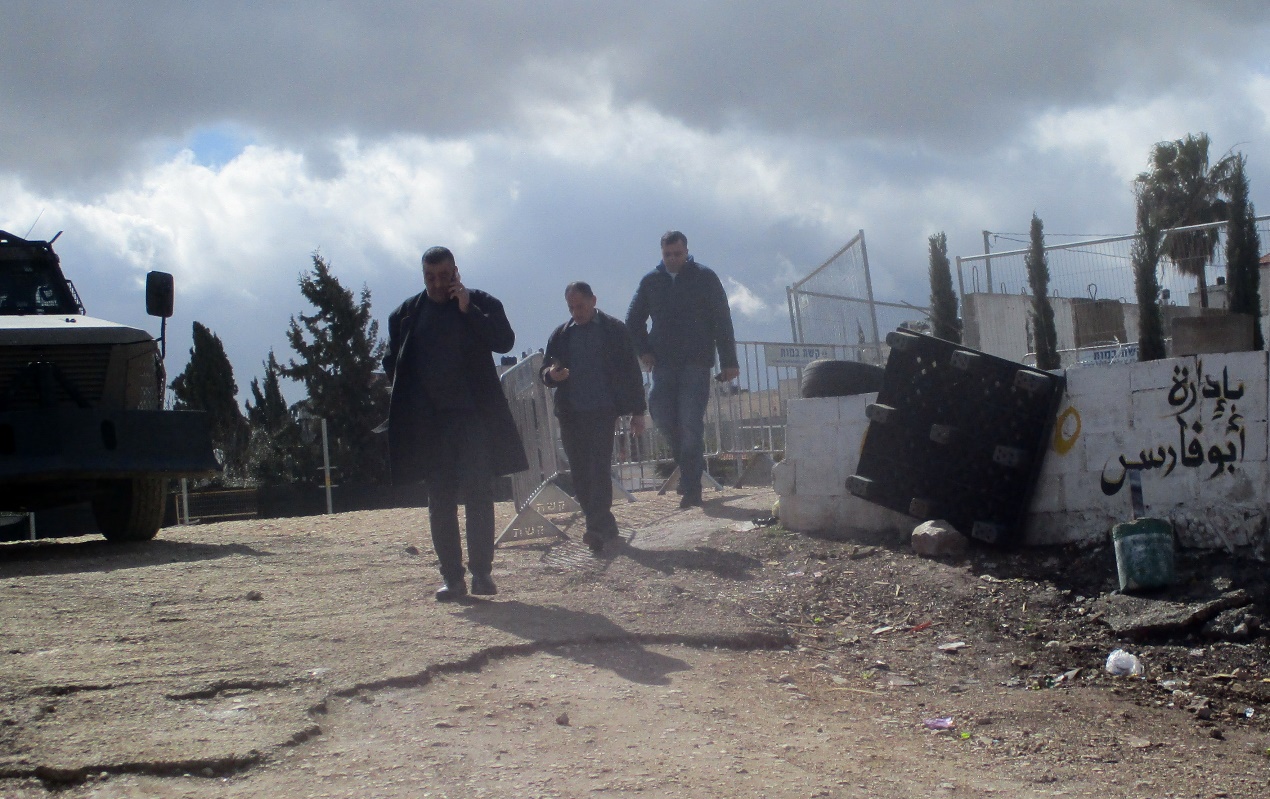
On our way out, while we were already on the bridge, we watched from a distance an incident whereby a man was evidently walking in the direction of the vehicle checkpoint from the north. This is a hugely sensitive area in which a number of Palestinians have been shot because the soldiers or security guards stationed in the checkpoint perceived them as terrorists coming to do them harm. Fortunately for the man (and everyone within sight of him), this time a number of security guards ran toward him shouting, reached him, and lowered him to the ground. People standing next to us on the bridge began to video the event on their smartphones (we didn’t due to the distance from it), and we hoped that no knee would be put into action. Very quickly, though, the man was brought to his feet and accompanied by the guards in the direction of the security offices. When one of them saw they were being filmed from above, he shouted at the people to stop, and the incident concluded.
As we continued over the bridge, a woman who appeared to be in her thirties or forties walked alongside us and expressed distress. She told us that she is a cancer patient and that the climb up to the bridge was very difficult for her. Again we ask whether there are possible alternatives not only for people in wheelchairs but also for those who have difficulty walking up the stairs or the ramp, either because of a physical or health handicap or due to age. Since we know that all the changes and improvements at Qalandiya have been made for the sake of the Palestinians who must pass through, it’s hard to believe that this segment of the population was not taken into account when the bridge was planned as the only way for pedestrians to enter and exit the checkpoint.
Qalandiya Checkpoint / Atarot Pass (Jerusalem)
See all reports for this place-
Click here to watch a video from Qalandiya checkpoint up to mid 2019 Three kilometers south of Ramallah, in the heart of Palestinian population. Integrates into "Jerusalem Envelope" as part of Wall that separates between northern suburbs that were annexed to Jerusalem in 1967: Kafr Aqab, Semiramis and Qalandiya, and the villages of Ar-Ram and Bir Nabala, also north of Jerusalem, and the city itself. Some residents of Kafr Aqab, Semiramis and Qalandiya have Jerusalem ID cards. A terminal operated by Israel Police has functioned since early 2006. As of August 2006, northbound pedestrians are not checked. Southbound Palestinians must carry Jerusalem IDs; holders of Palestinian Authority IDs cannot pass without special permits. Vehicular traffic from Ramallah to other West Bank areas runs to the north of Qalandiya. In February 2019, the new facility of the checkpoint was inaugurated aiming to make it like a "border crossing". The bars and barbed wire fences were replaced with walls of perforated metal panels. The check is now performed at multiple stations for face recognition and the transfer of an e-card. The rate of passage has improved and its density has generally decreased, but lack of manpower and malfunctions cause periods of stress. The development and paving of the roads has not yet been completed, the traffic of cars and pedestrians is dangerous, and t the entire vicinity of the checkpoint is filthy. In 2020 a huge pedestrian bridge was built over the vehicle crossing with severe mobility restrictions (steep stairs, long and winding route). The pedestrian access from public transport to the checkpoint from the north (Ramallah direction) is unclear, and there have been cases of people, especially people with disabilities, who accidentally reached the vehicle crossing and were shot by the soldiers at the checkpoint. In the summer of 2021, work began on a new, sunken entrance road from Qalandiya that will lead directly to Road 443 towards Jerusalem and Tel Aviv. At the same time, the runways of the old Atarot airport were demolished and infrastructure was prepared for a large bus terminal. (updated October 2021)
 Tamar FleishmanFeb-27-2026Qalandiya: On the way to prayer
-