
Qalandiya: the rumor in the West Bank - “When Netanyahu finishes with Gaza, he’ll begin with us”

The vision I saw on my way was like a wordless story, a mute bothersome scream, saying it is strictly forbidden to bring persons, let alone children, to such a base situation. This reality is no fate – it is the draconian working of a terrorist regime.
These days, when attention is all directed to the goings-on in the Gaza Strip, we must look at what is being done in the West Bank.
What I saw was a child, covered in a blue hoodie, kneeling. He was holding a thin wooden sliver, inserting it into the crack between the concrete and the ground, to a kind of enclave between the concrete and the trail leading to Qalandiya refugee camp, while trying to move and pull the stick in, out and sideways, to fish a coin or two that may have been dropped by those walking the trail – the coins disappearing from the public eye.
The sight which lasted a minute or two did not leave me that day and the days that followed, for this base place to which the Israeli regime has brought inhabitants of the West Bank is a chasm of want and misery.
And in the same context of reality of the West Bank – the rumor keeps spreading, either as estimate or even as knowledge: “When Netanyahu finishes with Gaza, he’ll begin with us, transfer us into Jordan”.
I have no idea what and who are the source of such a rumor, nor do I know if it is true or a conspiracy theory resulting from people’s fear, but when they say this, it means that he, Netanyahu, will transfer West Bankers to Jordan, and thus another threat looms aside the existing ones of worrying about the lack of livelihood, want and no permits.
Crossing the checkpoint, I stopped by the security guard to find out whether the gates intended for wheeled carriages are procedurally opened. I was told that there is such a procedure and he himself helps people with this, and whoever needs the gate opened has to call up the hotline whose number is posted.
I don’t know such a hotline, I don’t see numbers posted, and the last time I crossed the checkpoint I was forced to actually carry a very heavy baby pram chassis.
From gates and the pram our discussion became a long dialogue – the guy told me about his engagement in the Ethiopian sector’s protests, that his great grandmother died recently at the age of 115, we spoke of Israeli racism, colonialism here and abroad, and the question whether Ayman Aude was fit be the Prime Minister…
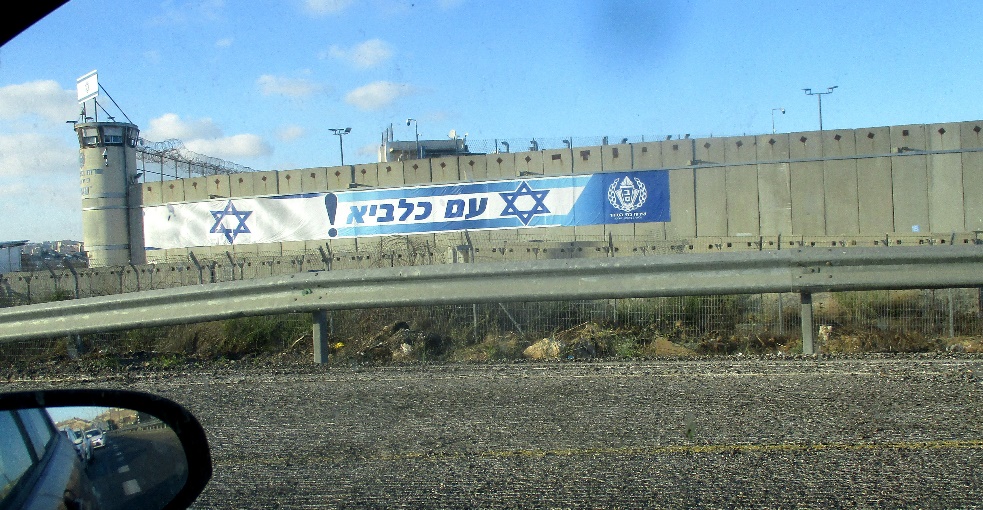
On my way home I noticed that the walls of Ofer Prison donned a new sign. This was no longer “Together we win”, but rather “A Nation like a Lion”.
I vowed not to neglect the empty cliches that await me.
Location Description
Qalandiya Checkpoint / Atarot Pass (Jerusalem)
See all reports for this place-
Click here to watch a video from Qalandiya checkpoint up to mid 2019 Three kilometers south of Ramallah, in the heart of Palestinian population. Integrates into "Jerusalem Envelope" as part of Wall that separates between northern suburbs that were annexed to Jerusalem in 1967: Kafr Aqab, Semiramis and Qalandiya, and the villages of Ar-Ram and Bir Nabala, also north of Jerusalem, and the city itself. Some residents of Kafr Aqab, Semiramis and Qalandiya have Jerusalem ID cards. A terminal operated by Israel Police has functioned since early 2006. As of August 2006, northbound pedestrians are not checked. Southbound Palestinians must carry Jerusalem IDs; holders of Palestinian Authority IDs cannot pass without special permits. Vehicular traffic from Ramallah to other West Bank areas runs to the north of Qalandiya. In February 2019, the new facility of the checkpoint was inaugurated aiming to make it like a "border crossing". The bars and barbed wire fences were replaced with walls of perforated metal panels. The check is now performed at multiple stations for face recognition and the transfer of an e-card. The rate of passage has improved and its density has generally decreased, but lack of manpower and malfunctions cause periods of stress. The development and paving of the roads has not yet been completed, the traffic of cars and pedestrians is dangerous, and t the entire vicinity of the checkpoint is filthy. In 2020 a huge pedestrian bridge was built over the vehicle crossing with severe mobility restrictions (steep stairs, long and winding route). The pedestrian access from public transport to the checkpoint from the north (Ramallah direction) is unclear, and there have been cases of people, especially people with disabilities, who accidentally reached the vehicle crossing and were shot by the soldiers at the checkpoint. In the summer of 2021, work began on a new, sunken entrance road from Qalandiya that will lead directly to Road 443 towards Jerusalem and Tel Aviv. At the same time, the runways of the old Atarot airport were demolished and infrastructure was prepared for a large bus terminal. (updated October 2021)
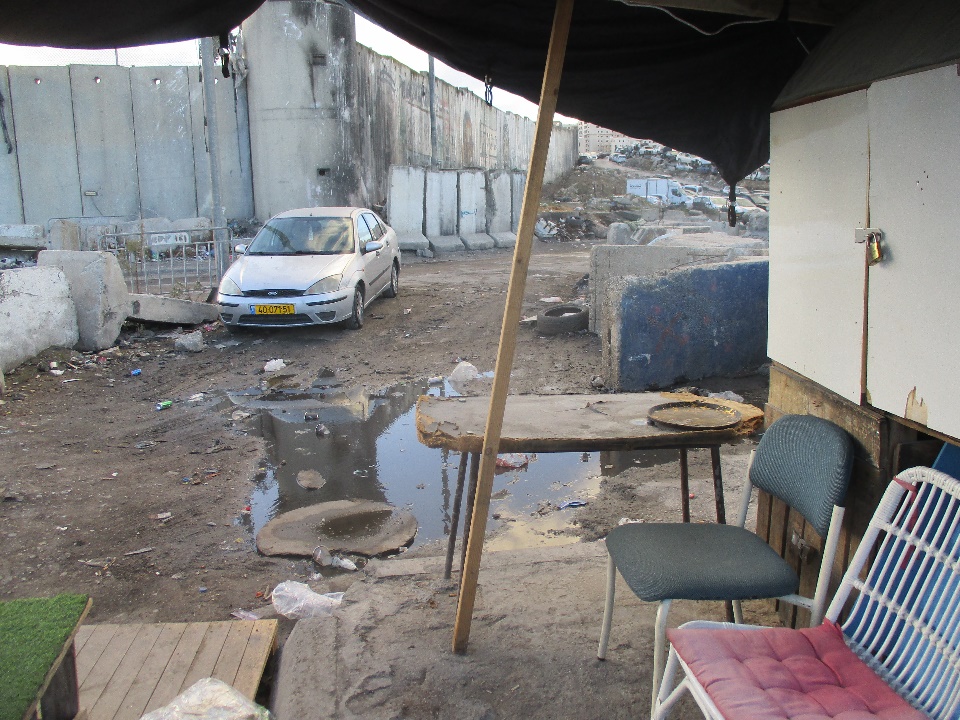 Tamar FleishmanNov-30-2025Qalandiya: Puddles and dirt after the rain
-