
Qalandiya: there is water in the faucets only a few hours a day

Water is a basic commodity. No water – no life.
The fact that Israel dehydrates the West Bank Palestinians should (also) be tried in international courts.
The roofs in towns and villages are loaded with water tanks, voicelessly telling the dehydration story that Israel exerts upon the Palestinian homes situated on the darker side of the Apartheid Wall.
Friends said that there is water in their faucets only a few hours a day. For the rest of the time, they must use water kept in buckets on the roofs.
Thus, in Qalandiya refugee camp, thus in Kafr ‘Aqab which is a part of larger-Jerusalem and whose inhabitants hold a blue (Israeli resident) ID. They, for their part, pay the municipality regularly for fear of having their resident status revoked. The municipality, on the other hand, violates its contract with its own inhabitants and denies them their most basic rights.
“I am on my way to take a shower at a friends house, on the other side of the Wall”, says a person who stopped for a moment and explained that he does not wish to waste his daily water allotment on a shower.
I made contact with the Israeli Civil Rights Association and they – said my interlocutor – are petitioning this issue as well at the Israeli Supreme Court.
Once again, the search for anyone of Abdallah’s family has come to nothing.
Abdallah is still in jail, no one knows why nor until when.
His incarceration has lasted many months and its end is nowhere to be seen. A common friend said that at the end of every month in jail, his release date is postponed by another month. He is suspected of belonging to Hamas. Not violent Hamas, with guns and such – said the man – but believing in the organization’s principles. That’s why.
People said that yesterday, Saturday, the day Khan Yunes was attacked in the attempt to eliminate Mohammad Def, an action during which so many Palestinians were killed for no fault of their own, people who need to cross Qalandiya Checkpoint could not do so. The checkpoint was closed from morning till evening, like a curfew, the start and finish of which remained unannounced.

The highway between Ramallah and Jerusalem, broken by a checkpoint that slows down and crowds its traffic, is used by many as an opportunity to persuade the drivers stuck in this endless wait to show their waters, trying to make a few shekels for their family’s livelihood. The vendors are usually young men and boys, women rarely deal in vending. But a little girl leans on a windshield and offers a package of tissues for sale. It’s a very rare sight, attesting to the dire economic situation experienced by West Bank Palestinians.
I write “West Bank Palestinians” because the Jewish West Bankers live on an entirely different economic plane, completely detached from that of their neighbors whose land they have stolen and whose future is the colonists’ existential future.
Kufr 'Aqab
See all reports for this place-
Kufr 'Aqab
25,000 people live in this village, and since the erection of the Separation Wall, it has been disconnected from Jerusalem and become a neighborhood totally abandoned as far as law enforcement and planning and construction are concerned. The thousands of inhabitants of this undefined urban area pay municipal taxes to the city of Jerusalem but the Israeli authorities – municipality, police, and various service companies – hardly enter these places, and the Palestinian authorities avoid them too since the Oslo Accords forbid them to act within Jerusalem’s jurisdiction.
MachsomWatch teams coming to their Qalandiya vigils sometimes go through the village itself, and the organization’s tours include the enclaves north of Jerusalem.
-
Qalandiya Camp
See all reports for this place-
Qalandiya Camp The camp was founded east of the village of Qalandiya in 1949 and became inhabited by Palestinian refugees from Jerusalem and the surrounding villages whose homes had remained on the Israeli side of the armistice lines. The camp was included in Jerusalem’s municipal jurisdiction after 1967, and since the erection of the Separation Wall has been disconnected from the city and become no-man’s-land between Jerusalem and Ramallah. It numbers about 10,000 inhabitants and many of them hold a Jerusalem ID. It is considered one of the most difficult camps both from a criminal and a ‘security’ standpoint, and also one of the most neglected and impoverished. It suffers from poverty, neglect, crime, illegal construction, and the lack of proper municipal services. Terrorist attackers have come from there, and it often seems ‘security’ incidents, numerous incursions, and arrests, including the killing of youths following stone-throwing.
-
Qalandiya Checkpoint / Atarot Pass (Jerusalem)
See all reports for this place-
Click here to watch a video from Qalandiya checkpoint up to mid 2019 Three kilometers south of Ramallah, in the heart of Palestinian population. Integrates into "Jerusalem Envelope" as part of Wall that separates between northern suburbs that were annexed to Jerusalem in 1967: Kafr Aqab, Semiramis and Qalandiya, and the villages of Ar-Ram and Bir Nabala, also north of Jerusalem, and the city itself. Some residents of Kafr Aqab, Semiramis and Qalandiya have Jerusalem ID cards. A terminal operated by Israel Police has functioned since early 2006. As of August 2006, northbound pedestrians are not checked. Southbound Palestinians must carry Jerusalem IDs; holders of Palestinian Authority IDs cannot pass without special permits. Vehicular traffic from Ramallah to other West Bank areas runs to the north of Qalandiya. In February 2019, the new facility of the checkpoint was inaugurated aiming to make it like a "border crossing". The bars and barbed wire fences were replaced with walls of perforated metal panels. The check is now performed at multiple stations for face recognition and the transfer of an e-card. The rate of passage has improved and its density has generally decreased, but lack of manpower and malfunctions cause periods of stress. The development and paving of the roads has not yet been completed, the traffic of cars and pedestrians is dangerous, and t the entire vicinity of the checkpoint is filthy. In 2020 a huge pedestrian bridge was built over the vehicle crossing with severe mobility restrictions (steep stairs, long and winding route). The pedestrian access from public transport to the checkpoint from the north (Ramallah direction) is unclear, and there have been cases of people, especially people with disabilities, who accidentally reached the vehicle crossing and were shot by the soldiers at the checkpoint. In the summer of 2021, work began on a new, sunken entrance road from Qalandiya that will lead directly to Road 443 towards Jerusalem and Tel Aviv. At the same time, the runways of the old Atarot airport were demolished and infrastructure was prepared for a large bus terminal. (updated October 2021)
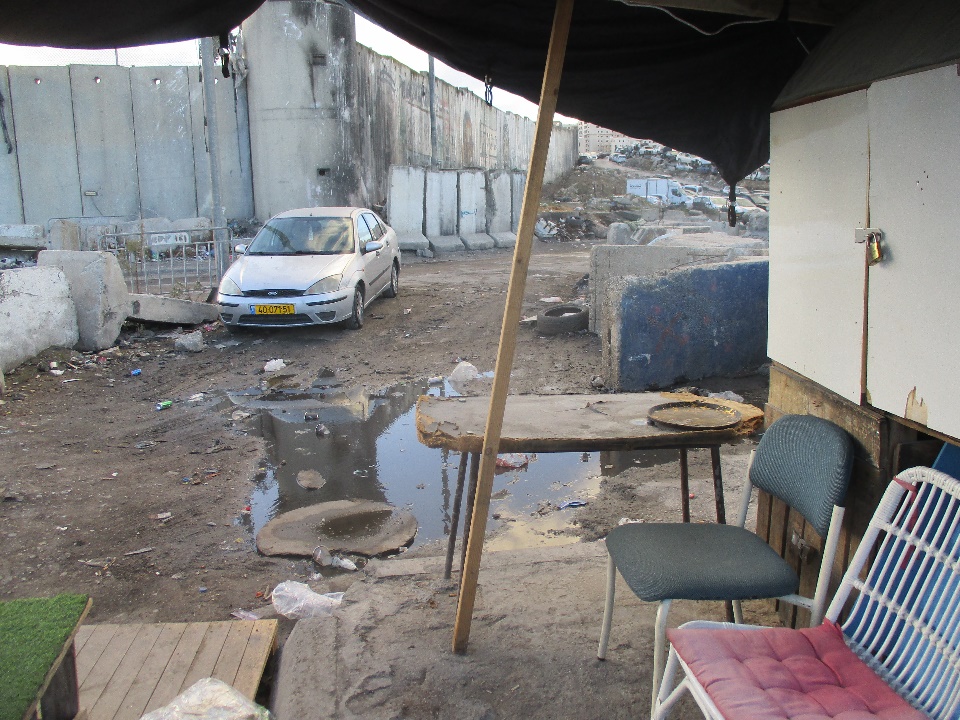 Tamar FleishmanNov-30-2025Qalandiya: Puddles and dirt after the rain
-