
Qalandiya, Thu 21.8.08, Afternoon
We drove via road 443 towards the Qalandiya CP and noted that the impromptu CP on the way there was almost empty.
We left the car at one of the parking lots along the wall. Next to the lot was a coffee tent where a couple of youngsters motioned us to come. They pointed to the top of the wall and called out attention to the new addition, which decorates it  . Some even thought that the barbed wire was electrified; others denied this. According to them this was done in preparation of the Ramadan in order to prevent youngster from
jumping over the wall in order to get to the prayers in the mosques. We had a little depressing conversation with them in which they expressed their despair and lack of hope for better conditions in the future.
We went through the pedestrian passage. No inspection whatsoever takes place for those exiting Israel. We again wondered why at the Rachel crossing people who go out of Israel to Bethlehem have to wait in long lines after their day of work, to show their papers and sometimes even have to have the palms of their hands inspected. On the way back the waiting area was empty and in the ‘sleeves’ there also very few people. We stood in line with them and talked to a girl student who studies psychology in Bit Zeit and lives in Beit Hanina. She has to cross the CP in both directions daily. She cannot tell us how long the average waiting time in the line is, usually half an hour, but at times much longer.
Once in a while we heard deafening screams over the loudspeakers of one of the girl soldiers who gave instructions in Hebrew to an old lady: “Put your cell phone on the conveyor belt” and if the order wasn’t fulfilled within a second, the order was repeated even louder!The queue was stopped for a while due to a long discussion at the window with a woman and her three sons. They all wanted to go through, but permission was given only to the mother. The long negotiations made those in line angry. After about fifteen minutes the sons returned in the Palestinian direction and their mother was sent on her way. After we too had passed we
asked the girl at the window what it had been all about. She replied that the sons had come with photocopies of their birth certificates instead of the originals and the law does not allow them to pass with those.
On the way out we met with a polite girl soldier who asked us why the Watch Women always take the part of the Palestinians and condemn the soldiers who fulfill their duty. We tried to explain our position (our opinions were not entirely the same). And again one of the cardinal issues of the organization came up: What is our position and what is our role vis-à-vis the soldiers?
Qalandiya Checkpoint / Atarot Pass (Jerusalem)
See all reports for this place-
Click here to watch a video from Qalandiya checkpoint up to mid 2019 Three kilometers south of Ramallah, in the heart of Palestinian population. Integrates into "Jerusalem Envelope" as part of Wall that separates between northern suburbs that were annexed to Jerusalem in 1967: Kafr Aqab, Semiramis and Qalandiya, and the villages of Ar-Ram and Bir Nabala, also north of Jerusalem, and the city itself. Some residents of Kafr Aqab, Semiramis and Qalandiya have Jerusalem ID cards. A terminal operated by Israel Police has functioned since early 2006. As of August 2006, northbound pedestrians are not checked. Southbound Palestinians must carry Jerusalem IDs; holders of Palestinian Authority IDs cannot pass without special permits. Vehicular traffic from Ramallah to other West Bank areas runs to the north of Qalandiya. In February 2019, the new facility of the checkpoint was inaugurated aiming to make it like a "border crossing". The bars and barbed wire fences were replaced with walls of perforated metal panels. The check is now performed at multiple stations for face recognition and the transfer of an e-card. The rate of passage has improved and its density has generally decreased, but lack of manpower and malfunctions cause periods of stress. The development and paving of the roads has not yet been completed, the traffic of cars and pedestrians is dangerous, and t the entire vicinity of the checkpoint is filthy. In 2020 a huge pedestrian bridge was built over the vehicle crossing with severe mobility restrictions (steep stairs, long and winding route). The pedestrian access from public transport to the checkpoint from the north (Ramallah direction) is unclear, and there have been cases of people, especially people with disabilities, who accidentally reached the vehicle crossing and were shot by the soldiers at the checkpoint. In the summer of 2021, work began on a new, sunken entrance road from Qalandiya that will lead directly to Road 443 towards Jerusalem and Tel Aviv. At the same time, the runways of the old Atarot airport were demolished and infrastructure was prepared for a large bus terminal. (updated October 2021)
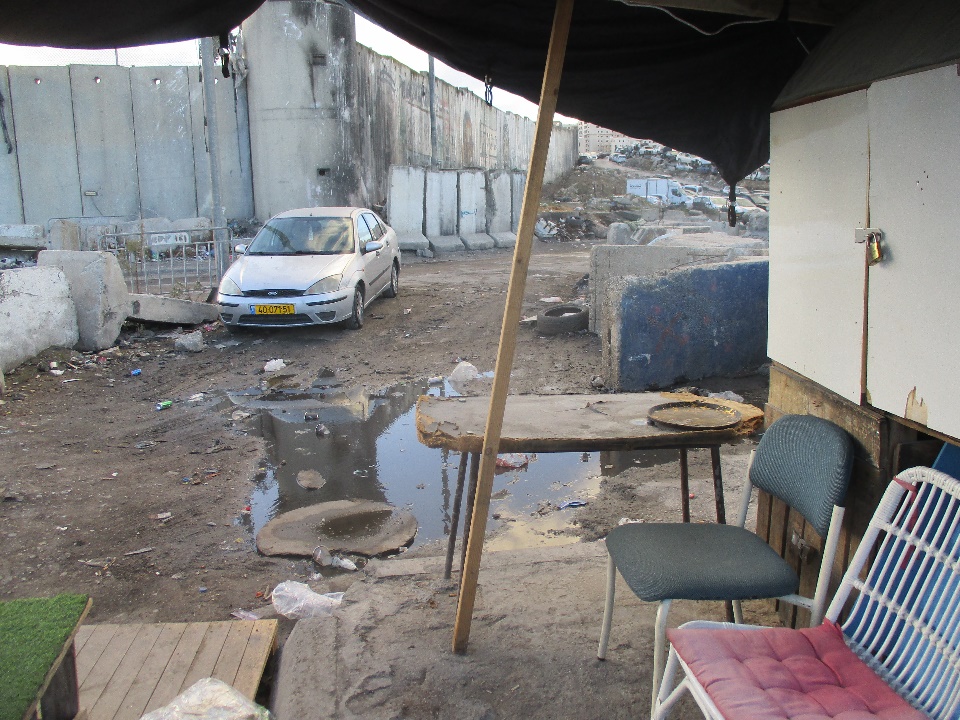 Tamar FleishmanNov-30-2025Qalandiya: Puddles and dirt after the rain
-