
Qalandiya, Wed 5.6.13, Afternoon
Translating: Ruth Fleishman
A new sticker on a pole was the only thing reminiscent of a protest.
It is now 46 years to the occupation and it seems as though something in the spirit has broken.
An old friend explained that since most people were worried about putting food on their tables at home, they had forgotten it was the Naksa day.
It was said that in the earlier a parade from Ramallah arrived with people baring flags of Palestine, but soon enough they turned back.
Beside the checkpoint a group of soldiers was waiting and an armed vehicle of the BP was patrolling: "to see that everything was alright", said the officer.
And two policemen pulled over vehicles at the entrance to the checkpoint, they hunted down unbuckled passengers, gave them tickets and enriched the state's till.
I was given an update regarding the trial of Ahmed from the Falafel stand, it has come to an end with a plea bargain according to which he has been sentenced to 16 months of imprisonment and a fine of 1,500 Shekels (I plan to write about the developments of the event and their meaning- which is much wider than this particular story).
Soldiers that mounted for inspection a Palestinian bus driving before me at the exit from the checkpoint, found some "criminals": A young woman, five little girls and an old wrinkled lady who had all remained on their seats and didn't come down at the entrance to the checkpoint, as required by the rules of occupation. They were taken off the bus and sent back with a security man who followed the old lady whose legs could barely carry her, and yelled: "Yallah, yallah…ruhi, ruhi!".
I took a photo. The attention of all the uniform wearers was diverted towards me: "give me the camera!", a soldiers ordered. I refused. "Delete everything you have just taken", she continued. I refused again. "Stand aside and wait a moment. I'm going to find out". I parked by the side of the road and stood next to the car. The soldier holding my ID called her commander. I waited. The moment didn't pass, it didn't take her a minute nor five. Everyone was busy with me, even when an ambulance arrived sounding its desperate sirens, they continued to deal with me. I walked towards the ambulance, passing the security man who tried to block my way and yelled: "You see, you are detaining the ambulance!" (it's nice to have someone to blame). I heard the driver say it was a severe emergency. But they persisted to deal with my affairs. Only once the police officer that was alerted by the soldier arrived and ordered her to hand my ID back to me and I was permitted to head on, did end yet another silly saga that originated from the intoxication of power of the uniform wearers, combined with their lack of knowledge of the law.
Qalandiya Checkpoint / Atarot Pass (Jerusalem)
See all reports for this place-
Click here to watch a video from Qalandiya checkpoint up to mid 2019 Three kilometers south of Ramallah, in the heart of Palestinian population. Integrates into "Jerusalem Envelope" as part of Wall that separates between northern suburbs that were annexed to Jerusalem in 1967: Kafr Aqab, Semiramis and Qalandiya, and the villages of Ar-Ram and Bir Nabala, also north of Jerusalem, and the city itself. Some residents of Kafr Aqab, Semiramis and Qalandiya have Jerusalem ID cards. A terminal operated by Israel Police has functioned since early 2006. As of August 2006, northbound pedestrians are not checked. Southbound Palestinians must carry Jerusalem IDs; holders of Palestinian Authority IDs cannot pass without special permits. Vehicular traffic from Ramallah to other West Bank areas runs to the north of Qalandiya. In February 2019, the new facility of the checkpoint was inaugurated aiming to make it like a "border crossing". The bars and barbed wire fences were replaced with walls of perforated metal panels. The check is now performed at multiple stations for face recognition and the transfer of an e-card. The rate of passage has improved and its density has generally decreased, but lack of manpower and malfunctions cause periods of stress. The development and paving of the roads has not yet been completed, the traffic of cars and pedestrians is dangerous, and t the entire vicinity of the checkpoint is filthy. In 2020 a huge pedestrian bridge was built over the vehicle crossing with severe mobility restrictions (steep stairs, long and winding route). The pedestrian access from public transport to the checkpoint from the north (Ramallah direction) is unclear, and there have been cases of people, especially people with disabilities, who accidentally reached the vehicle crossing and were shot by the soldiers at the checkpoint. In the summer of 2021, work began on a new, sunken entrance road from Qalandiya that will lead directly to Road 443 towards Jerusalem and Tel Aviv. At the same time, the runways of the old Atarot airport were demolished and infrastructure was prepared for a large bus terminal. (updated October 2021)
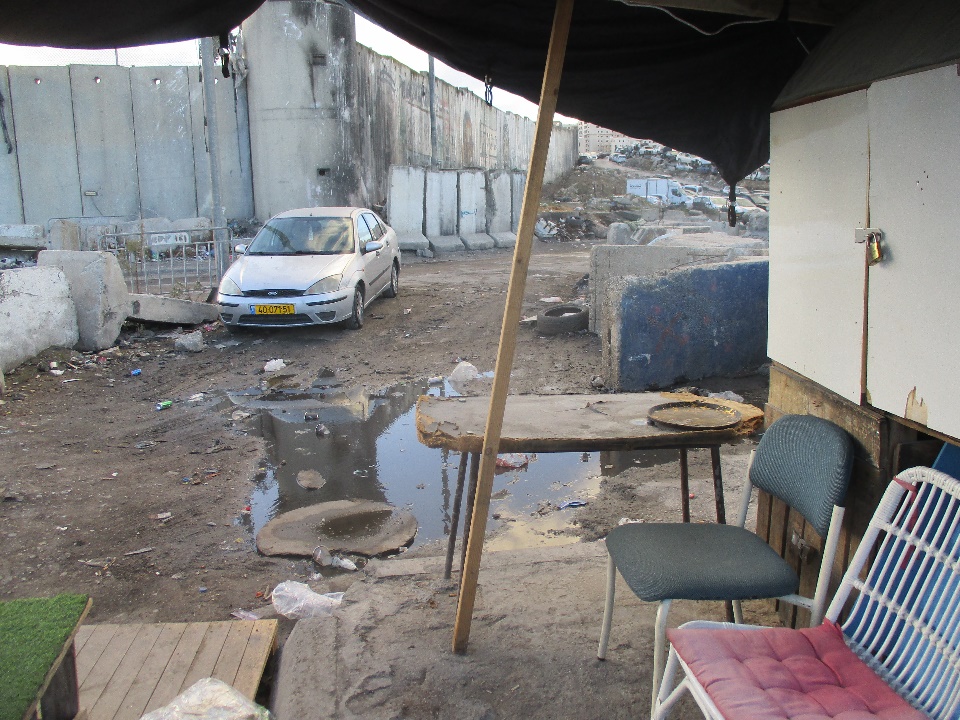 Tamar FleishmanNov-30-2025Qalandiya: Puddles and dirt after the rain
-