
Sansana (Meitar Crossing), South Hebron Hills, Susiya


1. Meitar checkpoint: From the west, sewage flows in the Hebron River. Inquiries on the subject to the authorities have not helped so far.
2. Susiya:
– Nasser is not here but reports on the phone of the demolition of houses near Bani Naim, east of Route 60 near the square. The houses are in Area C near Area B. Later in the day he sent us photos of the event (attached) but we were not there.
– We met Wadha, the wife of Azzam (an electrician, working in Israel). Southwest of the village, near the settlement of Susya, near the pillbox. The fields of the village that are not cultivated because they are afraid of harassment by the settlers. In the village live Israeli volunteers and also volunteers from abroad. Their main task is to guard the shepherds grazing in these areas against the attacks of the settlers. Because they are equipped with cameras that document everything there are less attacks. (But we remember the severe violence against such volunteers in the past in Tuwani. Hopefully the situation will not deteriorate). Here we met volunteers on theri way to a demonstration against Maon cowshed, and we decided to go there as well.The story of the demonstration below. First I will complete details about Susiya.
– At the demonstration we also met Nasser who took pictures (and also Basel Adra from Tuwani who also took pictures). Nasser said that one evening there was a checkpoint near Susiya and he knew he would be delayed. Indeed, he was summoned to the office of the head of the Civil Amistration, who accused him of inciting the area, for example at the house demolition incident near Tuwani. He claimed he was taking the pictures because he was very afraid that such things would happen to other people. He was dismissed with a vague warning that “You know that we are watching you.”
– At the demonstration we also met Muhammad Jaber Nawaj’a who previously ran the school in Susiya. In 2015 he moved to run a new school in Shaab al-Butum east of Abigail. 56 students study there from kindergarten to tenth grade.
3. The demonstration about half a kilometer south of the Maon-Carmel co’shed, west of the road:
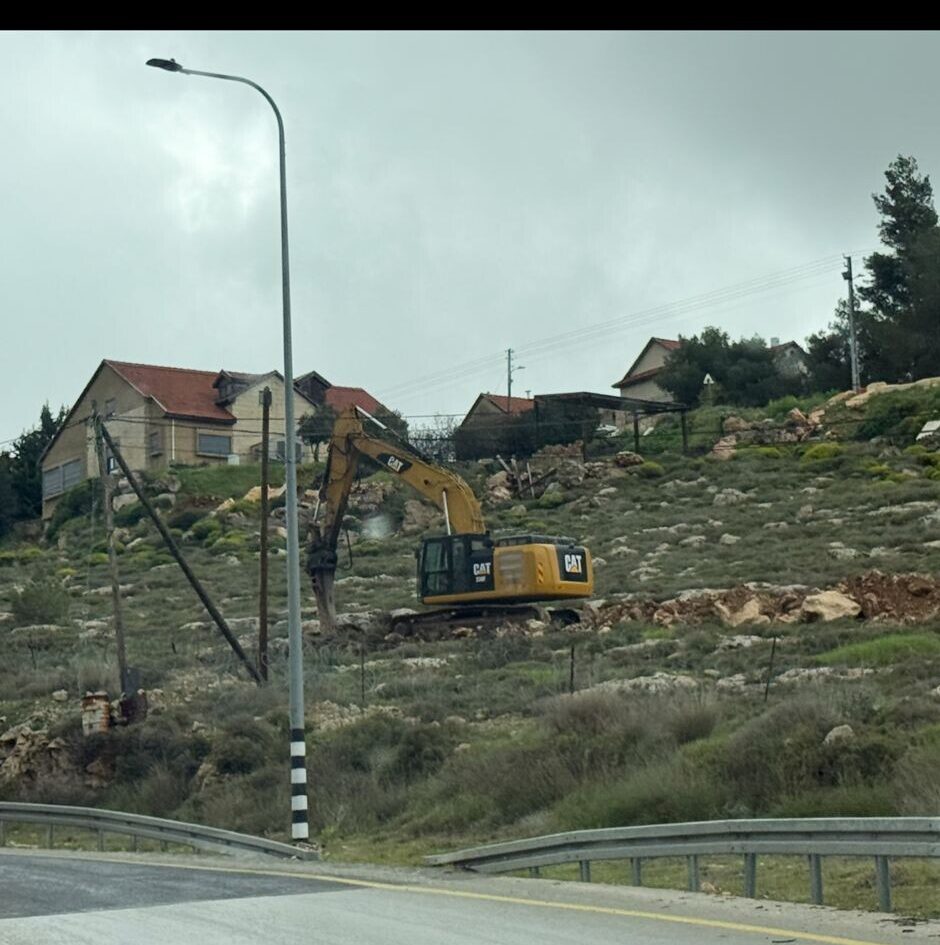
When we arrived, many vehicles were already parked somehow on the sides of the road south of the area. It was a silent demonstration by many Palestinians, against a takeover of the land by a settler with a bulldozer. Those present claimed that the area was privately owned by three families from Yatta. But later I heard from the Peace Now monitoring team that it is estimated that a breakthrough is being made to establish another agricultural farm, on large tracts of land that have been declared state lands since the 1980s, and may now have their allotment contract from the Settlement Division. So my assessment is that this breakthrough towards state lands is being made on private Palestinian land. The report from Peace Now is that the works are illegal because they do not have a valid building permit and plan.
While I was photographing the settler accompanied by the Kfir soldiers, the policeman (Avi Becker, according to his badge, there was another policeman with him in the car) approached me and demanded to know who I was and my guest. He proceeded that we identify ourselves and register our details with him, much to my very vocal displeasure – I argued that he did not continue by identifying and registering other citizens such as the settlers in the area. His reasoning was that it was a closed military area. At my demand to see a suitable order, he lied and claimed that he had such a document and would show me only after he had written down our details, as he did on a piece of paper (not on the mobile computer). He threatened to arrest me and only withdrew when I reported to him that I had already been arrested in the past by the police during a demonstration (it was in Be’er Sheva during Cast Lead Operation), and that I had sued the police for illegal arrest, and won thousands of shekels in compensation
From then on, Kfir soldiers, including two officers with the rank of major, both conducted the “event.” They pushed the silent Palestinian protesters away and even fired some smoke grenades. I walked amongst them protesting loudly , including giving an orderly “lecture” about the Kfir Brigade which is not protecting the security of the state and its citizens at all, since the state is far west of us, but protects a settler engaged in taking over land. That is, a brigade set up to carry out the oppression and occupation of the Palestinians in order to liberate the other infantry brigades for the service of defending the state borders. I offered them to sign up now for Breaking the Silence. They had to show me the order signed by Avi Zafrani, including a map of the barn and a circle drawing of the area to which the order applies. Again they lied by pointing out the place within the circle on the map, in practice we were not in front of the barn but about half a mile south of it meaning the order did not apply at all to the place of land preparation and demonstration.
The settler and his bulldozer immediately resumed work. If I had more courage I would lie down under the bulldozer wheels.
All the evidence I write here of such an “event” is another wound in the human heart, in the Israeli heart, in the Jewish heart.
4. North on Road 60, Gush Etzion area:
Friends from Yeruham sent a package to a son who serves in the Nahal and is now doing “employment” in the Carmei Tzur settlement area. It was an opportunity to see the settlement, including its surrounding area.
– On Road 60 in front of Carmi Tzur, a sign “Lev Yehuda” announcing the implementation of the occupation by laying a road (yes, from the same Hebrew root) . This section is about Palestinian land. In the more northern section, between El Arrub and Gush Etzion, south of the Musa Alami farm, which according to the locals, was Jordan King Abdullah’s land. The building is now owned by settlers.
Meitar checkpoint / Sansana
See all reports for this place-
Meitar Checkpoint / Sansana The checkpoint is located on the Green Line and serves as a border crossing between Israel and the West Bank. It is managed by the Border Crossing Authority of the Defense Ministry. It is comprised of sections for the transfer of goods as well as a vehicle checkpoint (intended for holders of blue identity cards, foreign nationals or diplomats and international organizations). Passing of Palestinians is prohibited, except for those with entry permits to Israel. Palestinians are permitted to cross on foot only. The crossing has a DCO / DCL / DCL / DCL (District Coordination Office), a customs unit, supervision, and a police unit. In the last year, a breach has been opened in the fence, not far from the crossing. This breach is known to all, including the army. There does not appear to be any interest in blocking it, probably as it permits needed Palestinian workers without the bureaucratic permits to get to work in Israel. Food stalls and a parking area economy have been created, but incidents of violent abuse by border police have also been recorded. Updated April 2022
-
South Hebron Hills
See all reports for this place-
South Hebron Hills
South Hebron Hills is a large area in the West Bank's southern part.
Yatta is a major city in this area: right in the border zone between the fertile region of Hebron and its surroundings and the desert of the Hebron Hills. Yatta has about 64,000 inhabitants.
The surrounding villages are called Masafer Yatta (Yatta's daughter villages). Their inhabitants subsist on livestock and agriculture. Agriculture is possible only in small plots, especially near streams. Most of the area consists of rocky terraces.Since the beginning of the 1980s, many settlements have been established on the agricultural land cultivated by the Palestinians in the South Hebron Hills region: Carmel, Maon, Susia, Masadot Yehuda, Othniel, and more. Since the settlements were established and Palestinians cultivation areas have been reduced; the residents of the South Hebron Hills have been suffering from harassment by the settlers. Attempts to evict and demolish houses have continued, along with withholding water and electricity. The military and police usually refrain from intervening in violent incidents between settlers and Palestinians do not enforce the law when it comes to the investigation of extensive violent Jewish settlers. The harassment in the South Hebron Hills includes attacking and attempting to burn residential tents, harassing dogs, harming herds, and preventing access to pastures.
There are several checkpoints in the South Hebron Hills, on Routes 317 and 60. In most of them, no military presence is apparent, but rather an array of pillboxes monitor the villages. Roadblocks are frequently set up according to the settlers and the army's needs. These are located at the Zif Junction, the Dura-al Fawwar crossing, and the Sheep Junction at the southern entrance to Hebron.
Updated April 2022
 MuhammadFeb-24-2026South Hebron Hill, Beit Hagai: Paving an internal security road
-
Susiya
See all reports for this place-
Susiya The Palestinian area lies between the settlement of Susya and a military base. The residents began to settle in areas outside the villages in the 1830s and lived in caves, tents and sukkot. To this day they maintain a traditional lifestyle and their livelihood is based on agriculture and herding. Until the 1948 war, the farmers cultivated areas that extended to the Arad area. As a result of the war, a significant portion of their land left on the Israeli side was lost. After the 1967 war and the Israeli occupation, military camps were established in the area, fire zones and nature reserves were declared, and the land area was further reduced. The Jewish settlement in Susya began in 1979. Since then, there has been a stubborn struggle to remove the remains of Palestinian residents who refuse to leave their place of birth and move to nearby town Yatta. With the development of a tourist site in Khirbet Susya in the late 1980s (an ancient synagogue), dozens of families living in caves in its vicinity were deported. In the second half of the 1990s, a new form of settlement developed in the area - shepherds' farms of individual settlers. This phenomenon increased the tension between the settlers and the original, Palestinian residents, and led to repeated harassment of the residents of the farms towards the Palestinians. At the same time, demolition of buildings and crop destruction by security forces continued, as well as water and electricity prevention. In the Palestinian Susya, as in a large part of the villages of the southern Hebron Mountains, there is no running water, but the water pipe that supplies water to the Susya Jewish settlement passes through it. Palestinians have to buy expensive water that comes in tankers. Solar electricity is provided by a collector system, installed with donation funds. But the frequent demolitions in the villages do not spare water cisterns or the solar panels and power poles designed to transfer solar electricity between the villages. Updated April 2021, Anat T.
-