
Sansana, South Hebron Hills, Sun 17.8.08, Morning
06:45 – 10:30
Sansana-Meitar PC
It is seven o’clock and still many workers line up. We were told that only 2 of 4 checking posts are open and that inspections came to a halt after six o’clock, just after the buses of family members of prisoners arrived. Shortly after our arrival the checking resumed and the workers went through.
The workers expressed their worry about the new machine that has been installed lately and is placed in a special room. It is called: A System for Human Inspection. Two inspection installations are at work now; at the entrance the workers are checked through the regular magnometer, and near the exit is the room of this radiating one. They fear for their health, naturally. Yehuda, the man in charge, spoke to us, and explained that this machine is installed in some airports in the USA and that it is safe, and that the Ministry of Environmental Quality had no objections. Also, people are not daily searched there. The purpose for this additional system is for security purpose, to detect, for example, that a worker does not carry a revolver under his arm!
A worker commented and said that scientific research is putting so much effort in preventing cancer, and here they put a machine that increases the risk.
It is important to find out what kind of machine it is and whether it has been improved by the health authorities. The crucial question is why have the workers, who go through numerous checking have to be put under another radiating machine.
Road 60 and 356
There was quite Palestinian traffic on the roads and almost no military traffic.
The boulders, the concrete obstacles, the dirt mounds still litter the sides of the roads.
 At the Sheep Junction the road was open to cars, but the pedestrian short cut was blocked. The entrance to Bani Naim is blocked by boulders. The vineyard land of the convicted Jewish terrorist, Menahem livni nearby the village is protected by a strong yellow fence, like the fences of military camps. Till the land there is a proper coated road and from there on a dirt road.
The above pictures demonstrate the blocked entrance to Bani Naim and the military fence that protect Livni’s lands.
On the bridge of Halhoul-Hebron traffic flowed. There was no military presence at Shiuch-Sair junction.
Opposite the entrance to Kiryat Arba lies el-Bak’a, a little village or hamlet. There we bought tomatoes from a farmer, who told us that on Thursday an official from the DCO came to destroy his crop. He asked: “On what grounds?” “Because you steal water”. To this the farmer reacted: “You can’t deny me the right to live. It is you who steal our water”. He told us that the whole village lives under demolishing threats. They are not allowed to build a school, neither a clinic. When they tried to build one, they got immediately an order to stop the work and afterwards a demolishing order. Dr. Mustafa Barghouti keeps a clinic in a flat. They do not belong to area A, so the DCO has full responsibility for their welfare.
Along the 356 road we saw also that the little shades of the fruit vendors were destroyed, (for safety reasons. I wish they would have cared for the safety of the children who have to cross the dangerous highway to the school at the Shiuch-Sair junction, by installing at least signs).
Into Hebron we did not enter this time. Schools are still closed and there is almost no pedestrian movement in this evil ghost town.
Meitar checkpoint / Sansana
See all reports for this place-
Meitar Checkpoint / Sansana The checkpoint is located on the Green Line and serves as a border crossing between Israel and the West Bank. It is managed by the Border Crossing Authority of the Defense Ministry. It is comprised of sections for the transfer of goods as well as a vehicle checkpoint (intended for holders of blue identity cards, foreign nationals or diplomats and international organizations). Passing of Palestinians is prohibited, except for those with entry permits to Israel. Palestinians are permitted to cross on foot only. The crossing has a DCO / DCL / DCL / DCL (District Coordination Office), a customs unit, supervision, and a police unit. In the last year, a breach has been opened in the fence, not far from the crossing. This breach is known to all, including the army. There does not appear to be any interest in blocking it, probably as it permits needed Palestinian workers without the bureaucratic permits to get to work in Israel. Food stalls and a parking area economy have been created, but incidents of violent abuse by border police have also been recorded. Updated April 2022
-
South Hebron Hills
See all reports for this place-
South Hebron Hills
South Hebron Hills is a large area in the West Bank's southern part.
Yatta is a major city in this area: right in the border zone between the fertile region of Hebron and its surroundings and the desert of the Hebron Hills. Yatta has about 64,000 inhabitants.
The surrounding villages are called Masafer Yatta (Yatta's daughter villages). Their inhabitants subsist on livestock and agriculture. Agriculture is possible only in small plots, especially near streams. Most of the area consists of rocky terraces.Since the beginning of the 1980s, many settlements have been established on the agricultural land cultivated by the Palestinians in the South Hebron Hills region: Carmel, Maon, Susia, Masadot Yehuda, Othniel, and more. Since the settlements were established and Palestinians cultivation areas have been reduced; the residents of the South Hebron Hills have been suffering from harassment by the settlers. Attempts to evict and demolish houses have continued, along with withholding water and electricity. The military and police usually refrain from intervening in violent incidents between settlers and Palestinians do not enforce the law when it comes to the investigation of extensive violent Jewish settlers. The harassment in the South Hebron Hills includes attacking and attempting to burn residential tents, harassing dogs, harming herds, and preventing access to pastures.
There are several checkpoints in the South Hebron Hills, on Routes 317 and 60. In most of them, no military presence is apparent, but rather an array of pillboxes monitor the villages. Roadblocks are frequently set up according to the settlers and the army's needs. These are located at the Zif Junction, the Dura-al Fawwar crossing, and the Sheep Junction at the southern entrance to Hebron.
Updated April 2022
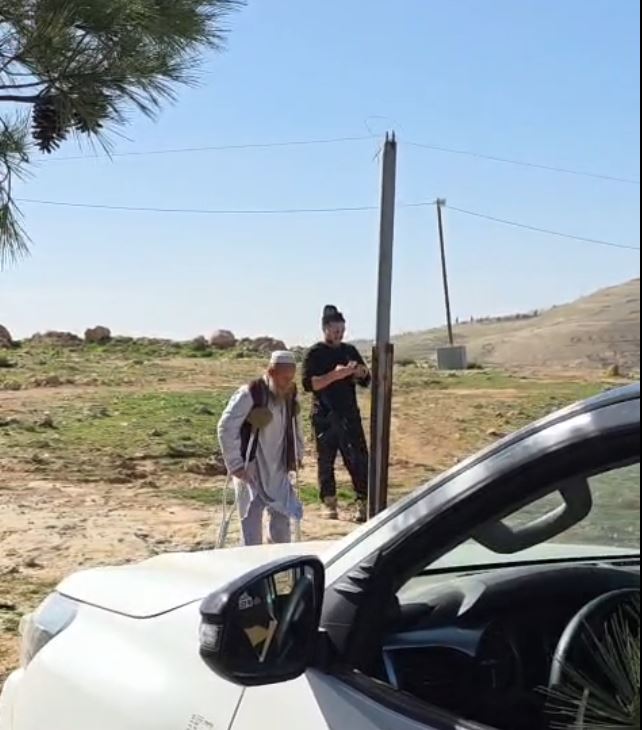 Feb-3-2026Security coordinator of the Abigail settlement, the one who injured Sheikh Saad (next to him)
-