
Shuafat refugee camp and Nabi Samwil enclave - the start of the school year
7:15 – Shuafat refugee camp checkpoint – we came to see how the school year started in this difficult place. Lots of younger and older children are waiting for the buses that take them to the schools and some kindergartens in Jerusalem. The transports are divided between boys and girls, a tiny one is forced to leave her brother’s hand and push her lone self to the bus. We are an attraction – the girls smile and chat with us in Arabic, that is, with Netanya. There is a list manager, and when two girls not on the list ask to join – the answer is absolutely no. The shuttle buses have a special route, and they are not taken off the bus at the checkpoint for inspection. This is also how they bypass the big traffic jam of cars going to Jerusalem.

On exiting through the pedestrian barrier, the checking female soldier is taken aback by our presence and immediately calls the checkpoint commander. A team of community police arrives, a new term for us, they tell us that there are also such police walking around in Jerusalem and Kfar Saba. They tell about their educational exploits in the neighborhood – school visits, road safety instructions, dealing with traffic jams at traffic lights and even accompanying a visit by the Minister of Education yesterday, who clarified what the only school here lacks. Nice of him.
We travel to Nabi Samwil, to the Palestinian school inside the suffocated enclave, which is completely cut off from its surroundings. You need special permits to reach the Al Jib checkpoint, which leads to another Palestinian enclave leading to the West Bank, and crossing with permits to Jerusalem, which is about a kilometer away from here, if granted, can only be done with a long drive to the Qalandiya checkpoint.
The religious settlers took over buildings here and operate tours of the Jewish/Arab site.

The school has been renovated, and the principal seems content now in a separate room from the female teachers with the religion teacher who teaches Hadith. It’s new to us that he is included in the permanent staff. It’s amazing to see the tiny classes that contain 5 students and a teacher (the students are only from the little Nebi Samuel and from the Bedouin village of Al-Khalila adjacent to Givat Ze’ev). The teachers come from Jerusalem and definitely make an effort to instruct the material. We are surprised to see subtraction and addition drills on the 8th grade’s board. Everyone is happy to see us again. We also visit the tiny, but happy and colorful kindergarten.

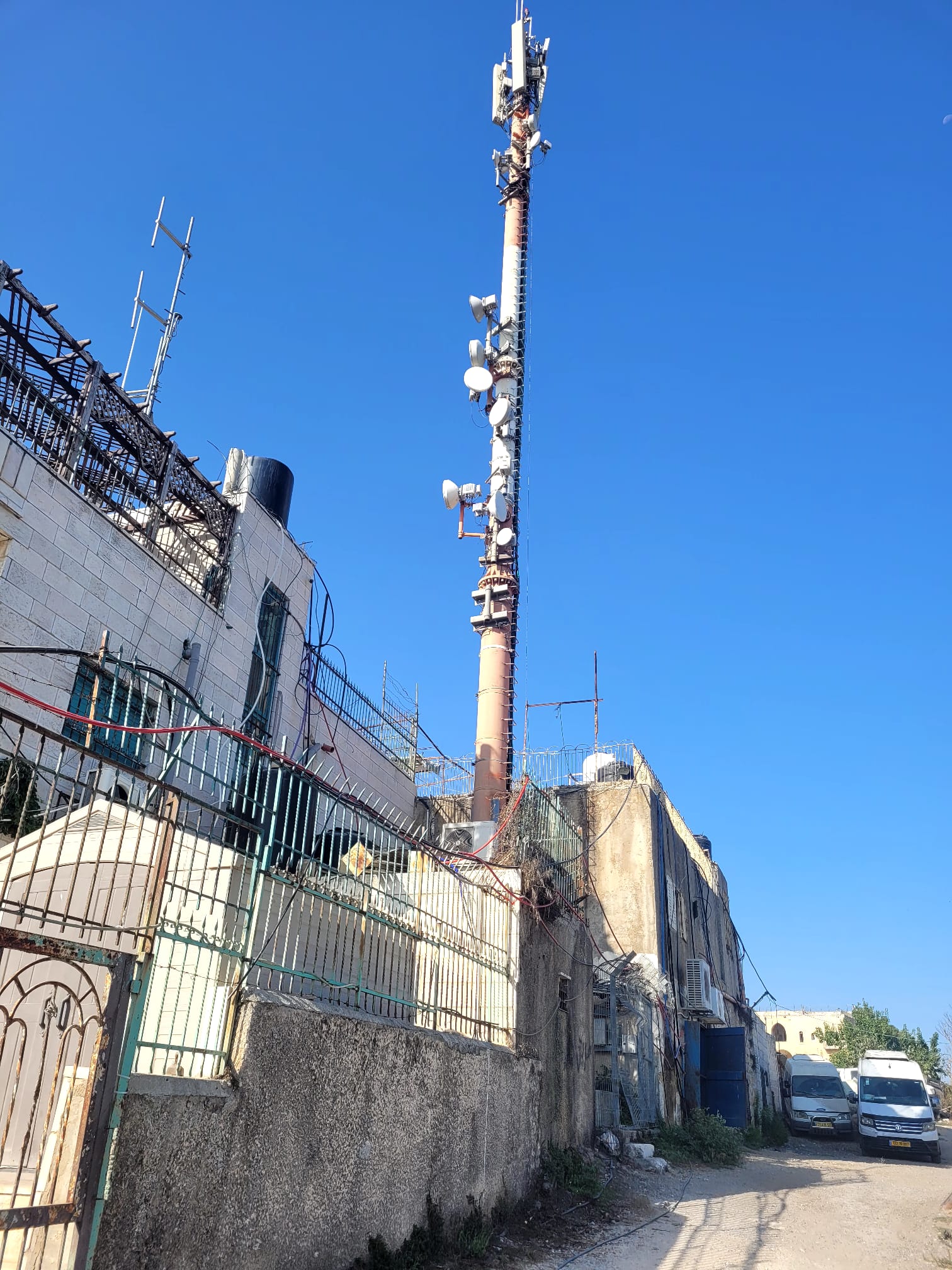
We were curious whether the breach in the fence near the Har Shmuel settlement was still active, after all the recent events. Well, yeah. For pedestrians, if needed, a taxi is waiting. The driver says that the Border Guard soldiers come here for visits, and mainly cause problems for people with medical permits, not work permits. Obviously, because how will they succeed in building all the tunnels on Highway 1 intended for Israelis if the workers from 7 villages in the northern Jerusalem enclave cannot get to work on time night and day?
Checkpoint Shu'afat camp / Anata-Shu'afat (Jerusalem)
See all reports for this place-
The Shu’afat checkpoint is located in the northern part of East Jerusalem at the exit from the village of Anata and the Shu’afat refugee camp, which are located in the area annexed to Jerusalem in 1967. The refugee camp borders the Shu’afat neighborhood to the west, Pisgat Ze’ev to the north, the French Hill neighborhood to the south and the planned expansion of Ma’aleh Adumim to E-1 in the east. It was established in 1966 for 1948 refugees from the West Bank and was populated after the Six Day War by persons who had been expelled from the Jewish Quarter. Today its population comprises some 25,000 people holding blue ID cards and some 15,000 people with Palestinian ID cards. The camp lacks adequate infrastructure and services, and suffers from poverty, neglect and overcrowding. All its buildings are connected to the public electricity and water infrastructure, but not all are connected to the sewer system. The camp’s services are provided by UNRWA, except for those such as health clinics and transportation of pupils to schools in Jerusalem. In 2005, the Israeli High Court of Justice rejected a suit by the residents requesting that the route of the separation fence be drawn such that the camp would remain on the Israeli side, but conditioned its approval of the route on the establishment of a convenient and rapid crossing facility for the inhabitants of the neighborhood, most of whom are residents of Jerusalem.
A temporary checkpoint operated there until December, 2011. It was extremely congested during rush hours, and dangerous for pedestrians (especially children) because of inadequate safety provisions. The new checkpoint was inaugurated south of the old one, for public and private transportation and for pedestrians, intended solely for the residents of the camp – holders of blue ID cards, and those with Palestinian ID cards who possess appropriate permits. There are five vehicle inspection stations at the checkpoint, and two for pedestrians (one of which is currently closed) where scanners have been installed but are not yet operating. According to the army, representatives of government agencies will also be present to provide services to residents of the neighbourhood. The pedestrian lanes are very long, located far from the small parking lots, and accessible through only a single revolving gate. Anat TuegJan-25-2026Anata: A new outpost has been built south of the junction
-
Har Shmuel CP
See all reports for this place-
Har Shmuel CP
This checkpoint is located on the way between Bidou and the enclave villages around Nabi Samauil, and separates them. It also blocks the way for Nabi Samauil farmers headed to their own farmlands that have become ‘state land’. Further along, the way to Bidou is another unmanned barrier blocking the road to Beit Iksa. Another large manned checkpoint with a watchtower separates the Bidou enclave from Israel proper. Importantly, the entire Bidou enclave is defined Area C and C by the Oslo Accords, and its fencing-in as an enclave was carried out in order to take over Palestinian land and build settler-colonies on it.
The holes in the barrier fence close to Har Shmuel are used for pedestrians working inside Israel. The workers we have met said that the way they must take from their home inside the enclave to their workplace in Jerusalem about 15 kilometers long – through another enclave: Bir Naballah. Driving this way in part involves potholed tracks, finally landing them at the overcrowded Qalandiya Checkpoint, which they cross to their work inside Israel. Incidentally, some of the workplaces are right opposite the Bidou enclave, so their track ends up being nearly circular.
-
Nabi Samwil
See all reports for this place-
Nabi Samwil - a village literally placed in a transparent cage.
This Palestinian village is 800 years old. It is located on top of a hill, its altitude 890 meters above sea level, and overlooks the entire area. According to Jewish, Christian, and Muslim traditions, the Prophet Samuel was buried here. In recent years the mosque has been turned into a popular Jewish prayer site. Jews use the basement for prayer, and Muslims the upper part of the mosque. New signs are placed here, containing verses from the Jewish scriptures and mention of exclusively Israeli historical times. The nearby spring has become a popular site of ritual bathing. On Iyar 28th, every year, a mass-celebration is held in memory of the Prophet Samuel.
Until 1967 this was a well-off village that developed around the mosque, with a population of 1,000 owning thousands of dunams of farmland. In 1967 most of the villagers fled, and only 250 remained. In 1971 Israel expelled them, and until the 1990s completely razed its houses that were sitting on a Crusader and Hellenist archeological stratum, without any kind of compensation for the expelled inhabitants. Parts of the village lands are at present used for the settler-colony of Har Shmuel, another part has been declared a national park. Villagers have tried to restore their lives on their remaining lands, a short distance from their original homes, in an area that formerly held structures to house the village’s livestock.
Then the Separation Fence was erected in the West Bank, the village remained an enclave caught between the Green Line and the Fence, and its inhabitants were torn away from other West Bank villages. Any exit to the West Bank requires crossing the distant Jib checkpoint, with a permit. The movement to Israel inside the Green Line is forbidden as well. In 1995 the entire village area was declared a national park – not only around the mosque and antiquities around it which take up about 30 dunams, but an area of no less than 3,500 dunams including the new village and all of its land. Any additional construction is forbidden: any room, caravan, fence, a newly planted tree. Work permits are issued sparingly. There is a tiny school made up of several caravans.
Watch the movie by Eran Turbiner and MachsomWatch: NABI SAMWIL 1099-2099, a film by Eran Torbiner
-