
South Hebron Hills - earth blockades prevent entrance and exit to and from the villages

There is nothing new along the entire drive on Route 60.
About a kilometer from Al-Fawwar, in front of the spring, a military van
stands near the post, which is not manned.
Qilqis — open on both sides.
At the southern entrance to Hebron in front of Bani Naim, there is a
military jeep. Another jeep half a kilometer away.
We stopped to visit Ata Jaber at the northern entrance to Hebron, who picks
grapes on his property, for grape honey and other products, and beans which he
sells in the market in Hebron. He says he was fired about a month ago, after 5 months of work, at the Rami Levy branch in Ashdod. They claimed he was too old.
I ask what about the settlers who often come to disturb and harass, this is still happening.
The house of his mother and brother (Jaushi) is located in front of Ata’s area. Givat HaHarsina was built above their house. The settlers throw bottles and stones, mainly young people. The police came but did nothing. There is new construction in Givat HaHarsina. The area below it belongs, according to Ata, to his family.
We entered Hebron.
In the House of Contention there is a new kiosk. On the way I see 2 foreign women and a man with tags. We stopped. I talked to them, and it turns out they are from the UN. They
are patrolling. I told about the MachsomWatc and what we have been doing in the occupied territories for years. I expanded on Masafer Yatta and the area. I blessed them for reporting to the world about what is happening there and I received a blessing back, for our activity.
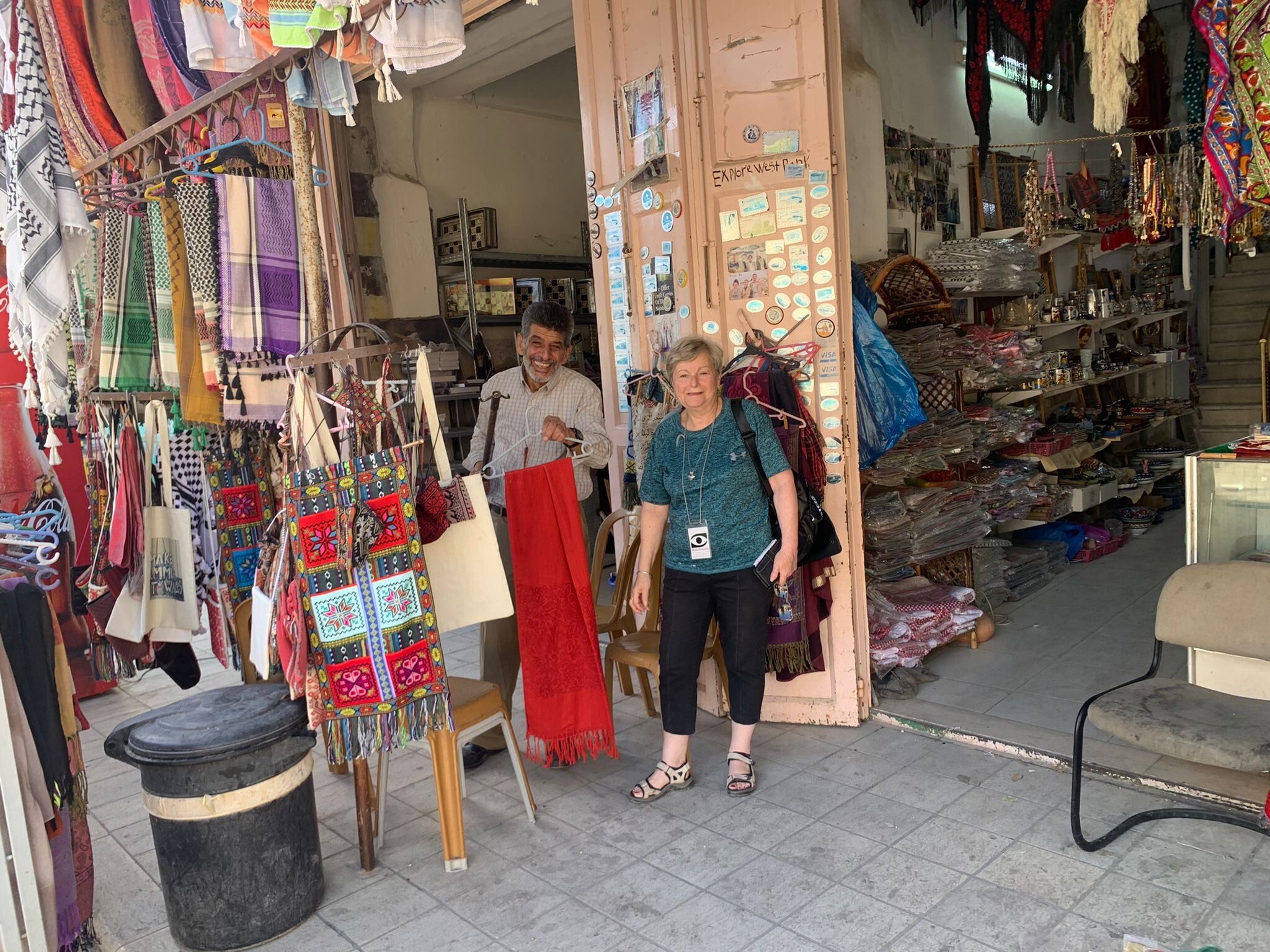
We arrived at Abed’s, at his shop in front of the Cave of the Patriarchs. Not far away, a class of religious girls receive an explanation from teachers about Hebron.
Abed tells about the bad condition of his sick wife who was treated in Jordan, and he was hospitalized due to dehydration.
It is said that settlers celebrated en masse and for that reason they did not allow Muslims to enter the Cave of the Patriarchs. He has no livelihood because there are almost no tourists. Heart pinched.
We continued to the grocery store of Kafiza. He also tells about settlers who marched accompanied by the army from Kiryat Arba into his neighborhood (Wadi Al Rus neighborhood). A boy who came to shop at the store told us that soldiers pushed him but he was not arrested.
We went to check the sidewalk which they had destroyed at the entrance to Givat HaMevaser on the way, most of the shops are closed.
The sidewalk was partially repaired.
We returned via road 317.
Muhammad receives a message about the demolition of a house in Al Rafia not
far from the Zif intersection. Later it became known that on that day they destroyed houses in three villages.
In the Carmel settlement, construction is progressing. This can be seen from the road.
We notice the soldiers at the entrance to Samu’ and there is a bulldozer working to build piles of dirt to close the entrance.
From the At-Tuwani area onwards, up to a rope barrier, earthen embankments have been erected to prevent exit and entry.
The entrance to Abu Safi was also closed. They are not allowed to go out and buy groceries and water.
This too was later published on social networks.
Occupation everywhere. You can’t miss it.
A-Tuwani
See all reports for this place-
A-Tuwani
The locals came to a-Tuwani during the 20th century from the village of Yatta. They settled in abandoned ruins, utilizing the arable land, pastures for grazing sheep and the abundance of natural caves for habitation. The residents who settled in the caves came from families who could not purchase land for houses in the mother villages, as well as shepherds who did not have enough land to graze. They were joined by clan members who quarreled with other families in the mother locality.
Some of the residents today live in concrete buildings built above the caves. In the area of the village are several water cisterns and an ancient water well called 'Ein a-Tuwani. Local residents are forced to buy water in containers and transport them through many road blocks to the village. With the help of international organizations, an electrical system was installed in the village. In the late 90s of the 20tTh century, an elementary school was established in the serving several small villages in the area.
In 2004, MachsomWatch began visiting and reporting from the Khirbet Tuwani cave village, which suffers badly from the settlers of nearby outposts, and especially from the extremist Ma'on outpost. . The settlers contaminate cisterns, poison the flocks and uproot trees.Particularly notable is the harassment of children from the surrounding villages on their way to school in a-Tuwani, so much so that military escort of children is required to separate them from the attackers (this was arranged following an initiative of the organization's members). In the past year, the escort has been without the vital presence of overseas volunteers.
Near a-Tuwani there are several families who have returned to the caves due to the incessant demolitions of the civil administration (as there is a total construction ban in all of area C). Destroyed are not only residential and agricultural buildings, but also water pipes, machinery. Even water cisterns are clogged up. a-Tuwani residents have created an association for non-violent demolition protests, but in the past year the army’s harsh harassment and settler violence have intensified and escalated. The incident of the small generator confiscation, which left a young man paralyzed, is one of many examples - any legitimate protection of property rights leads to violence and even shootings by the army and the civil administration.
Updated April 2022
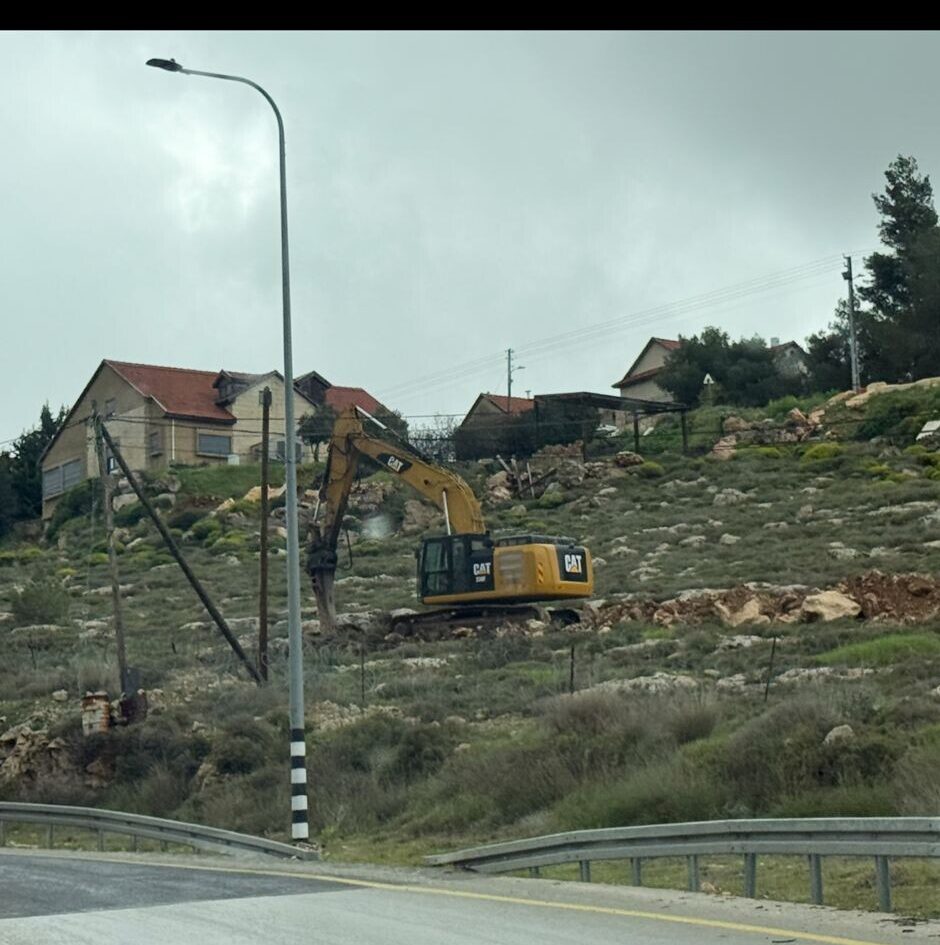 MuhammadFeb-24-2026South Hebron Hill, Beit Hagai: Paving an internal security road
-
Dura Al-Fawwar Junction
See all reports for this place-
Junction on Route 60: west - the town of El Dura, east - the Al Fawwar refugee camp. There is a manned pillbox at the junction. From time to time the army sets up flying checkpoints at the entrance to El Fawwar and Al Dura. Al-Fawwar is a large refugee camp (7,000 inhabitants in 2007) established in 1949 to accommodate Palestinian refugees from Be'er Sheva and Beit Jubrin and environs. There are many incidents of stone-throwing. In the vicinity of the pillbox there are excellent agricultural areas, Farmers set up stalls adjacent to the plots close to the road. In recent months the civil administration has set up dirt embankments thereby blocking access to the stalls, and making it impossible for the farmers to sell their vegetables. Updated April 2021, Michal T.
-
Hebron
See all reports for this place-
According to Wye Plantation Accords (1997), Hebron is divided in two: H1 is under Palestinian Authority control, H2 is under Israeli control. In Hebron there are 170,000 Palestinian citizens, 60,000 of them in H2. Between the two areas are permanent checkpoints, manned at all hours, preventing Palestinian movement between them and controlling passage of permit holders such as teachers and schoolchildren. Some 800 Jews live in Avraham Avinu Quarter and Tel Rumeida, on Givat HaAvot and in the wholesale market.
Checkpoints observed in H2:
- Bet Hameriva CP- manned with a pillbox
- Kapisha quarter CP (the northern side of Zion axis) - manned with a pillbox
- The 160 turn CP (the southern side of Zion axis) - manned with a pillbox
- Avraham Avinu quarter - watch station
- The pharmacy CP - checking inside a caravan with a magnometer
- Tarpat (1929) CP - checking inside a caravan with a magnometer
- Tel Rumeida CP - guarding station
- Beit Hadassah CP - guarding station
Three checkpoints around the Tomb of the Patriarchs
 Raya YeorDec-18-2025Hebron - Yusri Jaber and part of his family
-
Mesafer Yatta
See all reports for this place-
This is happening in Fire Area 918 in the South Hebron Hills
On the eve of Remembrance Day (the day before Israel Independence Day), 4th May, 2022, the Israeli High Court decided on the transfer and expulsion of residents from 8 Palestinian communities in the area of Masafar Yata in the South Hebron Hills. Residents of the villages have been living under the threat of demolition, evacuation and expropriation since the IDF issued evacuation orders in 1999 based on the 1980s proclamation of their area of residence as a firing zone for IDF drills. None of the nearby settlements were included in this zone. The Masafer Yata Palestinian villages retain a special lifestyle and ancient agricultural culture. They also posess a clear historical documentation that testifies to a Palestinian settlement in this area, generations before the establishment of Israel, long ago in the caves and at later times outside them.
Evacuating residents from the area means destroying these historic villages and leaving entire families (about 2,000 people, children, adults, and the elderly) homeless. This is contrary to international law.
In June 2022, a firing drill started, and life became harder.
-
South Hebron Hills
See all reports for this place-
South Hebron Hills
South Hebron Hills is a large area in the West Bank's southern part.
Yatta is a major city in this area: right in the border zone between the fertile region of Hebron and its surroundings and the desert of the Hebron Hills. Yatta has about 64,000 inhabitants.
The surrounding villages are called Masafer Yatta (Yatta's daughter villages). Their inhabitants subsist on livestock and agriculture. Agriculture is possible only in small plots, especially near streams. Most of the area consists of rocky terraces.Since the beginning of the 1980s, many settlements have been established on the agricultural land cultivated by the Palestinians in the South Hebron Hills region: Carmel, Maon, Susia, Masadot Yehuda, Othniel, and more. Since the settlements were established and Palestinians cultivation areas have been reduced; the residents of the South Hebron Hills have been suffering from harassment by the settlers. Attempts to evict and demolish houses have continued, along with withholding water and electricity. The military and police usually refrain from intervening in violent incidents between settlers and Palestinians do not enforce the law when it comes to the investigation of extensive violent Jewish settlers. The harassment in the South Hebron Hills includes attacking and attempting to burn residential tents, harassing dogs, harming herds, and preventing access to pastures.
There are several checkpoints in the South Hebron Hills, on Routes 317 and 60. In most of them, no military presence is apparent, but rather an array of pillboxes monitor the villages. Roadblocks are frequently set up according to the settlers and the army's needs. These are located at the Zif Junction, the Dura-al Fawwar crossing, and the Sheep Junction at the southern entrance to Hebron.
Updated April 2022
MuhammadFeb-24-2026South Hebron Hill, Beit Hagai: Paving an internal security road
-
Zif Junction
See all reports for this place-
Zif Junction located on the crossroads that directs towards Road 356 to Yata. Yata is the district city of the southern Hebron Mountains. Usually, this junction is open to traffic. The nearby pillbox is unmanned. But the army and police are present occasionally, sometimes setting up a checkpoint and sometimes detaining residents from the big city. Often, the Israeli policemen inspect vehicles and distribute driving reports to Palestinian vehicles. s
-