
South Hebron Hills, Huda kindergarden
Aim of the shift: Creative activity in the Huda kindergarten in Hashem-el-Daraj (the nose of the stair)
Topic of activity: Spring: Butterfly art activity
30 children, 2 preschool teachers (Huda and Chaula), and an assistant (Amna) were present today.
Today’s activity is a continuation of the caterpillar activity that we did two weeks ago. The activity is quite complex at the end of which the children leave with a butterfly whose wings move. As with the previous activity, the children were enthusiastic. It seems that the children are more experienced working with glue and scissors and were not afraid of getting dirty with glue and colors – see the pictures. The instructions for the activity in Hebrew and Arabic is attached.
Halfway through as we waited for the painted toilet paper rolls, which formed the body of the butterfly, to dry, we taught a song (in Arabic) on butterflies (“Come to me, butterfly ….”), and the children acted out the song. It was fun!
Toward the end of the activity, it was clear that the preschool teachers were feeling pressured. It turned out that once again they were hosting a meeting of village women with an instructor that was coming from Hebron. The meeting is held in the big classroom in the preschool. As the women began to arrive, the preschool teachers were tense because their faces were not covered and Mohamed was present in the building although he had been ‘pushed’ into the kitchenette (not to worry, he was provided with pita and lebana). Many of the women have children in the preschool and they are familiar with (and also appreciate) our activities.
The instructor arrived: She is from Beni Naim, some sort of engineering student. Her work with the women is funded by the ActionAid organization for the rights of women and children. When I introduced myself – from Israel, her body language conveyed hostility which is understandable. A worker from ActionAid was outside in a car waiting for her. Once again I explain our activities and our belonging to MachsomWatch in Israel. Again a very restrained reaction, to say the least. In contrast, as we are leaving the preschool, children from the nearby grade school were passing by on their way home – they called me by name with excitement and approached us. It seems that after 4-5 years of activity, a generation of children has grown that recognizes (and appreciates) us. It was heartwarming.
When we left, we noticed the fence of trees growing around the preschool (which is cared for by Amna). But most of the courtyard is barren and full of thorns. We proposed an activity of planting cacti during our next visit. Each child will be responsible for caring for a plant. This can be a way of encouraging self-esteem and a sense of responsibility in the children, etc.
Pictures of the activity can be found in Album 14-4-2016. The link is:
https://picasaweb.google.com/113044451662544057850?authkey=Gv1sRgCNS_j8qy0sCOGA
South Hebron Hills
See all reports for this place-
South Hebron Hills
South Hebron Hills is a large area in the West Bank's southern part.
Yatta is a major city in this area: right in the border zone between the fertile region of Hebron and its surroundings and the desert of the Hebron Hills. Yatta has about 64,000 inhabitants.
The surrounding villages are called Masafer Yatta (Yatta's daughter villages). Their inhabitants subsist on livestock and agriculture. Agriculture is possible only in small plots, especially near streams. Most of the area consists of rocky terraces.Since the beginning of the 1980s, many settlements have been established on the agricultural land cultivated by the Palestinians in the South Hebron Hills region: Carmel, Maon, Susia, Masadot Yehuda, Othniel, and more. Since the settlements were established and Palestinians cultivation areas have been reduced; the residents of the South Hebron Hills have been suffering from harassment by the settlers. Attempts to evict and demolish houses have continued, along with withholding water and electricity. The military and police usually refrain from intervening in violent incidents between settlers and Palestinians do not enforce the law when it comes to the investigation of extensive violent Jewish settlers. The harassment in the South Hebron Hills includes attacking and attempting to burn residential tents, harassing dogs, harming herds, and preventing access to pastures.
There are several checkpoints in the South Hebron Hills, on Routes 317 and 60. In most of them, no military presence is apparent, but rather an array of pillboxes monitor the villages. Roadblocks are frequently set up according to the settlers and the army's needs. These are located at the Zif Junction, the Dura-al Fawwar crossing, and the Sheep Junction at the southern entrance to Hebron.
Updated April 2022
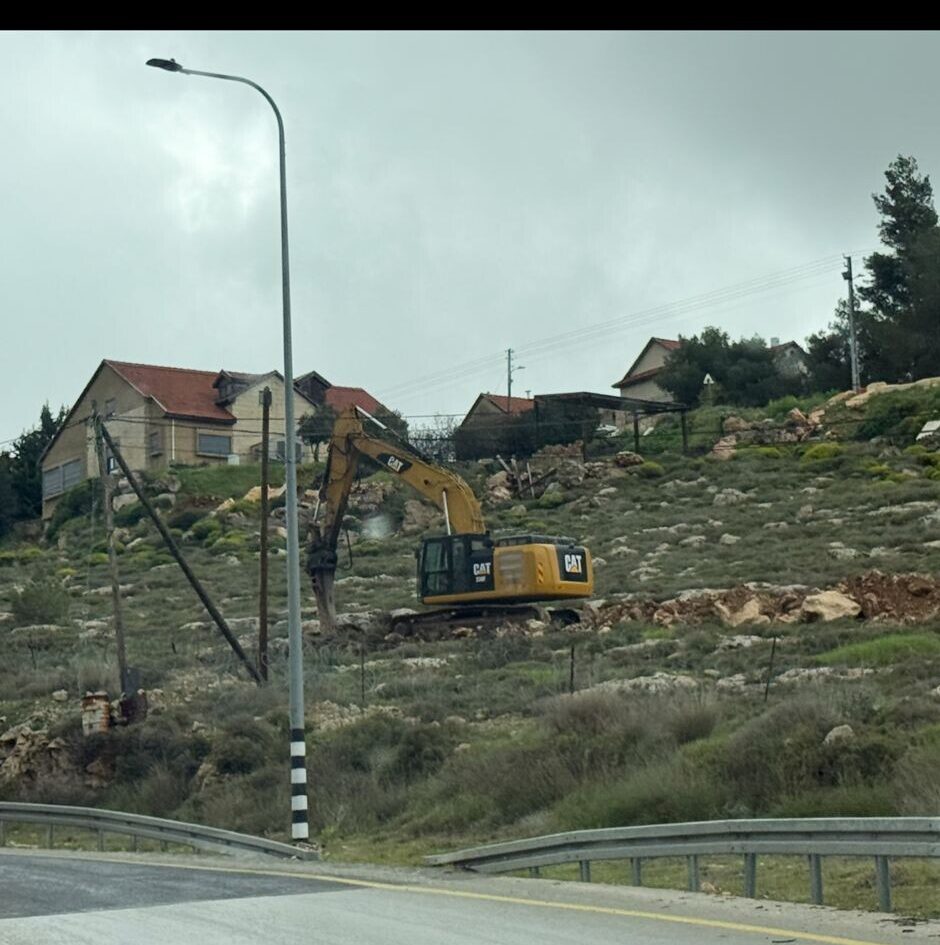 MuhammadFeb-24-2026South Hebron Hill, Beit Hagai: Paving an internal security road
-