
South Hebron Hills, Sun 20.3.11, Morning
Translator: Charles K.
It was a last-minute decision to go today, to meet Hammad from UNRWA and visit Huda in the kindergarten. That’s why we took our car to Umm-el-Hir, where we met Hammad. We left the car in Hakhaj’s care and drove in Hammad’s jeep to Hashem-al-Daraj (“the nose of the steps”).
Meitar checkpoint
deserted.
Route 317
It looks as if more caravans have been added to the Avigail outpost!
Umm-el-Hir: We watched a “movie” in Hakhaj’s tent – a member of his family filmed the large confrontation that occurred here yesterday (Saturday[!!]), between settlers from Ma’on (or Havvat Ma’on or Hurshat Ma’on) and residents of Tuwwani. The settlers came down to the village (you clearly see they’re inside the village), there was hitting, stone throwing. The army came, and despite the presence of activists and volunteers, two village residents were arrested. One resident was badly beaten, couldn’t rise, and was taken to the hospital. We intended to stop at Tuwwani on our way back, but it was already too late. It may be worth stopping there during a future shift, to hear the whole story.
Hammad says that since the murder (of Jewish family, trans.) in Itamar there are at least four incidents with settlers per day. Yesterday, Saturday, there was also an incident in Sussiya: settlers and their flocks entered an area recognized as Palestinian. The army arrived, sent them all away and declared the area (Palestinian!!) "closed military area".
Another incident: The Bweira neighborhood, north of Giv’at Hakharsina in Hebron. Settlers attacked a father and his two children, damaging their car. All three were injured.
The kindergarten in Hisham-el-Daraj
We came to finalize the renovation plans, in particular to settle on the gradual stages of construction in order not to interrupt the kindergarten’s operation and ensure that the most urgent renovations be carried out first, and each stage completed (unlike the present structure which was left without a roof, only one of corrugated metal). UNRWA has provided initial building materials. The kindergarten may move next door during construction.
The kindergarten has more children now (22) than there were when we visited last, but still fewer than usual. There are more tables (Hammad bought them in Hebron after we informed him this was requested by Huda), but less floor space. We agreed that Hammad will buy some additional essentials immediately (e.g. a cupboard with doors) in Hebron.
We also discussed the problem of water. If there will be a toilet (without running water; the water will come from a tank on the roof, and there will be a septic tank), funding will have to be provided to pay for the water. The Palestinian Authority supports only the school, while Israel does not provide anything (recall: this is in Area C). UNRWA assists in construction but not in upkeep or staff.
We gave Huda her March salary. We make sure to pay her each month or she won’t be able to keep working. When the kindergarten is operating fully, Huda employs a helper.
We pay her salary from donations to the British Shalom-Salaam Trust and from members of Machsom Watch. In general, it’s clear that we must first invest in people, otherwise there simply won’t be a kindergarten.
South Hebron Hills
See all reports for this place-
South Hebron Hills
South Hebron Hills is a large area in the West Bank's southern part.
Yatta is a major city in this area: right in the border zone between the fertile region of Hebron and its surroundings and the desert of the Hebron Hills. Yatta has about 64,000 inhabitants.
The surrounding villages are called Masafer Yatta (Yatta's daughter villages). Their inhabitants subsist on livestock and agriculture. Agriculture is possible only in small plots, especially near streams. Most of the area consists of rocky terraces.Since the beginning of the 1980s, many settlements have been established on the agricultural land cultivated by the Palestinians in the South Hebron Hills region: Carmel, Maon, Susia, Masadot Yehuda, Othniel, and more. Since the settlements were established and Palestinians cultivation areas have been reduced; the residents of the South Hebron Hills have been suffering from harassment by the settlers. Attempts to evict and demolish houses have continued, along with withholding water and electricity. The military and police usually refrain from intervening in violent incidents between settlers and Palestinians do not enforce the law when it comes to the investigation of extensive violent Jewish settlers. The harassment in the South Hebron Hills includes attacking and attempting to burn residential tents, harassing dogs, harming herds, and preventing access to pastures.
There are several checkpoints in the South Hebron Hills, on Routes 317 and 60. In most of them, no military presence is apparent, but rather an array of pillboxes monitor the villages. Roadblocks are frequently set up according to the settlers and the army's needs. These are located at the Zif Junction, the Dura-al Fawwar crossing, and the Sheep Junction at the southern entrance to Hebron.
Updated April 2022
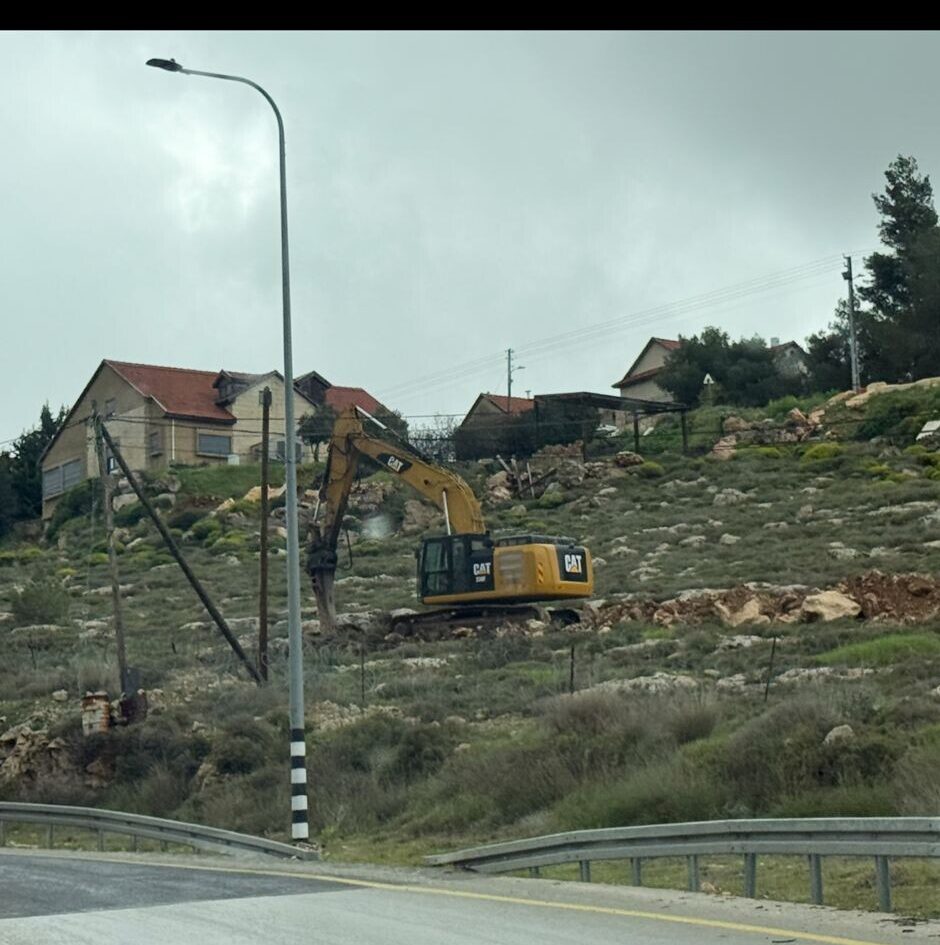 MuhammadFeb-24-2026South Hebron Hill, Beit Hagai: Paving an internal security road
-