
South Hebron Hills, Thu 29.12.11, Morning
Purpose of Shift:
Activity in Gan Huda for the 7th time this year, with the assistance of Eid & Huda.
HaKhashem-El-Daraj
Today is UNWRA’s clinic day in the village (the villagers are refugees from the Arad area and, therefore, receive their medical services from UNWRA). We don’t know the schedule of these visits and only realized that it was clinic day, when we arrived and saw an UNWRA car was parked outside one of the buildings. Occasionally, during our previous visits to the preschool, a child left the preschool to visit the clinic.
Twenty children were present today and there was also an additional woman who sometimes helps Huda. Huda and the children were truly happy to see us. Some of them got up and squeezed our hands in happiness. We are already friends and the children now feel freer in our presence.
Topic of activity: My house: reading, discussion, and construction
Program: Reading of “Yael’s House”, discussion on the topic of “the house”, and the building of a house from half of a milk carton pasted onto a carton basis. Because we were unable to obtain an Arabic version of “Yael’s House”, we used the Hebrew original. We told the story in Hebrew which Eid translated into Arabic, as the book was held up so that the children could see the pictures. In our version, “Yael” became “Eiman”. Of course, the telling of the story in conversational Arabic is not ideal because the beauty, the rhythm, the richness, and the literary value of the story are lost. Nevertheless, as can be seen in the photographs, the story elicited much interest and enthusiasm. The discussion on the topic of “my house’ was more limited – what a pity.
The creative activity this time was more complex than usual. Happily, Huda had already separated the younger and older children. The younger children were given drawing paper which we brought with us. Later, it became clear the importance of supervising the younger children because the activity didn’t hold their interest and they rambunctious.
As usual, we insisted on dividing the activity into well-defined steps. Coping with complex structure and attention are skills that we perhaps are helping to develop by means of these activities.
- We gave each child a carton, a half carton of milk, and paper to tear. On the table, we put small amounts of liquid paste on plastic plates. There was a logistical problem because of so many children crowded around small tables. The milk cartons were pasted to the carton base using strips of paper spread with paste. For some reason, both the children and Huda recoiled from tearing the paper by hand and becoming dirty from the paste. Also, from lack of experience, some of the children, using the “tongue depressors”, put far too much paste on the strips of paper (at least, the children no longer cry when we bring them out).
- Next step: The pasting of windows and doors that Huda had cut out ahead of time from colorful construction paper that we brought with us on the previous visit. The original plan was that each child would go to Muhammad and choose the pieces that he/she decided to paste – with the idea of reducing the automatic pasting and drawing we saw during our previous workshops- but because of the crowdedness of the preschool, it was impossible to do so. Instead, we went from table to table and each child, more or less, chose pieces.
- Next step: the children chose pictures of people and animals to cut, paint, and paste onto the doors and windows. Again we moved from table to table allowing the children to choose. It became clear that the tasks were too many for these children. Most of the children only pasted (with too much paste).
- Next step: paint the area around the house, paste sand (we brought in from outside) on the carton base, and paste wonderful decorations (sparkling stickers, pompons) that we left until the end.
At the end of the activity, Huda pasted a reward sticker (“kol hakavod – good work” or its equivalent in Arabic) on each child after saying a few words about the good work the child had done. The children held up their work for all of us to see and admire (see the photos).
The children took their projects home. They were very pleased and proud of their work.
The construction of building which will house the preschool is progressing (see the photos). The construction is being funded by UNWRA.
Photographs of the workshop (Muhammad) – album of December 30:
https://picasaweb.google.com/115469912026094971633?authkey=Gv1sRgCPzNi8HWpLaXzgE
“Staff” meeting:
According to our established routine, after the children have left for home, we sit, drink coffee – a courtesy of Muhammad, eat cookies, and discuss what we have learned from the day’s activity. As usual, we are quite excited at the end of each workshop. Our impression was that the activity was a little more complicated than usual, but was still appropriate for most of the children. It is good occasionally to do an activity that the children find challenging. The most important thing – the children enjoyed it.
The next workshop: Thursday 12/1/2012. The workshop topic: vegetables and fruit. It will include the reading of the book on the king of fruit, a discussion, and eating of fruit and vegetables, and the classification of cutouts of fruit and vegetables and the pasting of these cutouts on pictures of fruit and vegetables, and the coloring of the picture.
Our summary: Continuedsatisfaction from the activities. A feeling that our perseverance has created trusting and close relationships.
South Hebron Hills
See all reports for this place-
South Hebron Hills
South Hebron Hills is a large area in the West Bank's southern part.
Yatta is a major city in this area: right in the border zone between the fertile region of Hebron and its surroundings and the desert of the Hebron Hills. Yatta has about 64,000 inhabitants.
The surrounding villages are called Masafer Yatta (Yatta's daughter villages). Their inhabitants subsist on livestock and agriculture. Agriculture is possible only in small plots, especially near streams. Most of the area consists of rocky terraces.Since the beginning of the 1980s, many settlements have been established on the agricultural land cultivated by the Palestinians in the South Hebron Hills region: Carmel, Maon, Susia, Masadot Yehuda, Othniel, and more. Since the settlements were established and Palestinians cultivation areas have been reduced; the residents of the South Hebron Hills have been suffering from harassment by the settlers. Attempts to evict and demolish houses have continued, along with withholding water and electricity. The military and police usually refrain from intervening in violent incidents between settlers and Palestinians do not enforce the law when it comes to the investigation of extensive violent Jewish settlers. The harassment in the South Hebron Hills includes attacking and attempting to burn residential tents, harassing dogs, harming herds, and preventing access to pastures.
There are several checkpoints in the South Hebron Hills, on Routes 317 and 60. In most of them, no military presence is apparent, but rather an array of pillboxes monitor the villages. Roadblocks are frequently set up according to the settlers and the army's needs. These are located at the Zif Junction, the Dura-al Fawwar crossing, and the Sheep Junction at the southern entrance to Hebron.
Updated April 2022
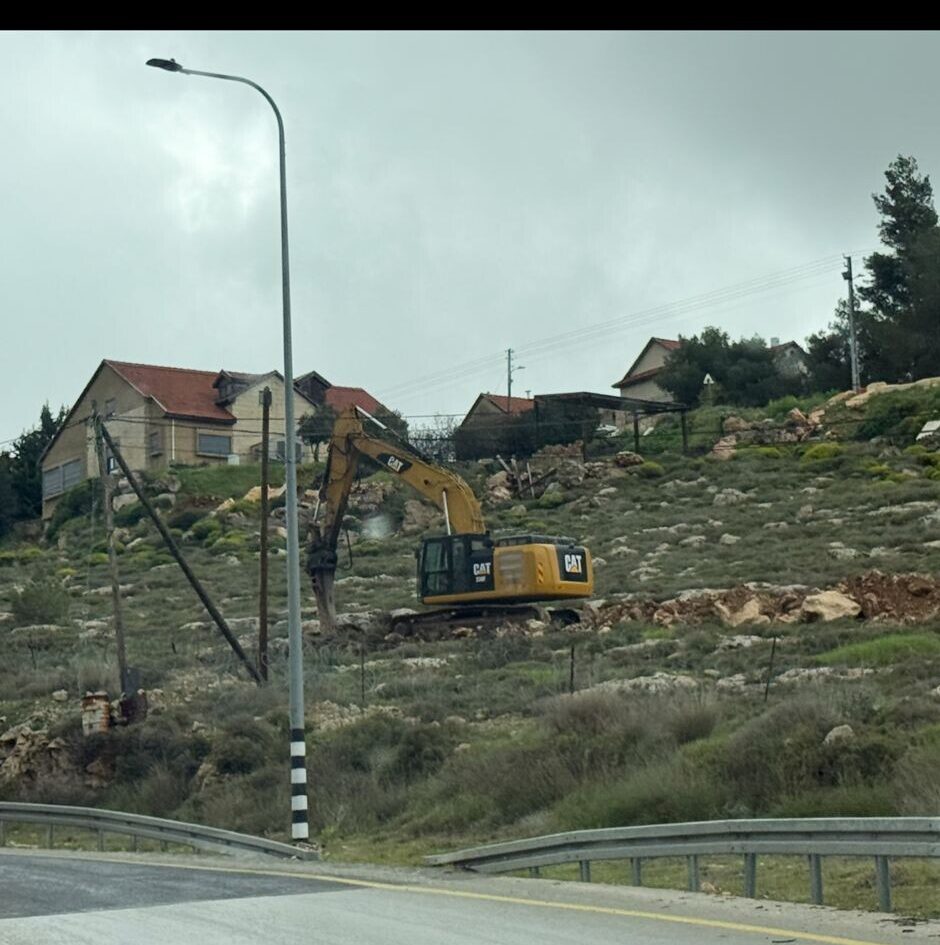 MuhammadFeb-24-2026South Hebron Hill, Beit Hagai: Paving an internal security road
-