
South Hebron Hills, Zif Junction
8:00-11:00
Aim of the shift: visit to the preschool of Amal (Zif intersection) and the “late” preschool at Umm el-Kheir
We first went to the preschool of Amal. The preschool has two classes: one for 4 year olds and one for 5 year olds. There are two other preschool teachers in addition to Amal. The children sat around tables writing in notebooks. We sat outside to talk to Amal – an impressive woman who initiated and runs the preschool. The children pay a small monthly fee – NIS 50, except for those who cannot afford it. The children bring their own food to preschool, except for those who do not have the financial means to do so, in which case Amal gives them food. Amal has a daily schedule for the preschool that includes outdoor activities, exercises, lessons in writing and arithmetic, and games. The hours of the preschool are from 7:00 until 12:00. Very impressive. The preschool lacks many things and Amal requested help. She needs a photocopier, paints for the walls, equipment for activities in the preschool. There is also a need for an awning or roof for the entry to the preschool. Winter is really a problem. There is flooding in the yard because of drainage problems. World Vision provided playground equipment in the yard and also flooring for the yard. Yael A., one of our members, provided many games and also a covering over the playground equipment. Amal found someone to put up the covering. We agreed to come in two weeks for an activity. We will bring the equipment for the activity. We left with a good feeling.
We continue on to Umm-el-Kheir. We know that there had been demolitions. We also knew there was a problem with the building used by the preschool and because of it, the preschool has not functioned for a year. The building belongs to the mukhtar of Hashem-el-Daraj and he was unwilling to continue to have it used for the preschool. We were received by Dalal and Ikhlas (with her baby who is named “Mira”), who are the teachers of the Umm-el-Kheir preschool. The status of the preschool is in the past tense because the building, which was used to house the preschool, and was a center, which was built recently but this building, was demolished a week ago.
There were two stages to the demolitions. The first occurred immediately after a visit of the Minister of Justice to the Carmel settlement (Umm-el-Kheir is adjacent to the fence of Carmel and the settlers don’t like it). The demolition took place early in the morning, before 6:00. Two stone buildings that stood for many years were destroyed, buildings in which lived village people. The tent that they now live in is also not legal because it is illegal to build on the site of buildings demolished by the government.
Dalal and Ikhlas spoke quietly about the demolitions with amazing self-control. Later E. joined us. Lucky for him – his house was not destroyed. E. is traveling abroad next week, an exhibit of his art work in Germany and then a visit to the American Congress in order to arouse public opinion regarding the situation of the Um-el-Khir villagers: all are “law breakers” – because there isn’t a program outline and the willingness of all those living in the area – Carmel settlers, the “Regavim” association, coordinator of activities in the territories –is to see everyone “evaporate” from the area. At a very short distance, the Avigail and Ashel outposts are flourishing. They are also “illegal”, but miraculously, there are no demolitions. So perhaps this is simply ethnic cleansing.
The result that the destruction has on the preschool: 40 children do not attend preschool. They remain home because there is no preschool – destroyed by the army. Need to remember: this is area C which is the responsibility of Israel. Thus in the villages of the southern Hebron hills there is no education before elementary school. The preschool at Um-el-Khir is funded by contributions from unofficial sources and organizations that exist with great difficulty. As for us – we are ashamed, ashamed, ashamed of our state!
South Hebron Hills
See all reports for this place-
South Hebron Hills
South Hebron Hills is a large area in the West Bank's southern part.
Yatta is a major city in this area: right in the border zone between the fertile region of Hebron and its surroundings and the desert of the Hebron Hills. Yatta has about 64,000 inhabitants.
The surrounding villages are called Masafer Yatta (Yatta's daughter villages). Their inhabitants subsist on livestock and agriculture. Agriculture is possible only in small plots, especially near streams. Most of the area consists of rocky terraces.Since the beginning of the 1980s, many settlements have been established on the agricultural land cultivated by the Palestinians in the South Hebron Hills region: Carmel, Maon, Susia, Masadot Yehuda, Othniel, and more. Since the settlements were established and Palestinians cultivation areas have been reduced; the residents of the South Hebron Hills have been suffering from harassment by the settlers. Attempts to evict and demolish houses have continued, along with withholding water and electricity. The military and police usually refrain from intervening in violent incidents between settlers and Palestinians do not enforce the law when it comes to the investigation of extensive violent Jewish settlers. The harassment in the South Hebron Hills includes attacking and attempting to burn residential tents, harassing dogs, harming herds, and preventing access to pastures.
There are several checkpoints in the South Hebron Hills, on Routes 317 and 60. In most of them, no military presence is apparent, but rather an array of pillboxes monitor the villages. Roadblocks are frequently set up according to the settlers and the army's needs. These are located at the Zif Junction, the Dura-al Fawwar crossing, and the Sheep Junction at the southern entrance to Hebron.
Updated April 2022
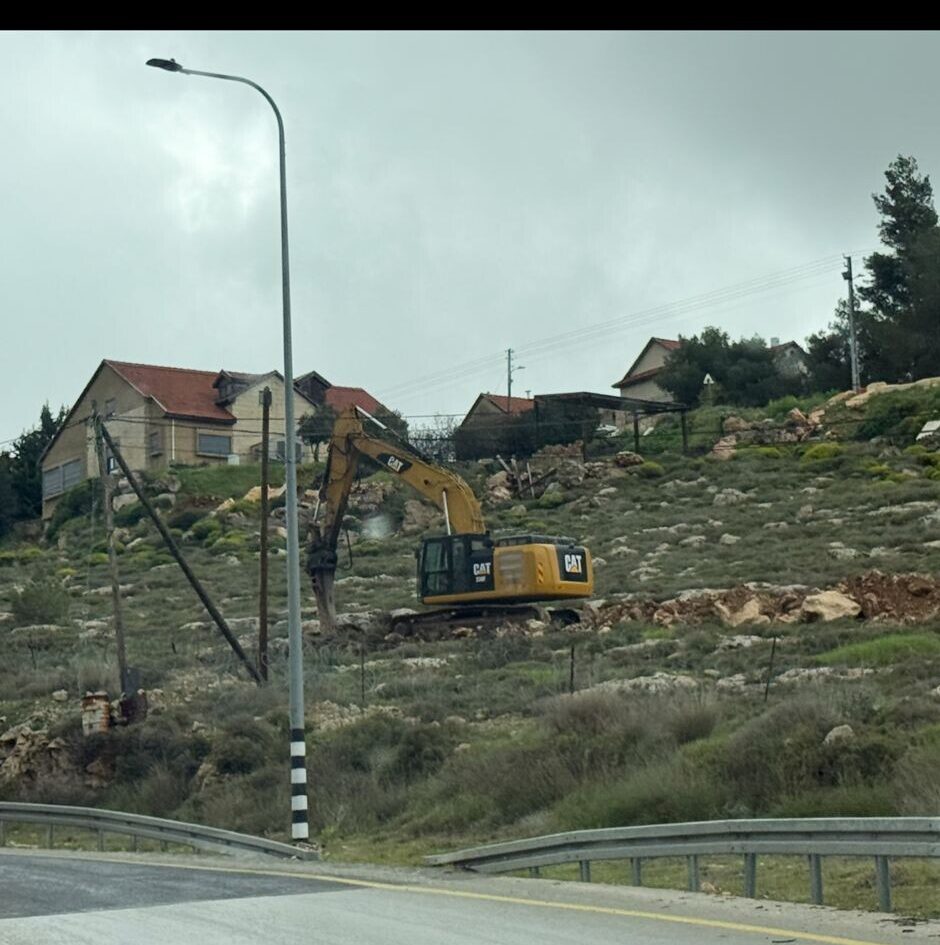 MuhammadFeb-24-2026South Hebron Hill, Beit Hagai: Paving an internal security road
-
Zif Junction
See all reports for this place-
Zif Junction located on the crossroads that directs towards Road 356 to Yata. Yata is the district city of the southern Hebron Mountains. Usually, this junction is open to traffic. The nearby pillbox is unmanned. But the army and police are present occasionally, sometimes setting up a checkpoint and sometimes detaining residents from the big city. Often, the Israeli policemen inspect vehicles and distribute driving reports to Palestinian vehicles. s
-