
South Hebron, PM
South Hebron, Wednesday 4.08.04, PM Observers: Mira B., Paula R., Leah Sh., Hagit B (reporting in Hebrew), Elena L (translating into English). We left Shoket at 14:30 and returned there at 18:30. We were a larger group than usual, in order to express our support for the Palestinian inhabitants of the South Hebron Hills on the day chosen by the settlers to conduct a parade and hold an assembly. We drove along route 317 and saw that the bulldozer had again been at work raising the dirt barriers higher. Samoa is completely blocked off from the east. We saw the intended alignment of the wall- and once again it was made clear to us that that the present alignment is aimed at annexing territory and settlements to Israel. It will also place the villagers in this area in an enclave within Israel and will cut them off from Yatta, their regional town. Indeed the road by which the villagers of Khirbet at-Tawani get to Yatta, which had been open for a month, has been closed again this morning!!! Why? We’ll try to find out tomorrow –although we can guess the answer- they can get to Yatta via route 317 and we have after all opened the northern gate into Yatta (The villagers later told us that the army had indeed told them to go via faraway Zif junction on route 317 – but there is only one car in the village).At all events now, at 16:00 hours, the yellow gate leading to northern Yatta is closed and locked. We stopped at the water cisterns of Susiya – on Monday we had received a phone call from N., a Palestinian who lives there, who told us of a military action which had taken place against their tents –’combing’ in army lingo – there were only women and children in the tents at the time and the soldiers, (eight of them) took out all the food from the tents and a sack of flour had been spilt. H. had already dealt with this incident by phone on Monday (the facts were not denied by the DCO representative T.) Today we came only to see the area. At Khirbet at Tawani we were received hospitably. We were given glasses of a marvelous tea with thyme. We expressed our support for them. We went to see the shop which sells the handwork of the women of the village –dresses and baskets etc. We were told that the police had come that morning again to see the cistern which had been poisoned. The police had also told the villagers that the route of the settlers’ march would not go through the village or even near it. From there we continued along route 356 – a lot of military traffic on the road, nuch more than usual. Asam – Yakniton CP was manned. The netting giving shade to the soldiers was up and the soldiers had water!! All the cars on the road had Israeli license plates; they clearly belonged to the settlers. Under the pillbox is a building painted in the colors of the Israeli flag and inscribed with the Biblical phrase “Judea will stay for ever”. This point is also the finishing post of the march and so it there were a lot of blue police and soldiers in evidence. Interesting to know whether they were protecting the marchers against the Palestinians or vice versa? Benei Haver junction: The starting point of the settlers’ march. The marchers are mainly boys and girls-but perhaps we arrived too early. There are a lot of military vehicles about. At the junction of route 60 with route 356 a flying CP-they didn’t have anyone to stop since in any case Palestinian keep away from these apartheid routes. Beni Na’im Route 60 Junction – open East Halhul – Sair. The crossing is open . There was a blue police patrol car –no detainees. There were no trasits and almost no traffic at all. The pillbox was manned and was decorated with an enormous Israeli flag (this is new). The junction between route 60 and route 35 – the Al- Jura CP. The pillbox is manned and so is the CP. We were on our way to the Halhul –Hebron bridge which is open. On our way back, there was only a soldier’s dummy at the Al- Jura CP. The Shiyuch –Hebron crossing (the girl’s school). The crossing is open and you take your life in your hands when crossing the main road. There is only a blinking traffic light and no Zebra crossing. The taxi drivers on one side of the crossing say that there have been no flying CPs for a month and a taxi driver on the other side says that only yesterday soldiers were here for two hours and checked everyone who wanted to cross. We met there a man from the organization al-KHAK-a human rights organization affiliated to the UN who told us about the problems he had dealt with today –they concerned water rights and the army at Susiya. Sheep’s Crossing – open Dura al- Fawwar crossing – open
South Hebron Hills
See all reports for this place-
South Hebron Hills
South Hebron Hills is a large area in the West Bank's southern part.
Yatta is a major city in this area: right in the border zone between the fertile region of Hebron and its surroundings and the desert of the Hebron Hills. Yatta has about 64,000 inhabitants.
The surrounding villages are called Masafer Yatta (Yatta's daughter villages). Their inhabitants subsist on livestock and agriculture. Agriculture is possible only in small plots, especially near streams. Most of the area consists of rocky terraces.Since the beginning of the 1980s, many settlements have been established on the agricultural land cultivated by the Palestinians in the South Hebron Hills region: Carmel, Maon, Susia, Masadot Yehuda, Othniel, and more. Since the settlements were established and Palestinians cultivation areas have been reduced; the residents of the South Hebron Hills have been suffering from harassment by the settlers. Attempts to evict and demolish houses have continued, along with withholding water and electricity. The military and police usually refrain from intervening in violent incidents between settlers and Palestinians do not enforce the law when it comes to the investigation of extensive violent Jewish settlers. The harassment in the South Hebron Hills includes attacking and attempting to burn residential tents, harassing dogs, harming herds, and preventing access to pastures.
There are several checkpoints in the South Hebron Hills, on Routes 317 and 60. In most of them, no military presence is apparent, but rather an array of pillboxes monitor the villages. Roadblocks are frequently set up according to the settlers and the army's needs. These are located at the Zif Junction, the Dura-al Fawwar crossing, and the Sheep Junction at the southern entrance to Hebron.
Updated April 2022
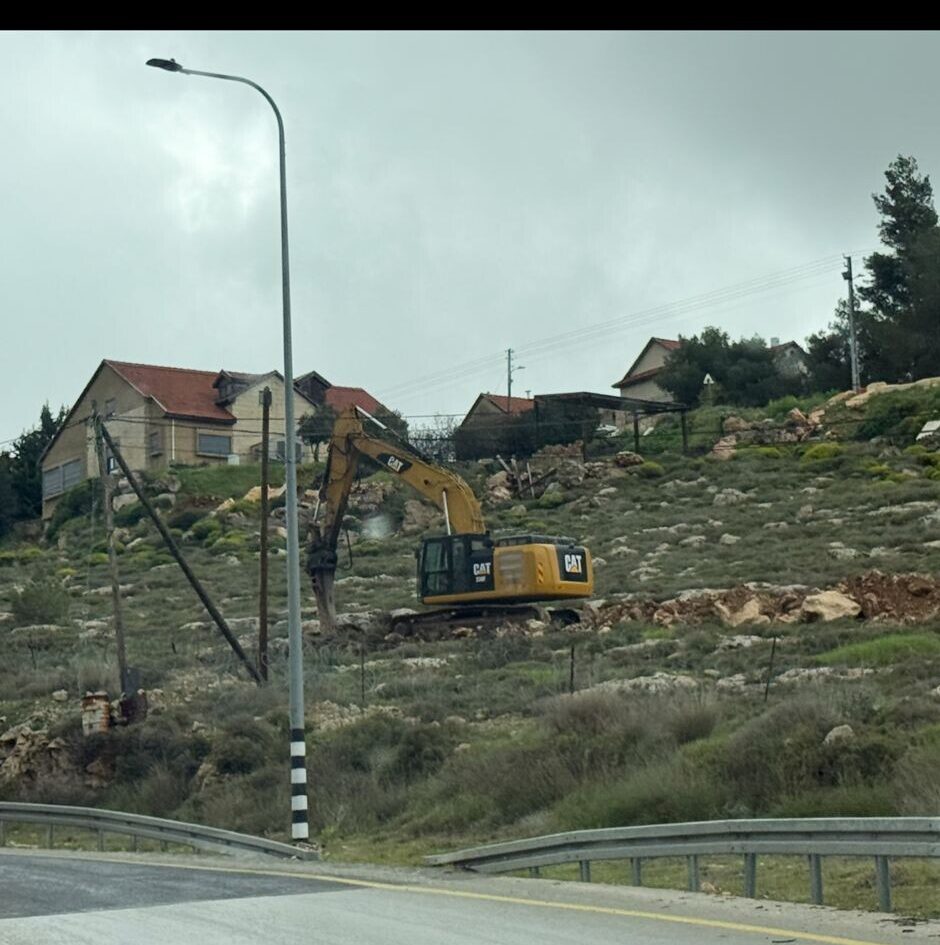 MuhammadFeb-24-2026South Hebron Hill, Beit Hagai: Paving an internal security road
-
Zif Junction
See all reports for this place-
Zif Junction located on the crossroads that directs towards Road 356 to Yata. Yata is the district city of the southern Hebron Mountains. Usually, this junction is open to traffic. The nearby pillbox is unmanned. But the army and police are present occasionally, sometimes setting up a checkpoint and sometimes detaining residents from the big city. Often, the Israeli policemen inspect vehicles and distribute driving reports to Palestinian vehicles. s
-