
Sukkot in Hebron: that's how it is seen from there
Today is the holiday of Sukkot, which is known as one of three festivals, and one of three dates that masses of Jews arrive in Hebron for reasons to be clarified below.
All the way on Road 60, soldiers’ blockades when the Israeli flag flies near every cement block or other blockage.
At the entrance to Dahariya, flags are attached to the concrete blocks on the dirt path to Abda. Soldiers and a flag, opposite the entrance to Deir Razih, under the IDF base, which overlooks the ramp to Negohot. Soldiers and a flag, and also near the spring on the other side of the road, at the crossroads of Dura-El Fawwar.
Above the road leading to Beit Hagai are soldiers with weapons drawn and flapping flags. Also at Kalkas on both sides of the road and at the Sheep Junction as above.
We reached Kiryat Arba and were not allowed to enter Hebron by car. They suggested that we join the organized transportation to the masses of the Children of Israel. We decided to give up the pleasure.
I called Mufid to tell him what was happening
Mufid says that three times a year on Sukkot, Pesach and Tisha B’Av Jews are taken to the grave of Otniel Ben Kenaz, which is right after the checkpoint Tarpat – the police block in H1. For this purpose, all those wishing to enter are allowed under heavy security and transportation only.
For the Palestinians there is, of course, curfew from 10 am to 6 pm and their shops are closed.
According to him, there are two more holy places for Jews around Hebron and its environs but could not tell me exactly where, what or who. The second place is called by them Bir al-Haram a-Romi, located in the entrance to Hebron from Halhul. And the third – he could did not remember the names.
Mufid is concerned about his family is coming from Jordan and he does not know when he will be able to meet them. He lives in H2 near Beit Hadassah near the stairs leading up to the Cordoba courthouse
While we were still talking our Hebron friend sent me pictures and videos that had been taken the previous evening on the roof of a house overlooking the Worshipers’ Route. The routine of the straw widow on this housetop is always in compliance with the needs of the IDF, because of its location and it is needed, so the army says, to secure the safety of the worshippers.(Natanya: Straw Widow: Soldiers occupy the roofs of houses or rooms and the inhabitatants are pushed into one room and only allowed out with permission of the soldiers.)
S. C. The woman called him and showed him the urine bottles that our soldiers had left on the roof. According to her, the water had a strange taste and when she went up to check the containers there was a trash can of the soldiers’ food and urine. In addition, the urine that poured on the roof also merged with the water they stored and lowered for use at home. The family are trying to empty the containers but have no water to wash them properly and they are very disgusted and will probably now have to replace the containers which cost a lot of money
I called Carmela Menashe (the journalist responsible for IDF of Kan – the public broadcasting network) and passed on all the material to her as well. I did not hear her reporting about it but maybe she did so.
According to Hagit Back, Hagit Ofran also knows about this and so does Yesh Din.
A happy holiday to all.
Dura Al-Fawwar Junction
See all reports for this place-
Junction on Route 60: west - the town of El Dura, east - the Al Fawwar refugee camp. There is a manned pillbox at the junction. From time to time the army sets up flying checkpoints at the entrance to El Fawwar and Al Dura. Al-Fawwar is a large refugee camp (7,000 inhabitants in 2007) established in 1949 to accommodate Palestinian refugees from Be'er Sheva and Beit Jubrin and environs. There are many incidents of stone-throwing. In the vicinity of the pillbox there are excellent agricultural areas, Farmers set up stalls adjacent to the plots close to the road. In recent months the civil administration has set up dirt embankments thereby blocking access to the stalls, and making it impossible for the farmers to sell their vegetables. Updated April 2021, Michal T.
-
Hakvasim (sheep) Junction
See all reports for this place-
One of the roadblocks (earthworks, rocks, concrete blocks or iron gates) that prevent transit of vehicles to Route 60 in the southern West Bank and block the southern entrance to Hebron. A manned pillbox supervises the place.
-
South Hebron Hills
See all reports for this place-
South Hebron Hills
South Hebron Hills is a large area in the West Bank's southern part.
Yatta is a major city in this area: right in the border zone between the fertile region of Hebron and its surroundings and the desert of the Hebron Hills. Yatta has about 64,000 inhabitants.
The surrounding villages are called Masafer Yatta (Yatta's daughter villages). Their inhabitants subsist on livestock and agriculture. Agriculture is possible only in small plots, especially near streams. Most of the area consists of rocky terraces.Since the beginning of the 1980s, many settlements have been established on the agricultural land cultivated by the Palestinians in the South Hebron Hills region: Carmel, Maon, Susia, Masadot Yehuda, Othniel, and more. Since the settlements were established and Palestinians cultivation areas have been reduced; the residents of the South Hebron Hills have been suffering from harassment by the settlers. Attempts to evict and demolish houses have continued, along with withholding water and electricity. The military and police usually refrain from intervening in violent incidents between settlers and Palestinians do not enforce the law when it comes to the investigation of extensive violent Jewish settlers. The harassment in the South Hebron Hills includes attacking and attempting to burn residential tents, harassing dogs, harming herds, and preventing access to pastures.
There are several checkpoints in the South Hebron Hills, on Routes 317 and 60. In most of them, no military presence is apparent, but rather an array of pillboxes monitor the villages. Roadblocks are frequently set up according to the settlers and the army's needs. These are located at the Zif Junction, the Dura-al Fawwar crossing, and the Sheep Junction at the southern entrance to Hebron.
Updated April 2022
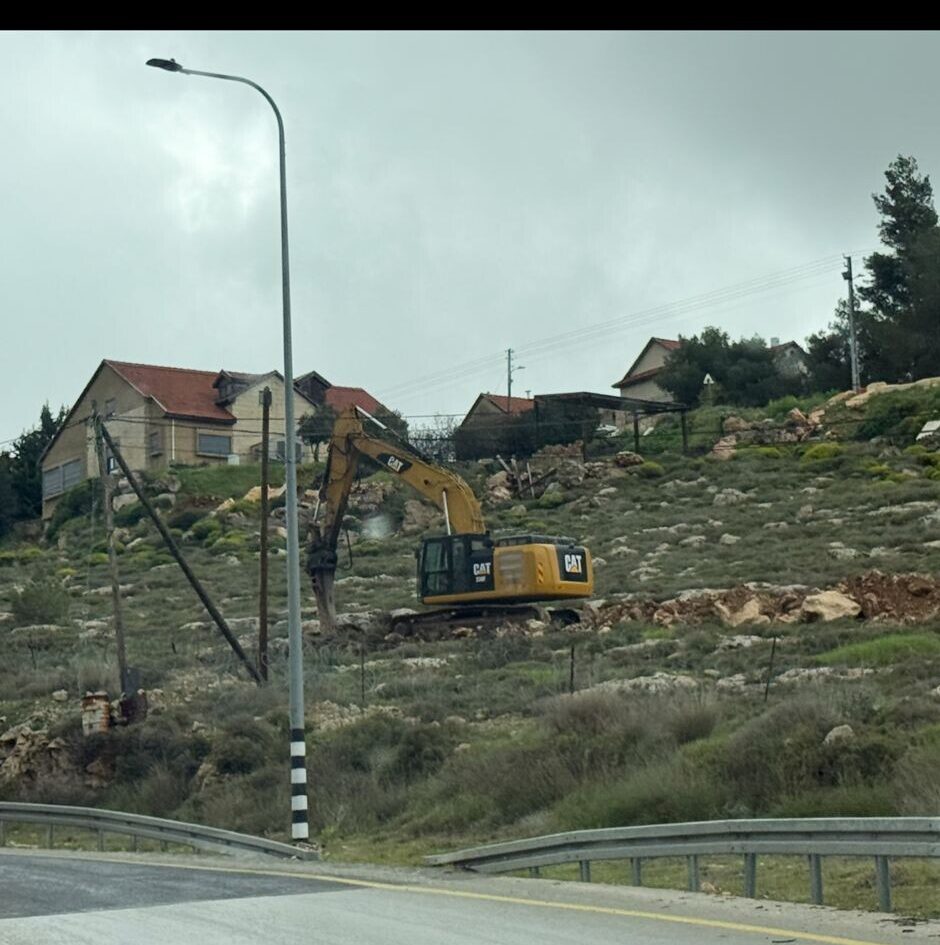 MuhammadFeb-24-2026South Hebron Hill, Beit Hagai: Paving an internal security road
-