
The Nof Zion Settlement and a Tour of the Southern Jerusalem Periphery
We began with a tour of the Nof Zion settlement.
About thirty years ago, Israeli developers managed to purchase a plot of land from Palestinians in Jabal Mukaber, on which they initiated the construction of a luxury housing neighborhood called “Nof Zion.” Approval was granted for the construction of 390 housing units and several hotels. In the early 2000s, construction of Phase A of the settlement began. The project ran into difficulties when it became clear that luxury apartments in the heart of a Palestinian neighborhood were not attractive; the only people interested in living there were ideological settlers, not necessarily people of means. The development company went bankrupt and entered into negotiations to sell the rights to a Palestinian-owned company. Settlement organizations recruited an Australian billionaire and Rami Levy, who provided the required sum to purchase the rights to the project and prevent its transfer into Palestinian hands.
Today, 170 families already live in the neighborhood. The apartments have 3, 4, or 5 rooms. A three-room apartment costs 2.5 million NIS—very cheap by Jerusalem standards. Construction is proceeding at full speed, and with each visit another slice of the hilltop is consumed by more and more buildings. The Jerusalem Municipality invested about 15 million NIS and built synagogues, a ritual bath (mikveh), and playgrounds. There is bus service to the neighborhood.

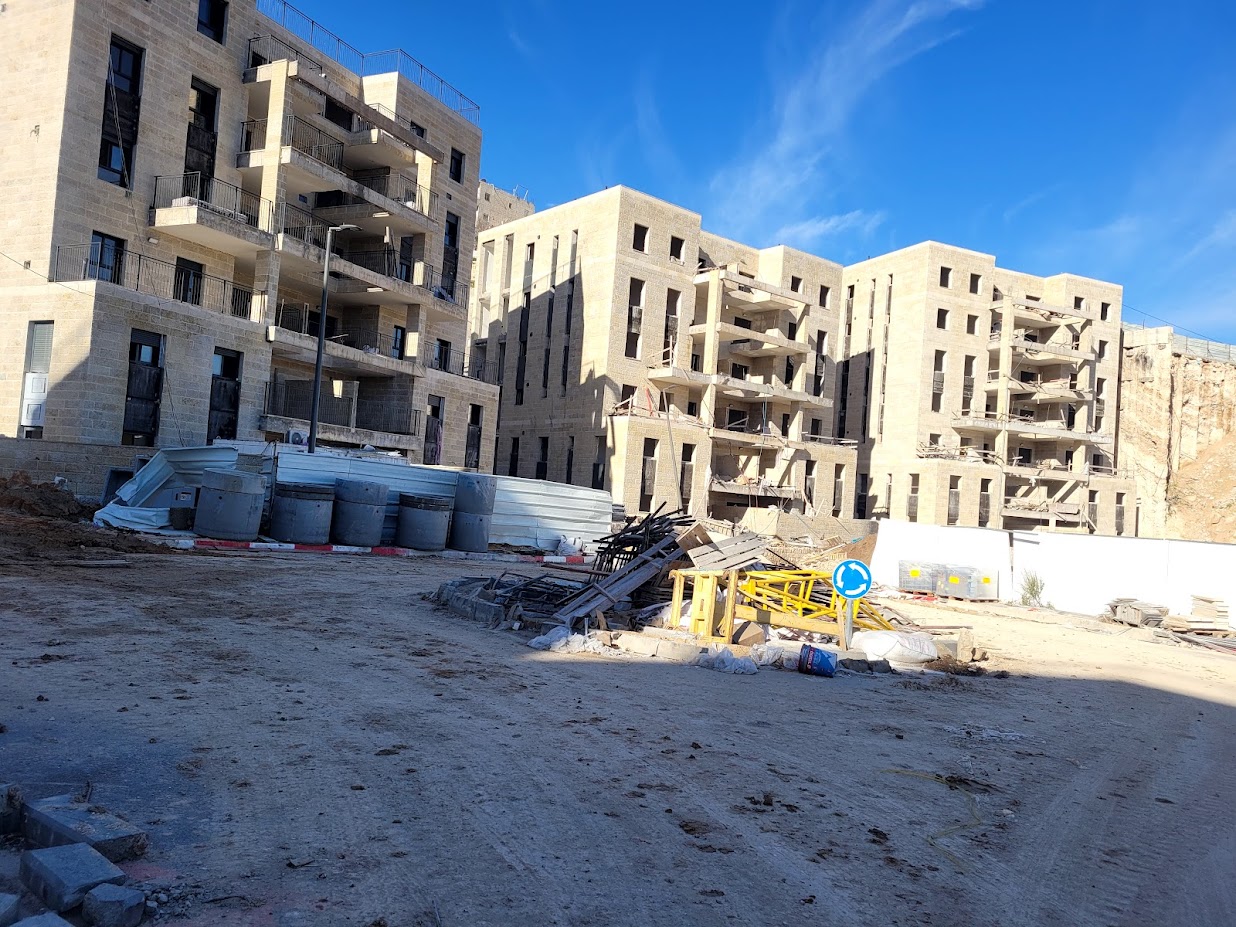
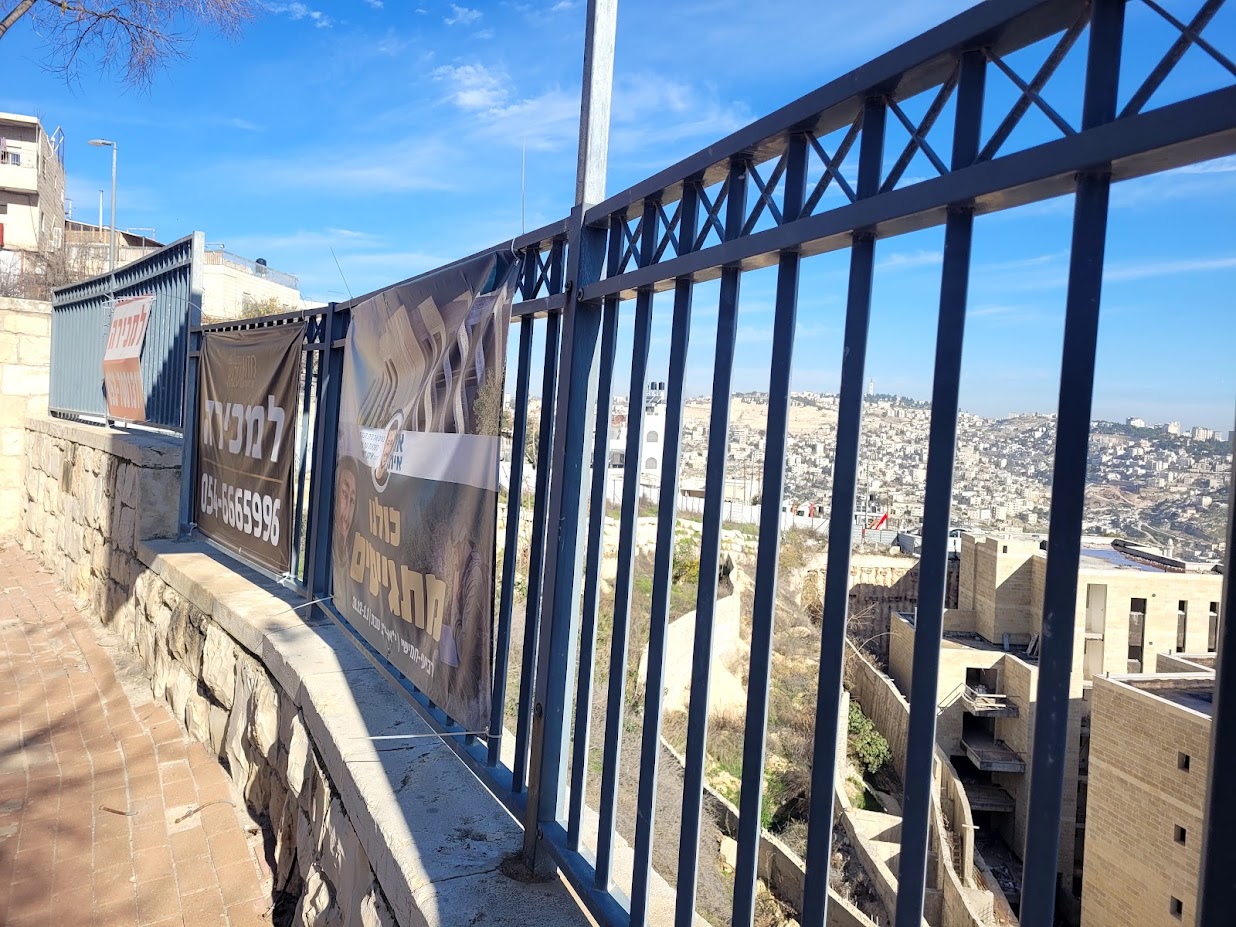
We met one of the Palestinian workers and spoke with him about the progress of construction at the massive site. We walked around a bit and took photos. While we were still there, a car arrived and the driver—apparently a security officer—politely explained that we were not allowed to be on the site “without appropriate clothing, shoes, and helmets,” and demanded that we leave. “We don’t have insurance for you, and what if, heaven forbid, you get hurt?” We understood the hint. We left and continued on our way.
We drove through Jabal Mukaber.
The neighborhood of Jabal Mukaber is in East Jerusalem, originally an Arab village that was annexed to the city. It is located on the eastern and northern slopes of Mount Etsel (or “Jabal Mukaber” in Arabic), founded by members of the Bedouin al-Sawahreh tribe. Municipally, the village is considered one of Jerusalem’s neighborhoods.
We continued along the American Road, the Eastern Ring Road, which is part of a ring road that cuts through Jerusalem via its eastern neighborhoods, running from north to south. It was paved with American funding during the period of Jordanian rule, hence its name.
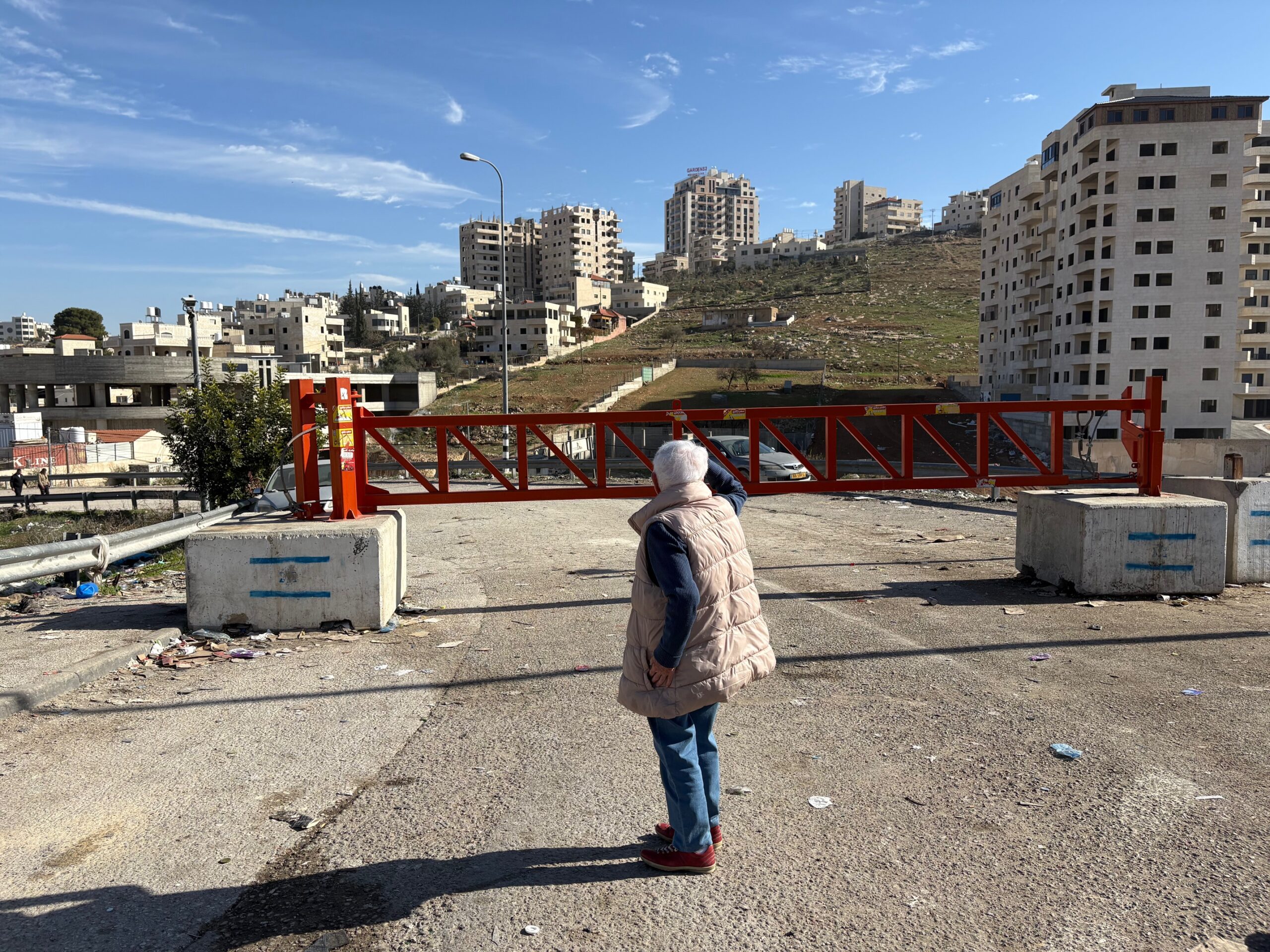
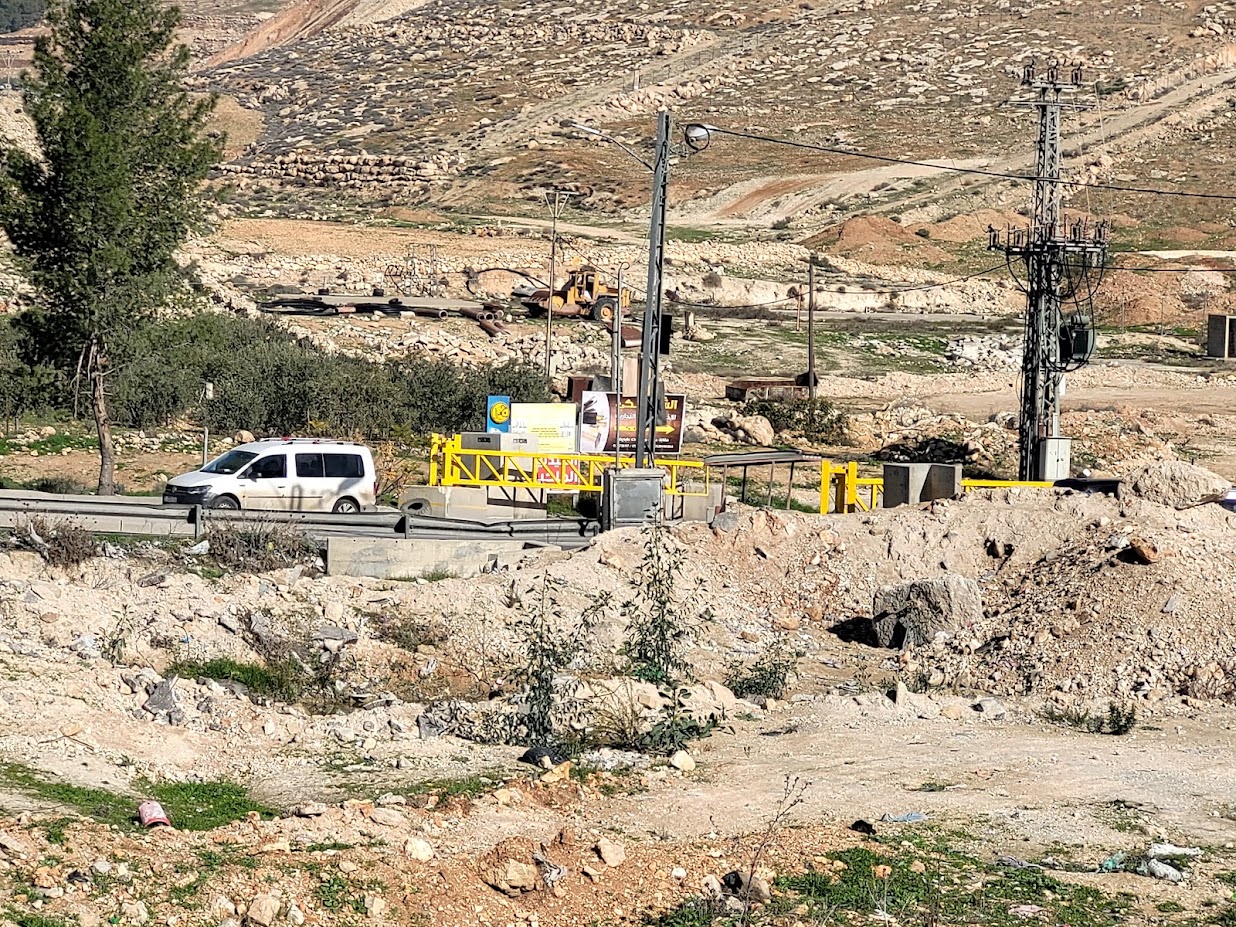
We reached Lieberman Road. Under pressure from residents of the Gush Etzion bloc, led by Avigdor Lieberman, who lives in the Nokdim settlement, the road was paved in order to prevent Gush Etzion residents from passing through Palestinian villages. The entrances to the villages along the way are closed—no one goes in or out. Near one of the checkpoints we met two despairing Palestinians who explained to us—what we of course already knew—how difficult the situation is.
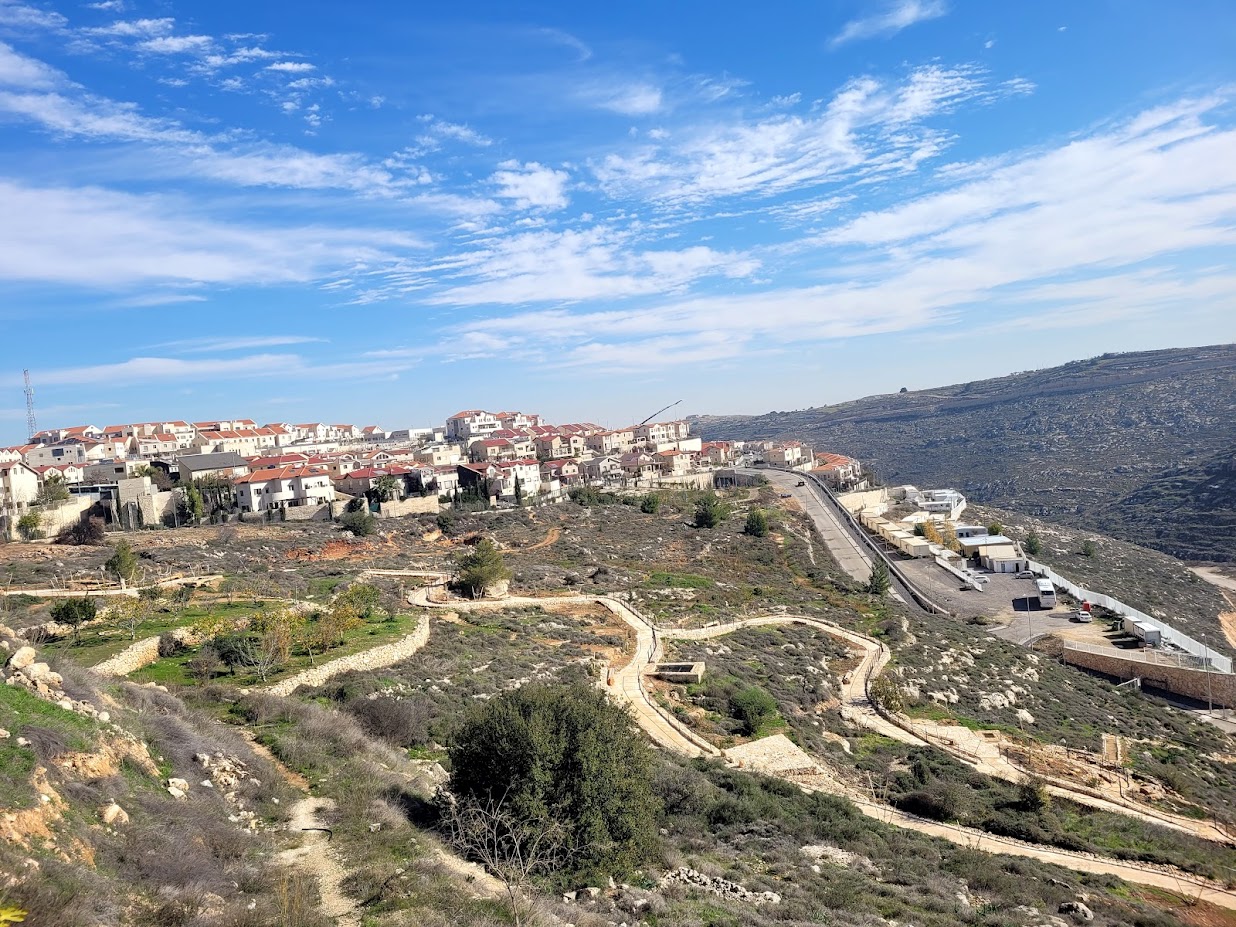
We continued to Efrat, which is expanding more and more. This expansion is part of a policy aimed at creating territorial continuity between the settlements of eastern Gush Etzion and strengthening Israeli control in the area.
We ended the tour with a visit to our long-time friend Nafuz. She is a widow, a mother of seven, whose home is under a demolition order that was approved—despite a humanitarian petition—by the Supreme Court.
The fear of a demolishon team’s arrival in the middle of the night has accompanied Nafuz for years. Over the years, following our appeals to MachsomWatch members abroad, she received interior renovations with the support of the AMOS association.
Her late husband, who was married to two women, left her completely destitute. She lives truly hand to mouth. We do our best to help her on a regular basis, to the extent that we can.
Location Description
Jabel Mukaber (Jerusalem)
See all reports for this place-
Jabal Mukaber is located on the eastern and northern slopes of Mount Atz (or "Jabal Mukaber" in its Arabic name). It was founded by the Bedouin tribe of Arab a-Sawahra. Today, the village is considered one of East Jerusalem neighborhoods. It numbers about 30,000 residents living on 1,010 dunams. The village has five main clans, numbering several hundred families. During the British Mandate, the tribe moved to live in a huge complex of permanent housing that was named as-Sawahra, with the part east of the Kidron Valley called as-Sawahra a-Sharqiya (Eastern Sawahra) and the western part – Sawahra al-Gharbiyya. The separation fence currently separates Jabal Mukaber from Sawahra a-Sharqiya.
The houses of Jabal Mukaber wrap around the ridge from the north and east, along one of the tributaries of the Kidron River. In the eastern part, the village houses border the Jewish East Talpiot neighborhood. most of the residents of the village are considered residents of Jerusalem, have blue identity cards and enjoy full civil rights in Israel, except for the right to vote for the Knesset and receive an Israeli passport.
The residents of Jabel Mukaber suffer from lack of Outline Plan for the village, overcrowding and a lack of residential and public spaces. Thus, there is a phenomenon of illegal construction in the neighborhood. Demolitions of houses without building permits have been carried out over the years, but since the 7th October War, their rate has increased.
In 2010, a wall was built separating it from its sub-neighborhood A-Sheikh Sa'ed. The wall left many residents with Palestinian IDs without Jerusalem residency and they lost their freedom of movement in Jerusalem.
In the northern part of the neighborhood, construction began in 2005 of a luxury Jewish neighborhood called Nof Zion. The neighborhood was planned to have about 400 housing units, a commercial center and a hotel. However, in April 2025, it was announced that it would be expanded. The apartments were marketed mainly to the religious community in the United States. Alongside the Nof Zion neighborhood, a plan is being promoted to establish the Nof Zahav neighborhood on state land in the Jabal Mukaber neighborhood. This plan also includes residential areas and hotels for tourists, and a place has been allocated for a synagogue, but not for the construction of a mosque.
During and after the Second Intifada, several residents of the neighborhood were involved in terrorist attacks: On March 6, 2008, the attack on Merkaz HaRav Yeshiva in the Kiryat Moshe neighborhood of Jerusalem, in which eight of the yeshiva's students were murdered; On November 18, 2014, an attack on the "Kehilat Bnei Torah" synagogue during morning prayers in the Har Nof neighborhood of Jerusalem; A resident of Jabal Mukaber carried out a car bombing on the Armon Hanatziv promenade. The terrorist drove his truck into a group of cadets. Updated April 2025
-