
Wadi Nar – have the instructions changed?


Shuafat refugee camp, Olive (Ras Abu Sbitan) checkpoint, Wadi Nar checkpoint
One of the goals of this morning’s shift was to check if there is any change or any effect on the conduct of checkpoints in Jerusalem due to the change of responsibilities after the elections, on the bodies that operate jointly – the border police and the police at the crossings (Ben Gvir), the Civil Administration (Smotrich), the IDF (Total responsibility for territory and security). We found the answer at the last checkpoint we visited – the Wadi Nar checkpoint (the container).
7:00 Shuafat refugee camp
There is a long traffic jam on the way out of the camp to Jerusalem. Every day, also today. The path leading the pedestrians to and from the checkpoint is very long. Why does the parking outside the checkpoint have to be so far, when a large area is unused on the western side of the checkpoint? Years have passed, and there is no other use for the empty space.
Beyond the Separation Wall, the built-up area of the refugee camp of Shuafat is within the urban border of Jerusalem, and only later is there a merger with the houses of the large village of Anata, Area B under Israeli security control. Those who live beyond the unmarked connection point are only entitled to a Palestinian identity card. The main road within the municipal area is very narrow and bumpy. Precisely in the area under the administrative responsibility of the Palestinian Authority the situation is improved.
On the way out of Anata, we notice the structure of a picturesque maqam on a hill above the Anata intersection, and Kamal takes us there. There are caves next to it and a green trail is marked on the rock. We are not sure if this is Israeli or Palestinian. The Maqam is not in use. People come to get some peace here sometimes.
Bulldozers are working on the road leading from the intersection to the settlement of Anaot. Kamal explains that there are traffic jams in the afternoon when the settlers return from Jerusalem to the north West Bank. At that time there is also Palestinian traffic from the Dead Sea area to the north West Bank villages. We would not be surprised if what is being done now is for the sake of separation. And that the movement of Palestinians will finally stop preventing the settlers from returning home quickly.
From there – to the olive checkpoint (Ras al Sabitan)
Eight in the morning, mainly students, patients, merchants, and others going out for various purposes – the workers go earlier. About 3,000 every morning. Depends on the condition of the checkpoint in Bethlehem. When there is a traffic jam is stuck – you drive more than half an hour to pass here. Two checkers move the people quickly.
We are waiting for Kamal on the Palestinian side (Area B) to drive south to the Wadi Nar checkpoint. I get the impression that there is a high and dense construction boom in al Eizariya. The plan is to move all Palestinian traffic to the south of the West Bank through the town and leave block E1 “clean” of Palestinians. It is not clear how the narrow Azaria roads will withstand the load – but maybe it is not interesting, because it is already a problem for the Palestinian Authority (if it survives).
9:00 Wadi Nar checkpoint (the Container)*
The Wadi Nar checkpoint is manned by the border police , Ben Gvir’s private army in the territories.
We arrived from al Ezariya to the checkpoint and stood by the open iron gate far from the inspection area. The traffic was slow. We photographed the checkpoint and the line of cars from a distance. Two Border Policemen immediately approached us in a panic and asked us to go back past the open gate. In the meantime, the inspectors stopped Palestinian traffic at the checkpoint.
At their request, we stepped back a few steps past the open gate, and in the process explained to the young soldiers that a checkpoint is an area that civilians pass through, unless a closed military area order is declared there, and that humanitarian organizations are allowed to watch and take pictures there.
After a few more minutes, a soldier and a soldier from the Special Forces arrived determined to evacuate us. They again stopped the passage of Palestinian traffic. This time they informed us that as Israelis, we are not allowed to stay in the entire area at all, and if we do not evacuate, they will evict us themselves. We asked if these were new instructions, but they claimed that they did not receive any, but this is the situation.
Is this a lack of knowledge on the part of the young soldiers, or has something changed in the instructions in the last few days, and is the IDF’s permission for humanitarian organizations to observe checkpoints without interfering with traffic or soldiers and even take pictures of them still valid, as it has been for all the years of our activities. We have to find what is happening..
We have been visiting the Wadi Nar checkpoint for more than 15 years. The checkpoint is for vehicles only and is located on the winding and steep road that connects Palestinian traffic between the North and South Banks. The checkpoint is Area C, like any IDF checkpoint, and the area around it is also under Israeli security control.
Al-'Eizariya
See all reports for this place-
Al-'Eizariya
At exit from Al-'Eizariya, before square leading to Maale Adumim. Mobile checkpoint (jeep and Border Police) operating till 09:00 am, facilitating traffic exiting Maale Adumin on three kilometer strip of road, also permissible for Palestinian vehicles. A similar checkpoint in the opposite direction, on road between Mishor Adumim and Adumim Junction. This checkpoint facilitates settler traffic on the Jerusalem-Jericho-Rift Valley road.
-
Checkpoint Shu'afat camp / Anata-Shu'afat (Jerusalem)
See all reports for this place-
The Shu’afat checkpoint is located in the northern part of East Jerusalem at the exit from the village of Anata and the Shu’afat refugee camp, which are located in the area annexed to Jerusalem in 1967. The refugee camp borders the Shu’afat neighborhood to the west, Pisgat Ze’ev to the north, the French Hill neighborhood to the south and the planned expansion of Ma’aleh Adumim to E-1 in the east. It was established in 1966 for 1948 refugees from the West Bank and was populated after the Six Day War by persons who had been expelled from the Jewish Quarter. Today its population comprises some 25,000 people holding blue ID cards and some 15,000 people with Palestinian ID cards. The camp lacks adequate infrastructure and services, and suffers from poverty, neglect and overcrowding. All its buildings are connected to the public electricity and water infrastructure, but not all are connected to the sewer system. The camp’s services are provided by UNRWA, except for those such as health clinics and transportation of pupils to schools in Jerusalem. In 2005, the Israeli High Court of Justice rejected a suit by the residents requesting that the route of the separation fence be drawn such that the camp would remain on the Israeli side, but conditioned its approval of the route on the establishment of a convenient and rapid crossing facility for the inhabitants of the neighborhood, most of whom are residents of Jerusalem.
A temporary checkpoint operated there until December, 2011. It was extremely congested during rush hours, and dangerous for pedestrians (especially children) because of inadequate safety provisions. The new checkpoint was inaugurated south of the old one, for public and private transportation and for pedestrians, intended solely for the residents of the camp – holders of blue ID cards, and those with Palestinian ID cards who possess appropriate permits. There are five vehicle inspection stations at the checkpoint, and two for pedestrians (one of which is currently closed) where scanners have been installed but are not yet operating. According to the army, representatives of government agencies will also be present to provide services to residents of the neighbourhood. The pedestrian lanes are very long, located far from the small parking lots, and accessible through only a single revolving gate.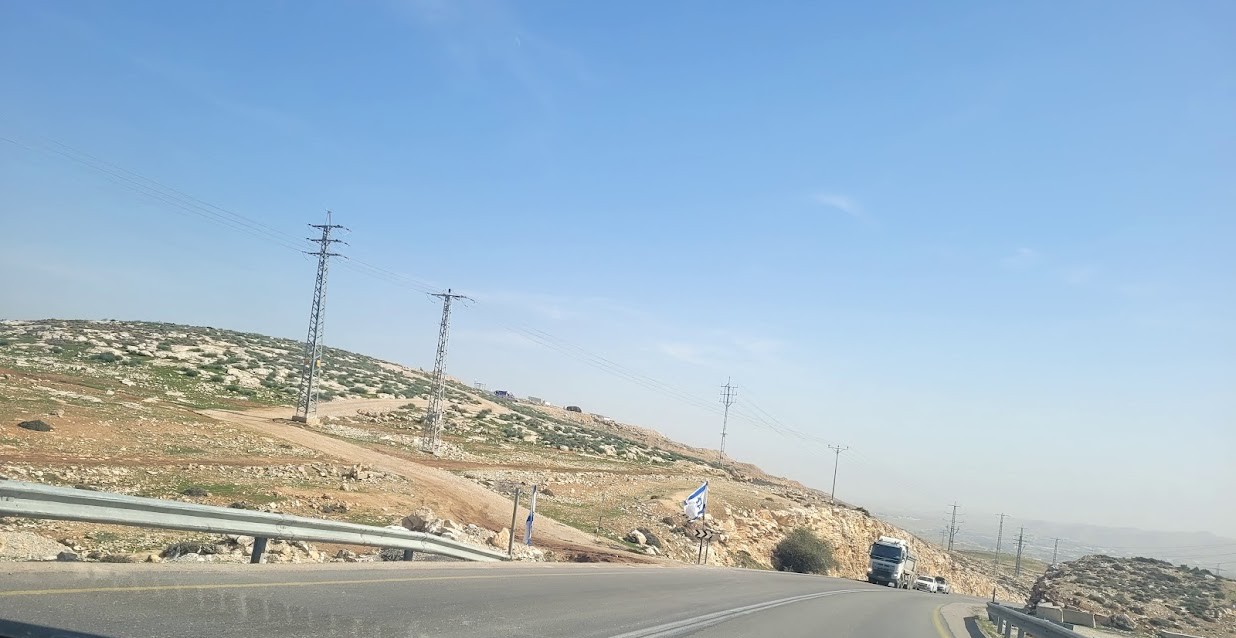 Anat TuegJan-25-2026Anata: A new outpost has been built south of the junction
-
Container (Wadi Nar)
See all reports for this place-
Wadi Nar Checkpoint ("Container", "The Kiosk") - a barrier for vehicles in Area B that is regularly manned - east of Abu Dis between Sawahra A Sharqiya and Bethlehem and its daughters. Controls Palestinian movement between the north and south West-Bank. Includes driving routes, access roads, spikes, traffic lights and signs. There is no pedestrian crossing. Open 24 hours a day with random checks enhanced on security alerts. The checkpoint is in Palestinian territory, allowing for separation between the north and the south Palestinian areas when necessary.
In 2015, the leading road from Azaria to Bethlehem was renovated, as well as the steep and narrow ascent to the Wadi Nar checkpoint, which was dangerously travelled in both directions! The temporary checkpoint was renovated and expanded, and pedestrian traffic was banned. From 2016, traffic travelling from the south bank to Azaria was directed to a one-way road near the Southern Keydar Jewish settlement.
Machsomwatch shifts visit this far-fetched checkpoint only occasionally.
(updated to July 2019)
-
Ras Abu Sbitan (Olive Terminal)
See all reports for this place-
A large checkpoint/crossing to the area of a-Tur, Abu Dis and the Old City; only for pedestrians. Located on Jerusalem’s municipal boundary.
One of the major crossings in Jerusalem’s central sector. It is located on the separation fence between the northern portion of the al-Ezariya neighborhood and the neighborhood of a-Tur and the rest of East Jerusalem. It is manned by Border Police soldiers and private security companies and operates 24 hours a day. Palestinians are forbidden to go through, other than permanent residents of East Jerusalem (holders of blue ID cards) and holders of work and commercial permits who are allowed through only on foot.
-