
Wadi Qadum: A house built in 2014, home to 100 people, is slated for demolition.
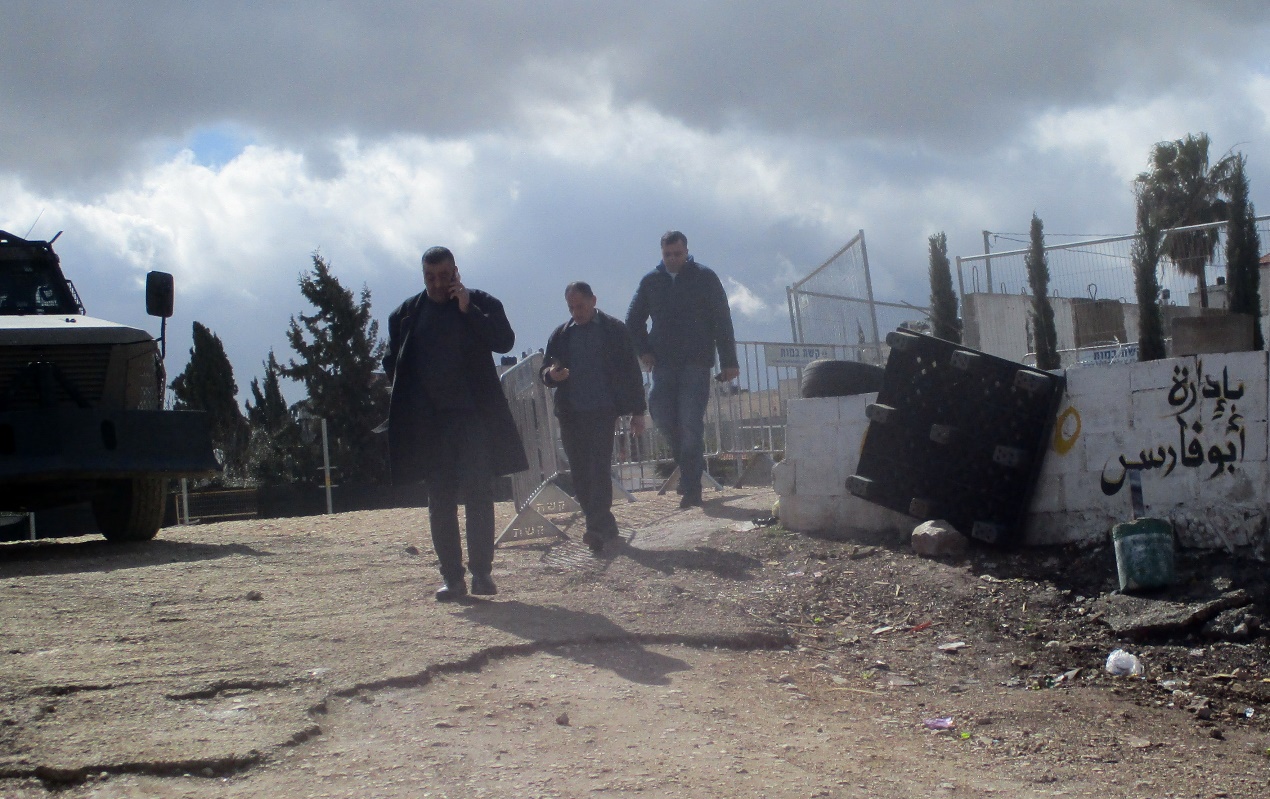
Sheikh Sa’ad – We were told that elementary school students are supposed to start their vacation only on June 20, but it seems that today they are not going to school in Jabal Mukaber. Only a few elderly women from Sheikh Sa’ad are passing through. Some of them are of an age that allows free passage (over 55), but they also need a permit proving they live in Sheikh Sa’ad. Only locals pass through here.
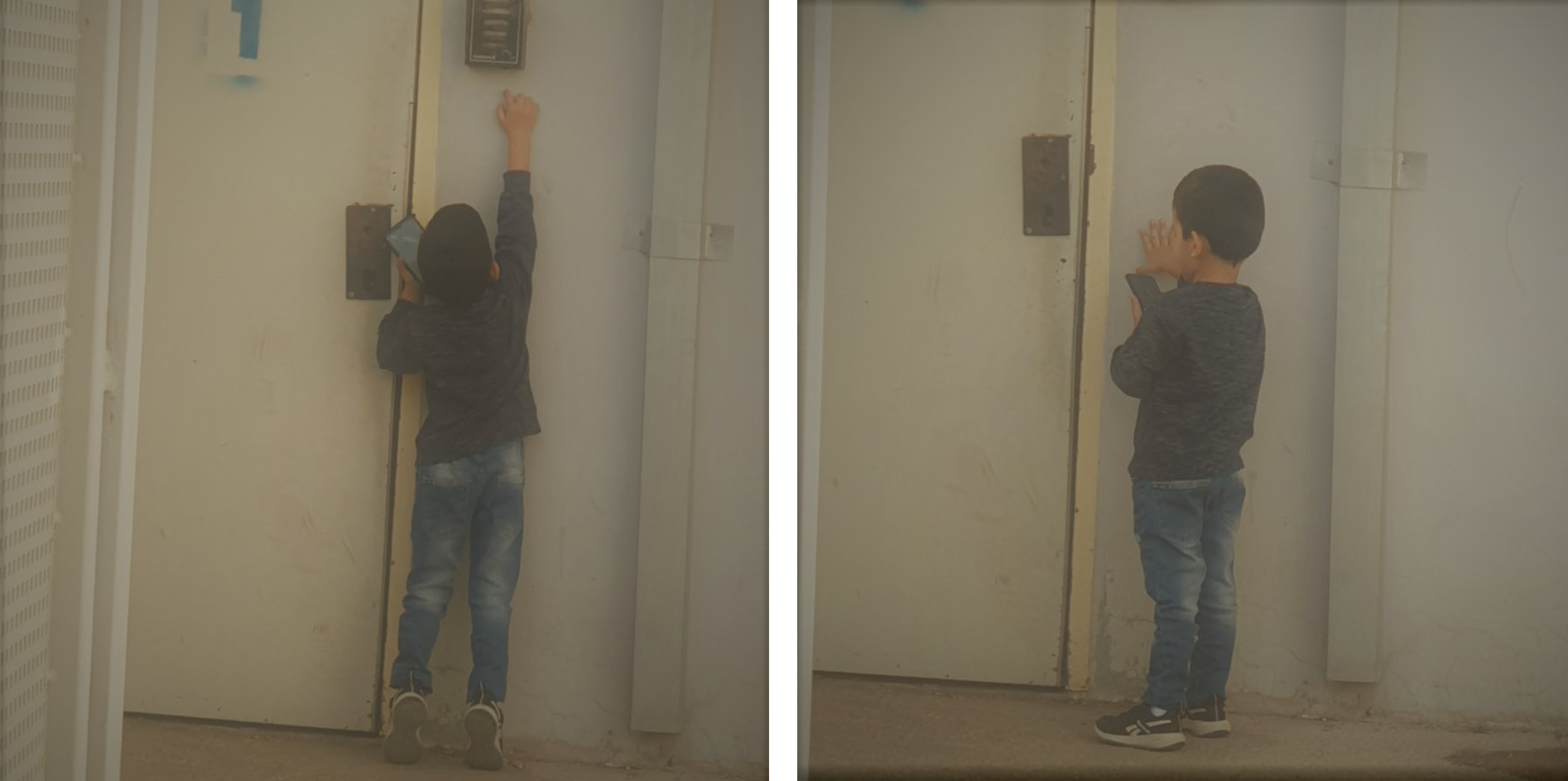
A mother, grandmother, and child entered the inspection booth. The child apparently came out alone in the middle of the women’s inspection, and the heavy door locked. He waited and waited and tried to open it. About 10 minutes passed before they came out. He didn’t cry, even though he was frightened – a child living among checkpoints…
Netanya talks with the women waiting for the bus to the Old City center. They say the crossing is “hik hik” – so-so, depending on the day, the luck, the soldiers.
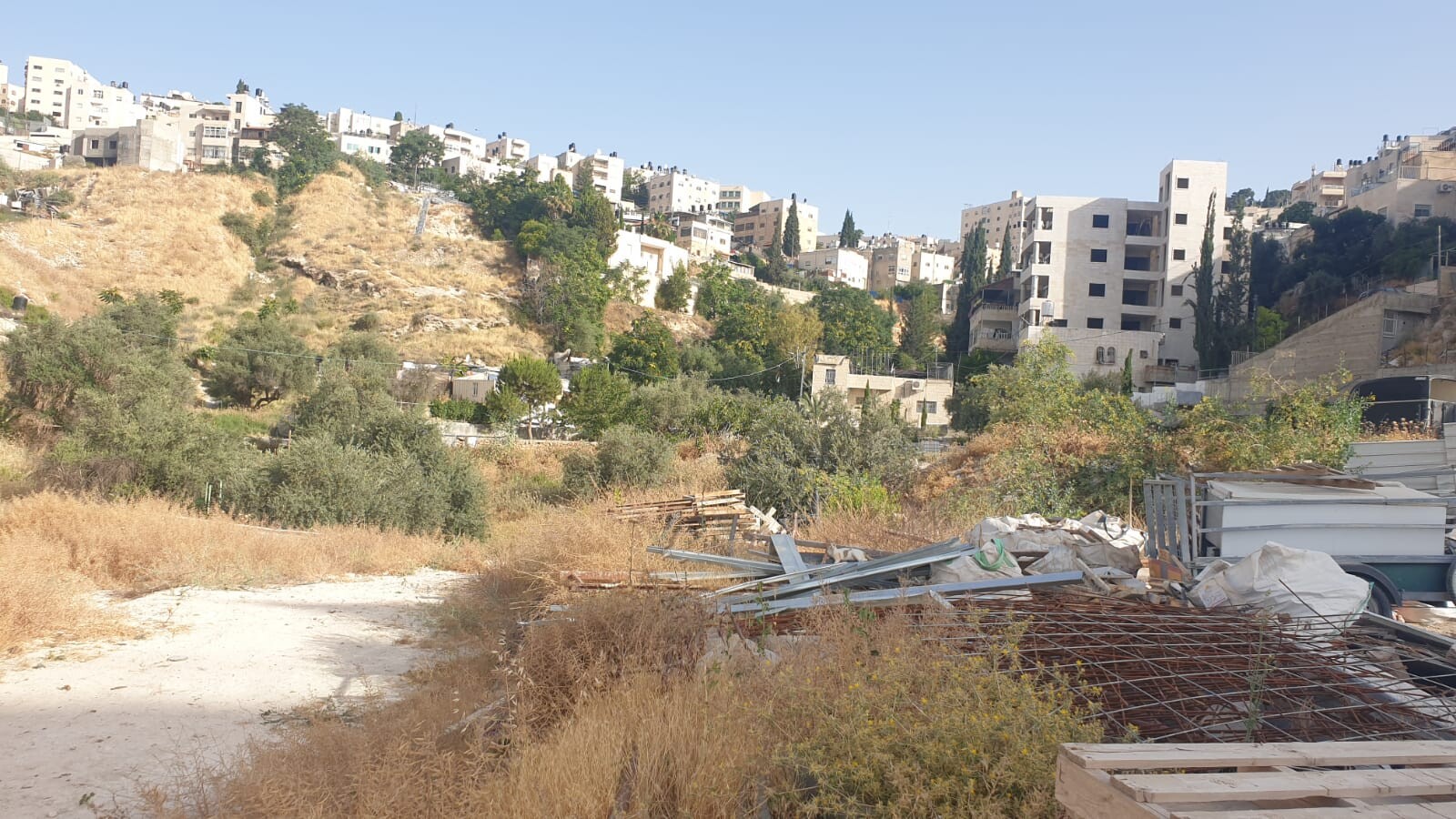
We receive from Aviv Tatarsky of Ir Amim the GPS coordinates of a house in Wadi Qadum (on the ascent to Ras al-Amud) that has received a new demolition order. Its residents are demonstrating today at noon at City Hall. It is a beautiful house of Jerusalem stone with elliptical balconies. It was built in 2014, 100 residents live there, and it has no permit (it is almost impossible to obtain a building permit in East Jerusalem).
This year the Custodian and the municipality launched a comprehensive operation to examine all permits and land registry (Tabu) records of all Palestinian houses in East Jerusalem in order to “make order” (that is, to evacuate and demolish). The location of the house is not a typical demolition site; it is situated in a wadi beneath the Mount of Olives, from where an apartheid tunnel is planned to be dug that will bring settlers from the southern West Bank to the roads of the northern West Bank. The municipality claims that the land is not zoned for housing but for sports, leisure, and recreation. It sounds like a cruel joke.
At the end of the shift, Netanya went to the residents’ demonstration in front of City Hall. She heard from the tenants that the contractor promised the permit would come and didn’t deliver. They are literally begging Moshe Lion to have mercy on the families who will be left without a home.

We go up to Abu Dis to see how the wall cutting through the neighborhood is doing – the graffiti artists have abandoned the wall that had become a symbol, and it remains a depressing gray. Another sign of profound Palestinian despair.
We decide to skip the Olive checkpoint and drive to the school in Nabi Musa to say hello to the teachers and students before summer vacation. But the school is locked from the outside; the residents of the Nabi Samuel enclave belong to the Palestinian Authority, and Kamal says that the Authority has several different dates for the start of summer vacation.
We walk around the area a bit and meet a man who shares part of a building with his four brothers and their families, which his father sold to settlers years ago. The building is used only for celebrations and religious seminars, and an ominous antenna stands on its roof. He says he hopes they won’t demolish the beginning of construction on his orchard land (perhaps because of the cooperation with the settlers?). With a bitter smile he tells us that in his opinion all the Palestinians’ troubles began when Arafat and the Palestinian Authority arrived in the West Bank. Until then everything was fine – no checkpoints, no attacks, quiet lives. We are stunned by this interpretation, which places the blame for the occupation on the Palestinians themselves. It is disturbing that even Kamal, our driver, expresses contempt regarding the hope for a Palestinian state led by the Authority, which does not take care of its residents at all. There is no future, they both say. We’re completely screwed.
The last stop is a view from the houses of old Kafr Qalandiya toward the plowed airport field of Atarot, whose eastern part has become a bus parking area. The realization drops visually – the enormous pedestrian bridge leading to the Qalandiya checkpoint arrives at vast parking lots for tourist buses, Palestinian buses, and Egged buses. Why didn’t they build the parking near the checkpoint for those leaving Ramallah and returning from Jerusalem? Hana asks not to ask stupid questions…
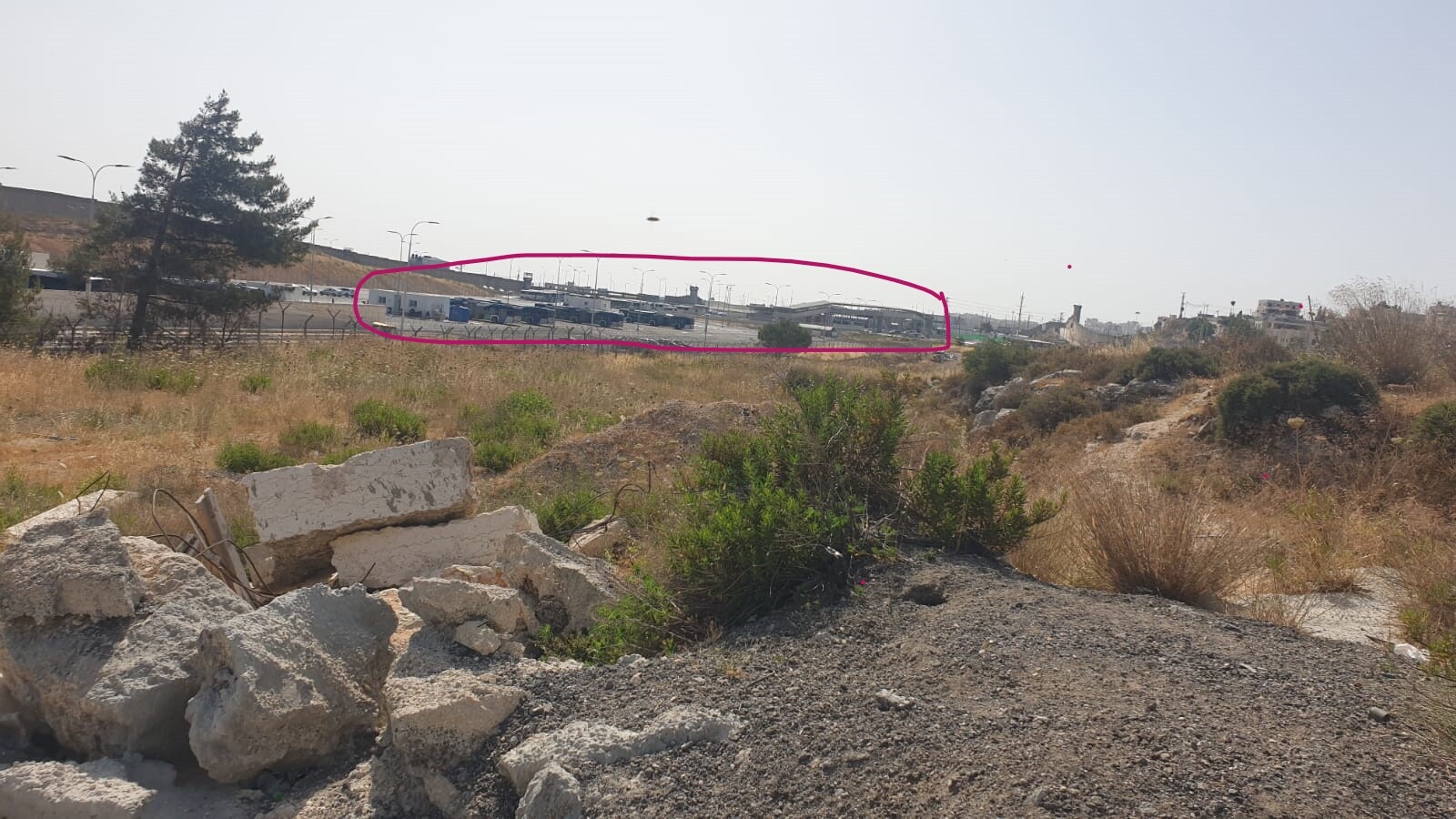
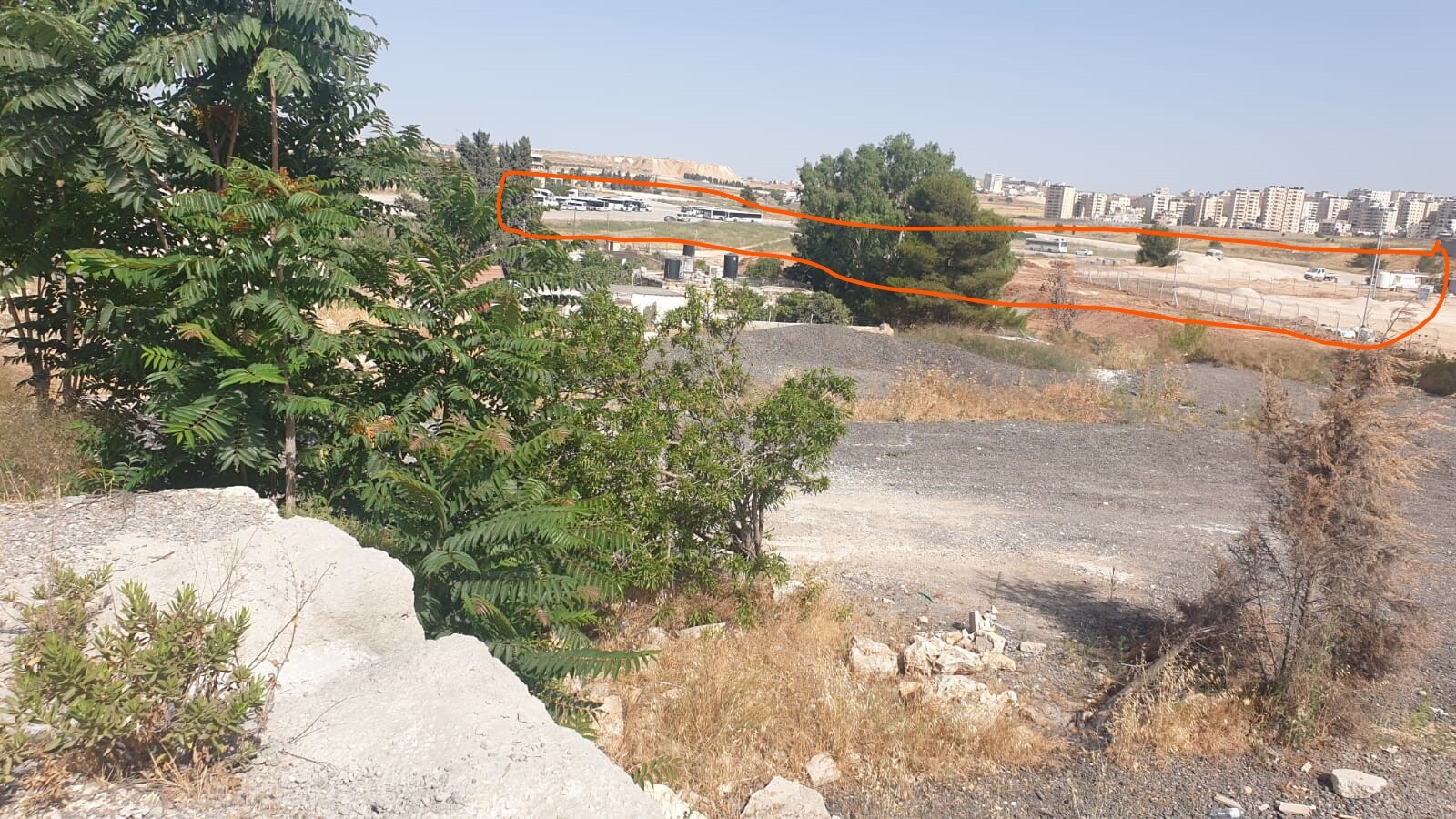
The enormous bridge leading pedestrians to the Qalandiya checkpoint connects to a bus parking lot.
On the western part of the route, the control tower still stands. In this entire area a very large Jewish neighborhood (probably ultra-Orthodox) is planned. At the moment there is an injunction halting the continuation of the planning approval process. They are waiting for the right moment. Don’t worry — such moments always arrive.
Location Description
Abu Dis / Lazarus gate (formerly The Wicket)
See all reports for this place-
Abu Dis / Lazarus Checkpoint/Gate (east of the former “wicket”)
Construction of the wall in the Abu Dis area blocked all the gaps that allowed people to cross from al-Ezariya to the neighbourhoods of Abu Dis and Ras al 'Amud that are located within Jerusalem’s municipal boundary. The Lazarus checkpoint is a gate in the wall adjacent to the Lazarus Monastery. Until 2011 it had a door for pilgrims to al-Ezariya and for the monastery’s kindergarten pupils from al-Ezariya. The crossing is currently closed, but the site has infrastructure for conducting inspections.
-
Qalandiya Checkpoint / Atarot Pass (Jerusalem)
See all reports for this place-
Click here to watch a video from Qalandiya checkpoint up to mid 2019 Three kilometers south of Ramallah, in the heart of Palestinian population. Integrates into "Jerusalem Envelope" as part of Wall that separates between northern suburbs that were annexed to Jerusalem in 1967: Kafr Aqab, Semiramis and Qalandiya, and the villages of Ar-Ram and Bir Nabala, also north of Jerusalem, and the city itself. Some residents of Kafr Aqab, Semiramis and Qalandiya have Jerusalem ID cards. A terminal operated by Israel Police has functioned since early 2006. As of August 2006, northbound pedestrians are not checked. Southbound Palestinians must carry Jerusalem IDs; holders of Palestinian Authority IDs cannot pass without special permits. Vehicular traffic from Ramallah to other West Bank areas runs to the north of Qalandiya. In February 2019, the new facility of the checkpoint was inaugurated aiming to make it like a "border crossing". The bars and barbed wire fences were replaced with walls of perforated metal panels. The check is now performed at multiple stations for face recognition and the transfer of an e-card. The rate of passage has improved and its density has generally decreased, but lack of manpower and malfunctions cause periods of stress. The development and paving of the roads has not yet been completed, the traffic of cars and pedestrians is dangerous, and t the entire vicinity of the checkpoint is filthy. In 2020 a huge pedestrian bridge was built over the vehicle crossing with severe mobility restrictions (steep stairs, long and winding route). The pedestrian access from public transport to the checkpoint from the north (Ramallah direction) is unclear, and there have been cases of people, especially people with disabilities, who accidentally reached the vehicle crossing and were shot by the soldiers at the checkpoint. In the summer of 2021, work began on a new, sunken entrance road from Qalandiya that will lead directly to Road 443 towards Jerusalem and Tel Aviv. At the same time, the runways of the old Atarot airport were demolished and infrastructure was prepared for a large bus terminal. (updated October 2021)
 Tamar FleishmanFeb-27-2026Qalandiya: On the way to prayer
-
Sheikh Sa'ed
See all reports for this place-
A checkpoint limited to pedestrians, located on Jerusalem’s municipal boundary.
The checkpoint sits on the separation fence at the entrance to Sheikh Sa’ad, dividing it from its neighbourhood of Jabel Mukkabar. It’s manned by Border Police soldiers and private security companies and operates 24 hours a day. Palestinians are forbidden to go through, other than residents of Jabel Mukkabar or Sheikh Sa'ad who have permits. Both groups are permitted through only on foot. Residents of East Jerusalem who don’t live in Jabel Mukkabar are also allowed to cross to Sheikh Sa’ad, but not in the opposite direction; they must return through the Sawahira ash Sharqiya checkpoint.
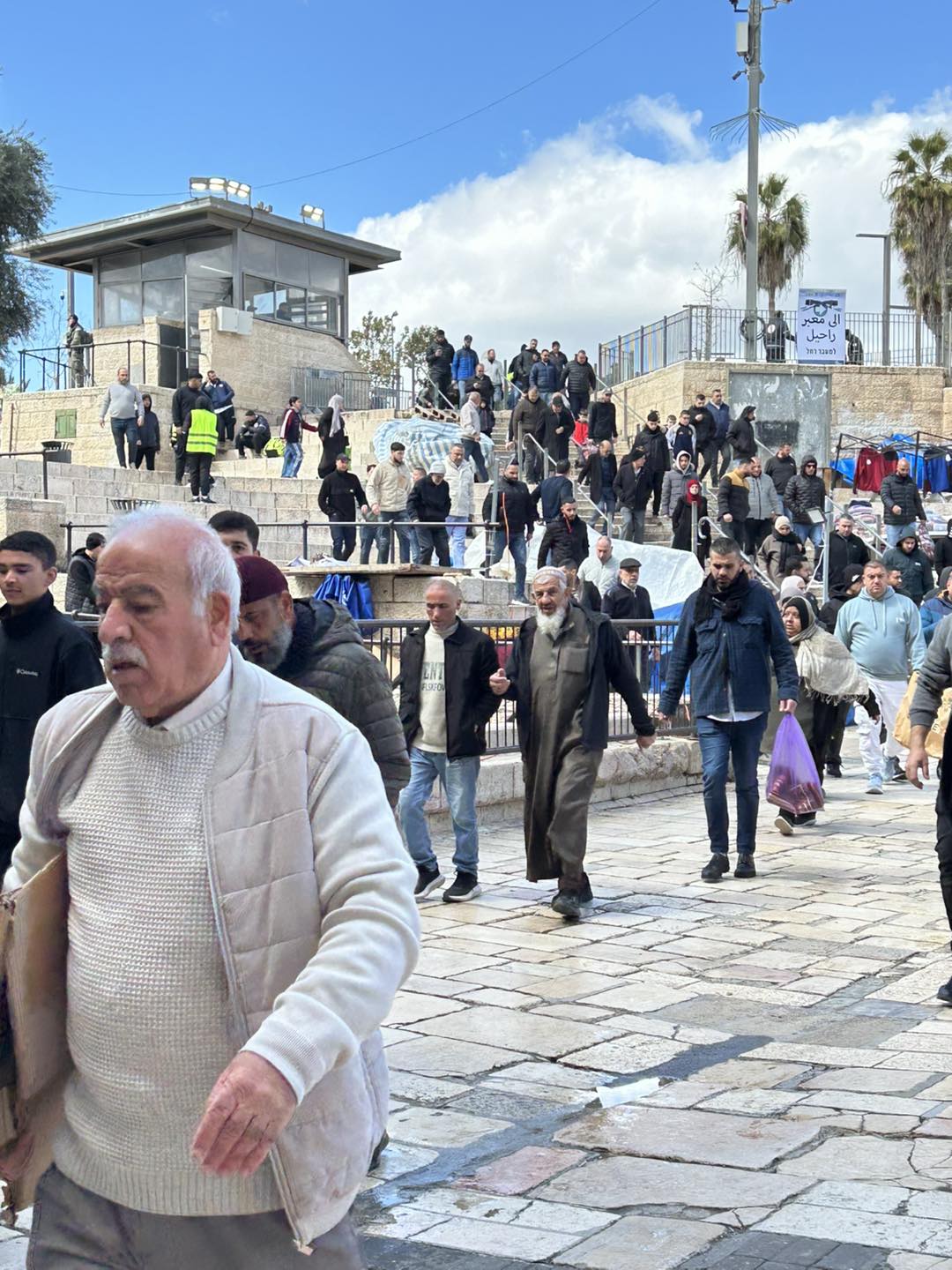 Avital CFeb-27-2026Jerusalem, Damascus Gate: Crowd rushing to prayer
-