
Qalandiya, Third Ramadan Friday
Silently restrictions piled up until they became a literal tower.
Instructions pile up high, and one can only wonder whose warped mind thought up this pile.
Those in charge, army men, have no idea or opinion about the essence of their activity, only blind obedience and the ever-repeated “we’re just following orders”, no standing behind their word and/or deed, no historical memory nor echoes of a different time and place.
Who’s above and who’s below:
Those arriving at the checkpoint are ‘welcomed’ by an armed soldier placed above their heads. He is stationed inside a fortified tower at the entrance to the “sterile” compound, clear of any Palestinian touch.
The differences in height define and wordlessly emphasize the common hierarchy of ruler and ruled.

Three iron rules enable passage to the Friday prayers at Al Aqsa Mosque – age, prayer permit and magnetic card – and now there are sub-rules.
Both kinds share a single purpose – to reduce as much as possible the number of people observing the Friday prayer edict at their highest place of worship.
Thus:
- The grandfather arriving at the first inspection post with his two grandchildren who are not yet ten years old was told that every senior may only get through with one child, so the grandfather must choose which of the two will be turned back, and who will continue. Is this a variation on Sophie’s Choice?
- A woman of the right age, holding a prayer permit and magnetic card was turned back shame-facedly because she showed a permit issued a week ago, and the sub-rule demands that such a permit be valid only for the required day of passage. Thus, just as the age must be exactly 55, not a day less, the same must be implemented regarding the paper permit issued neither for the previous nor the coming week. Precision, only precision.
- Following the rules is top priority at all times.
Who and what were seen, and no less important – who and what were not:
Scant passersby traffic in the only gate (unlike the many gates in previous years) to the compound in which the ‘fishermen’s net’ is practiced – that meticulous censure apparatus.
At the second inspection post, in the ‘sterile’ area free of Palestinians, a repeated, exact inspection (only according to instructions) is held. Whoever is found illegible and must be turned back is yelled at: “Go on, beat it, to your left!” and pushed back to the track leading back.


The grandmother who couldn’t and wouldn’t separate her two grandchildren who are not yet ten years old did not take part in this dirty game and turned back with both.

Rather desolate was also the gate which laundered language targeted as a ‘humanitarian crossing’. Most of the time the door was closed and those answering the criteria had to knock and yell until the gate was opened and the man/woman was inspected and let through.
Totally desolate and locked – they seemed to be part of the wall around the checkpoint – were the three gates facing north towards the refugee camp, which in previous years were buzzing with thousands of women.


Qalandiya Checkpoint / Atarot Pass (Jerusalem)
See all reports for this place-
Click here to watch a video from Qalandiya checkpoint up to mid 2019 Three kilometers south of Ramallah, in the heart of Palestinian population. Integrates into "Jerusalem Envelope" as part of Wall that separates between northern suburbs that were annexed to Jerusalem in 1967: Kafr Aqab, Semiramis and Qalandiya, and the villages of Ar-Ram and Bir Nabala, also north of Jerusalem, and the city itself. Some residents of Kafr Aqab, Semiramis and Qalandiya have Jerusalem ID cards. A terminal operated by Israel Police has functioned since early 2006. As of August 2006, northbound pedestrians are not checked. Southbound Palestinians must carry Jerusalem IDs; holders of Palestinian Authority IDs cannot pass without special permits. Vehicular traffic from Ramallah to other West Bank areas runs to the north of Qalandiya. In February 2019, the new facility of the checkpoint was inaugurated aiming to make it like a "border crossing". The bars and barbed wire fences were replaced with walls of perforated metal panels. The check is now performed at multiple stations for face recognition and the transfer of an e-card. The rate of passage has improved and its density has generally decreased, but lack of manpower and malfunctions cause periods of stress. The development and paving of the roads has not yet been completed, the traffic of cars and pedestrians is dangerous, and t the entire vicinity of the checkpoint is filthy. In 2020 a huge pedestrian bridge was built over the vehicle crossing with severe mobility restrictions (steep stairs, long and winding route). The pedestrian access from public transport to the checkpoint from the north (Ramallah direction) is unclear, and there have been cases of people, especially people with disabilities, who accidentally reached the vehicle crossing and were shot by the soldiers at the checkpoint. In the summer of 2021, work began on a new, sunken entrance road from Qalandiya that will lead directly to Road 443 towards Jerusalem and Tel Aviv. At the same time, the runways of the old Atarot airport were demolished and infrastructure was prepared for a large bus terminal. (updated October 2021)
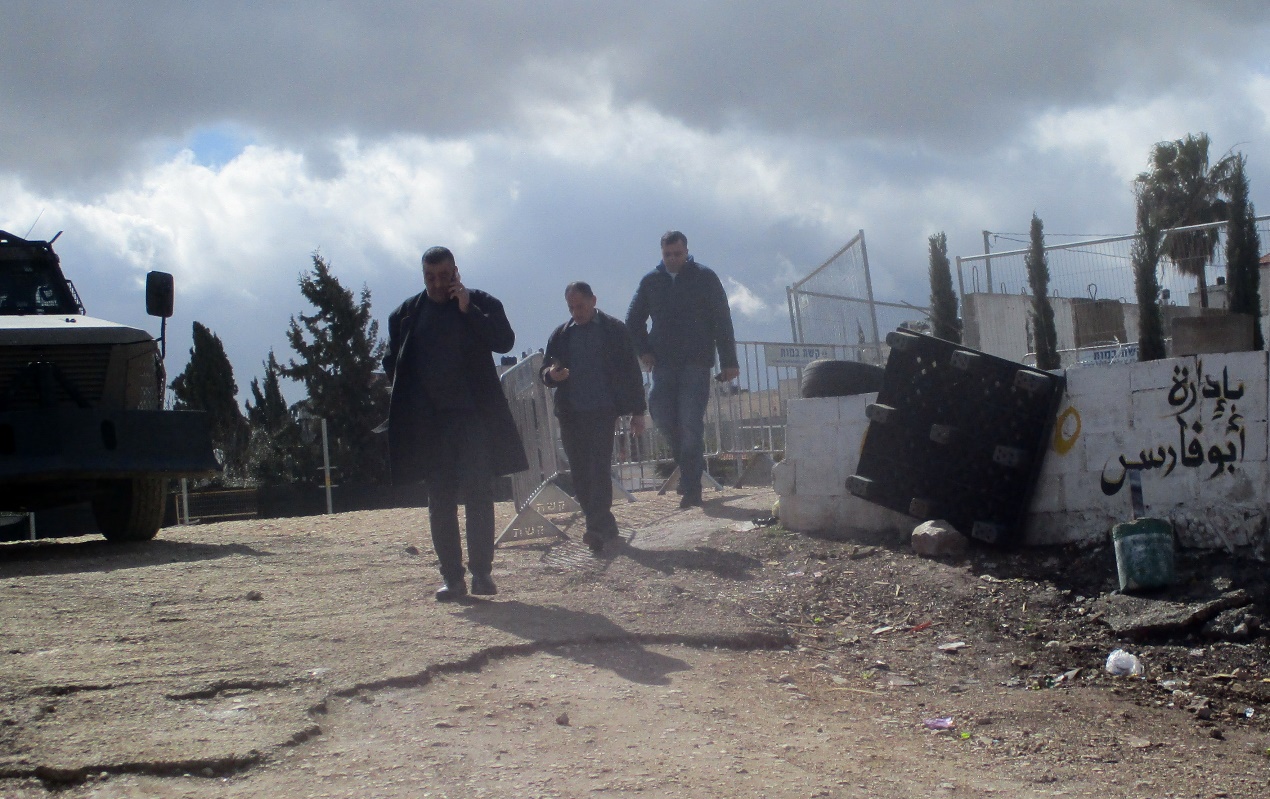 Tamar FleishmanFeb-27-2026Qalandiya: On the way to prayer
-