
Qalandiya - after the closure and before Ramadan. Hizma - show of presence

“It’s because there was a holiday”, the medical transport driver explained the large number of people, mostly children and their mothers, in the large bus headed for Gaza.
What I call closure he, not a Jew and obliged to be much more careful, calls a holiday.
The man collected all the IDs and permits and turned them into a package taken (in custody) from their owners for safekeeping until they reach Gaza.
Why custody? For fear that any of them might escape.
And how would any of them escape? Let’s say one of them would need to urinate on the way, and let’s assume – the unlikely – that he be allowed to do it by the side of the road, and let’s say the child and his mother would disembark and begin to run away – then this would keep it from happening…

“This is for Ramadan” a Palestinian explained that which needs no explanation, when the Border Police officers patrolled the area.
“May I ask a question or two?” I turned to them, but they had neither the time nor the will to listen, certainly not to answer, only this: “There will be lightened conditions during Ramadan”, said the senior officer among them.

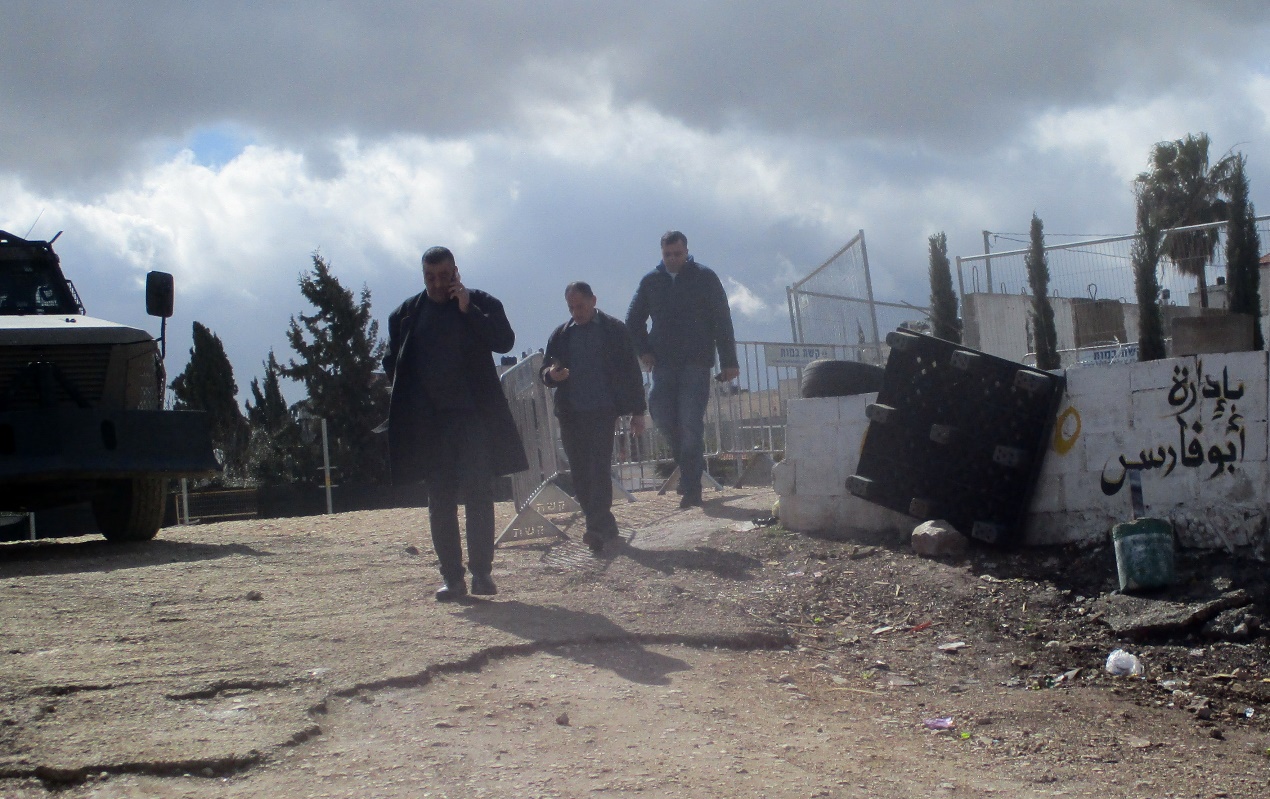
The Israeli army’s presence in Hizme has long since become a part of the landscape.
The activity which the soldiers call “show of presence” also has the title borrowed from the Israeli army lexicon: “To keep the local population in constant uncertainty”.
At all hours of the day, a manned military vehicle, its engine running, is parked at the entrance to the village, at times just to scare people, and at others while blocking the road.
Either way, towards the day’s end, at sundown, the soldiers enter the village, brakes screeching through the streets and alleys, at times they invade homes and arrest young or less young men, show presence and terrorize everyone there.
Hizma
See all reports for this place-
Hizma
A checkpoint at the north-eastern entrance to the Jerusalem area which was annexed in 1967, at Pisgat Zeev. The passage is allowed to bearers of blue IDs only. Open 24 hours a day.
-
Qalandiya Checkpoint / Atarot Pass (Jerusalem)
See all reports for this place-
Click here to watch a video from Qalandiya checkpoint up to mid 2019 Three kilometers south of Ramallah, in the heart of Palestinian population. Integrates into "Jerusalem Envelope" as part of Wall that separates between northern suburbs that were annexed to Jerusalem in 1967: Kafr Aqab, Semiramis and Qalandiya, and the villages of Ar-Ram and Bir Nabala, also north of Jerusalem, and the city itself. Some residents of Kafr Aqab, Semiramis and Qalandiya have Jerusalem ID cards. A terminal operated by Israel Police has functioned since early 2006. As of August 2006, northbound pedestrians are not checked. Southbound Palestinians must carry Jerusalem IDs; holders of Palestinian Authority IDs cannot pass without special permits. Vehicular traffic from Ramallah to other West Bank areas runs to the north of Qalandiya. In February 2019, the new facility of the checkpoint was inaugurated aiming to make it like a "border crossing". The bars and barbed wire fences were replaced with walls of perforated metal panels. The check is now performed at multiple stations for face recognition and the transfer of an e-card. The rate of passage has improved and its density has generally decreased, but lack of manpower and malfunctions cause periods of stress. The development and paving of the roads has not yet been completed, the traffic of cars and pedestrians is dangerous, and t the entire vicinity of the checkpoint is filthy. In 2020 a huge pedestrian bridge was built over the vehicle crossing with severe mobility restrictions (steep stairs, long and winding route). The pedestrian access from public transport to the checkpoint from the north (Ramallah direction) is unclear, and there have been cases of people, especially people with disabilities, who accidentally reached the vehicle crossing and were shot by the soldiers at the checkpoint. In the summer of 2021, work began on a new, sunken entrance road from Qalandiya that will lead directly to Road 443 towards Jerusalem and Tel Aviv. At the same time, the runways of the old Atarot airport were demolished and infrastructure was prepared for a large bus terminal. (updated October 2021)
 Tamar FleishmanFeb-27-2026Qalandiya: On the way to prayer
-