
Qalandiya, Fourth Friday of Ramadan month
Palestinian presence at the checkpoint on this last Friday of the Ramadan month is sparser than on the previous Fridays. It is always like this.

Perhaps because many who managed to reach Al Aqsa on Leilet Al Qadr did not return to the West Bank and perhaps because one never knows what might happen and prefers to take advantage of one’s privilege to enter and not await one’s last opportunity for this year.
Armed forces, on the other hand, were very heavily present. There were plenty of military police, civilian police (‘blues’), Border Police, special police units, Civil Administration, as well as an auxiliary addition from the Air Force. Perhaps from other forces as well. Among this vast forest of khaki and black, all in uniforms and shielded and armed, it is difficult to tell them apart.
The atmosphere among the Border Policemen, responsible for the men’s crossing – or non-crossing – was, as army lingo has it, ‘end of training atmosphere’. They scorned and insulted and pushed and shoved. They also hit and kicked young men who did not pass the age test. This, their violence, they carried out at the top of the hill, at a half-hidden spot, between two concrete blocks. Once in a while people standing below noticed an army leg kicking a civilian one, and an army hand shoving a civilian body.
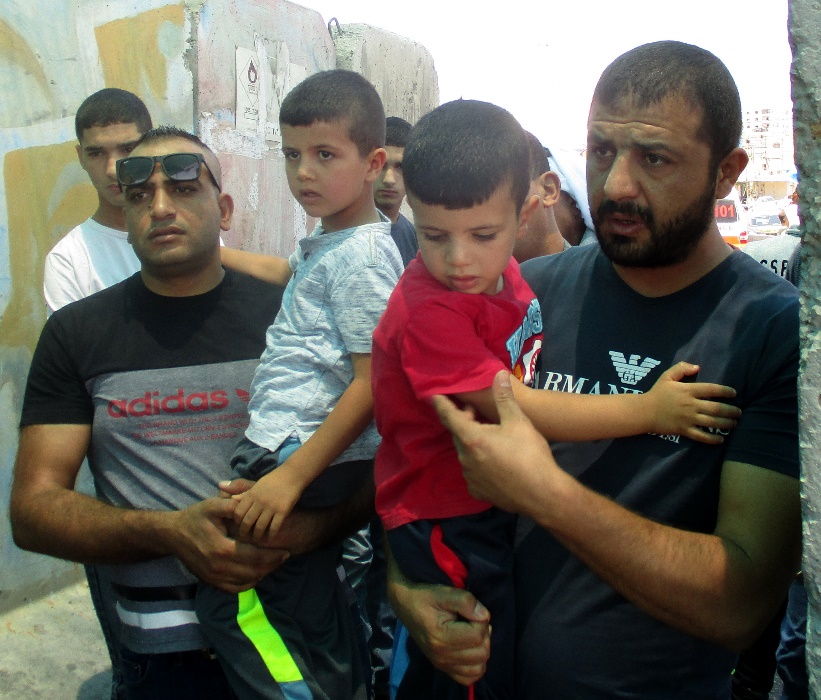
A resident of Jenin refugee camp in his twenties who fell victim to this violence shared his personal experience with us.
“One cannot give one’s memory orders” (Philippe Claudel, Brodeck’s Report).
One memory, of the second Friday of Ramadan, haunts me. It is my memory of a man. At the corner of the inner wall that surrounds the huge sterile area there is a very narrow opening through which whoever were caught just at the end of the selection process are turned away. Two soldiers guarded this opening. “No entry here. Only exit”.
People who crossed this line of no-return left, their paces heavy, their faces twisted.
Only one man, in his thirties, walking with his two children, a girl and a boy ages five and six, arrived here limp and smiling, instructed the children to approach the soldiers and shake their hand, and he himself approached, bowed servily, greeted the two submissively, and left.
I recalled stories of Jews dancing submissively for the local baron, and left, my paces heavy, as was my heart.
Qalandiya Checkpoint / Atarot Pass (Jerusalem)
See all reports for this place-
Click here to watch a video from Qalandiya checkpoint up to mid 2019 Three kilometers south of Ramallah, in the heart of Palestinian population. Integrates into "Jerusalem Envelope" as part of Wall that separates between northern suburbs that were annexed to Jerusalem in 1967: Kafr Aqab, Semiramis and Qalandiya, and the villages of Ar-Ram and Bir Nabala, also north of Jerusalem, and the city itself. Some residents of Kafr Aqab, Semiramis and Qalandiya have Jerusalem ID cards. A terminal operated by Israel Police has functioned since early 2006. As of August 2006, northbound pedestrians are not checked. Southbound Palestinians must carry Jerusalem IDs; holders of Palestinian Authority IDs cannot pass without special permits. Vehicular traffic from Ramallah to other West Bank areas runs to the north of Qalandiya. In February 2019, the new facility of the checkpoint was inaugurated aiming to make it like a "border crossing". The bars and barbed wire fences were replaced with walls of perforated metal panels. The check is now performed at multiple stations for face recognition and the transfer of an e-card. The rate of passage has improved and its density has generally decreased, but lack of manpower and malfunctions cause periods of stress. The development and paving of the roads has not yet been completed, the traffic of cars and pedestrians is dangerous, and t the entire vicinity of the checkpoint is filthy. In 2020 a huge pedestrian bridge was built over the vehicle crossing with severe mobility restrictions (steep stairs, long and winding route). The pedestrian access from public transport to the checkpoint from the north (Ramallah direction) is unclear, and there have been cases of people, especially people with disabilities, who accidentally reached the vehicle crossing and were shot by the soldiers at the checkpoint. In the summer of 2021, work began on a new, sunken entrance road from Qalandiya that will lead directly to Road 443 towards Jerusalem and Tel Aviv. At the same time, the runways of the old Atarot airport were demolished and infrastructure was prepared for a large bus terminal. (updated October 2021)
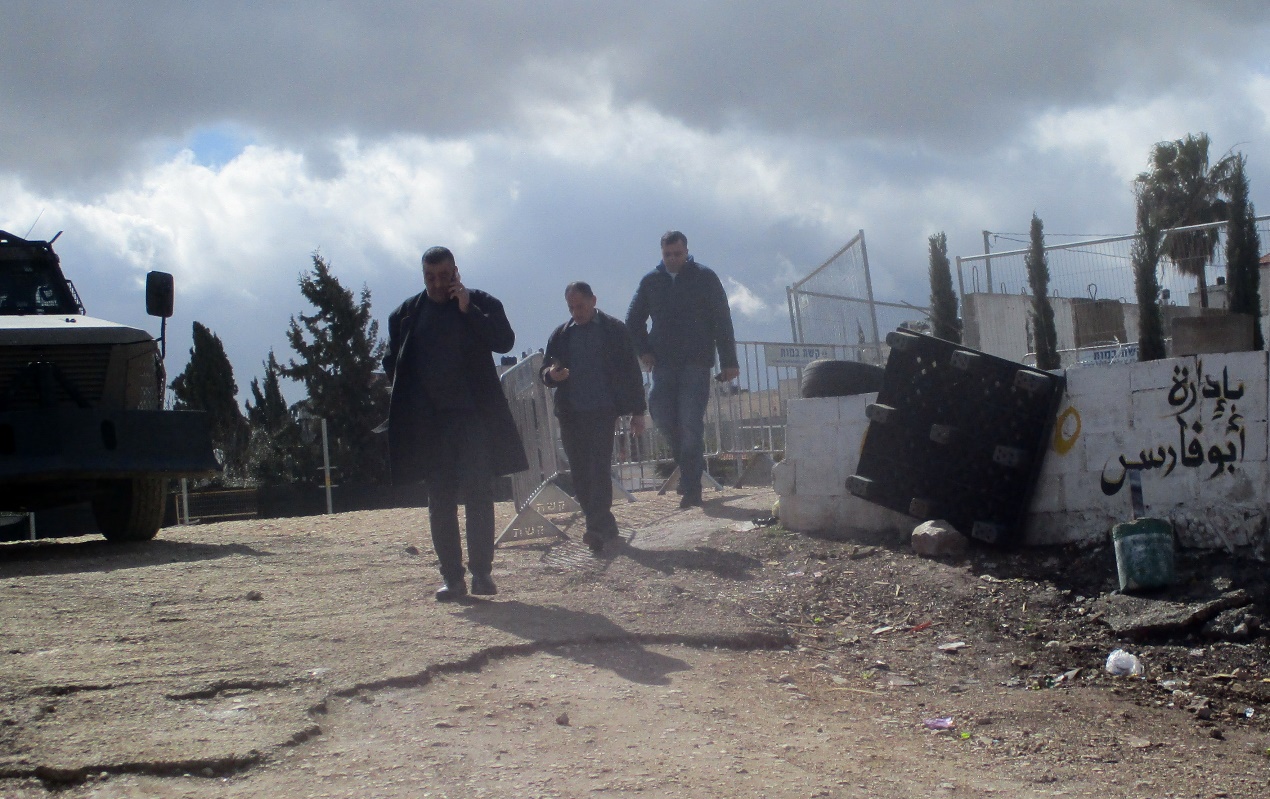 Tamar FleishmanFeb-27-2026Qalandiya: On the way to prayer
-