
Qalandiya
For years the coffee stall stood on the road leading to the vehicle checkpoint. For years it bothered no one, neither drivers nor pedestrians. Not only was it no hindrance, it even delighted body and mind in taste and appearance.
The taste was that of excellent Arabic coffee. And the appearance – a sign in both Arabic and Hebrew: “Aroma Coffee”.
Even TV’s Ohad Hamu credited the stall and Ahmad, its owner, with a TV item.
https://www.mako.co.il/news-israel/local-q4_2017/Article-24fd20681603061004.htm
But there’s a catch. The catch was inspectors of the Jerusalem municipality who raided the place, secured by policemen, and fined each of the vendors for hundreds of Shekels on grounds that they do not hold business permits.
I notified Ohad Hamu, thought he would find interest in this. It took a while, and two weeks ago he responded: it was no mere interest, he would actually try to help, and asked that I facilitate contact with Ahmad. Which I did. As I was sipping my weekly coffee there, Ohad and Ahmad spoke to each other on my telephone.
Ohad promised to do his best. We’ll wait for results with hope and skepticism…
**
The group of Gazans returning to the Gaza Strip after hospitalization in the West bank included a one-year-and five-months-old baby girl who has suffered from a serious kidney illness since birth. She was hospitalized in Ramallah, her mother said.
So, true, the baby is one of the fortunate few among the many ill patients inside the Gaza Strip who even got to exit the open-air Gaza prison and reached treatment. But whereas it is well known that West Bank residents ill with serious kidney conditions are sent to Motala, to the Augusta Victoria Hospital in East Jerusalem and not to other West Bank hospitals, one cannot help wondering why of all people this Gazan infant, suffering from a serious kidney condition, was hospitalized in Ramallah rather than in a hospital that specializes in problems of this sort.
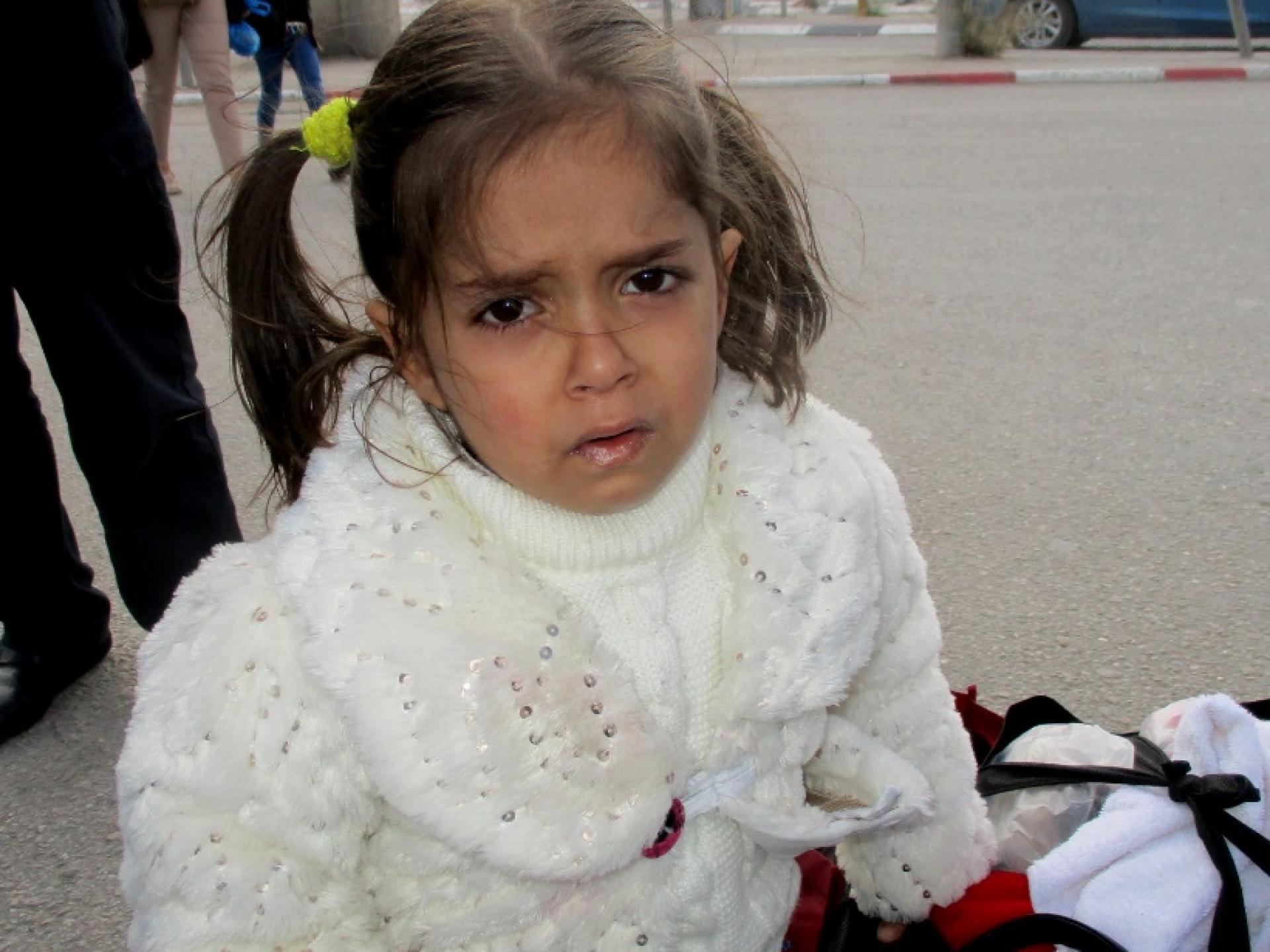
The not-so-long way across the checkpoint lasted a very long time.
Why? Because the woman-soldier carrying out inspections whom, we could not see from the outside, only heard her voice, had the entire waiting line on hold.
The invisible woman-soldier kept yelling at the elderly man facing her: “What have you got there?” but not only does the scrawny old man not understand Hebrew, his hearing is not that good. He stood there helpless, embarrassed, mumbling: “What?… What?…” and she, behind her bullet-proof glass window: “I see a knife!” The man insisted: “What?… What?…” Then a man standing alongside him, and finding himself stuck inside too, in the inspection area, volunteered to help and translated. The two opened the man’s bags, took out each object and presented it to the woman-soldier. She instructed them to place it all in a plastic tray, with which they went back and kept passing it through the metal detector. “I definitely see a knife. Once more!”
She ordered, they followed. Once more, back and forth through the metal detector. Again and again. We outside were the spectators of a theater of the absurd whose ending is unknown.
But every good thing comes to an end. The end came as, a half hour later, a policeman who was summoned entered the detention cubicle along with the old man and his plastic tray, and exited with them five minutes later.
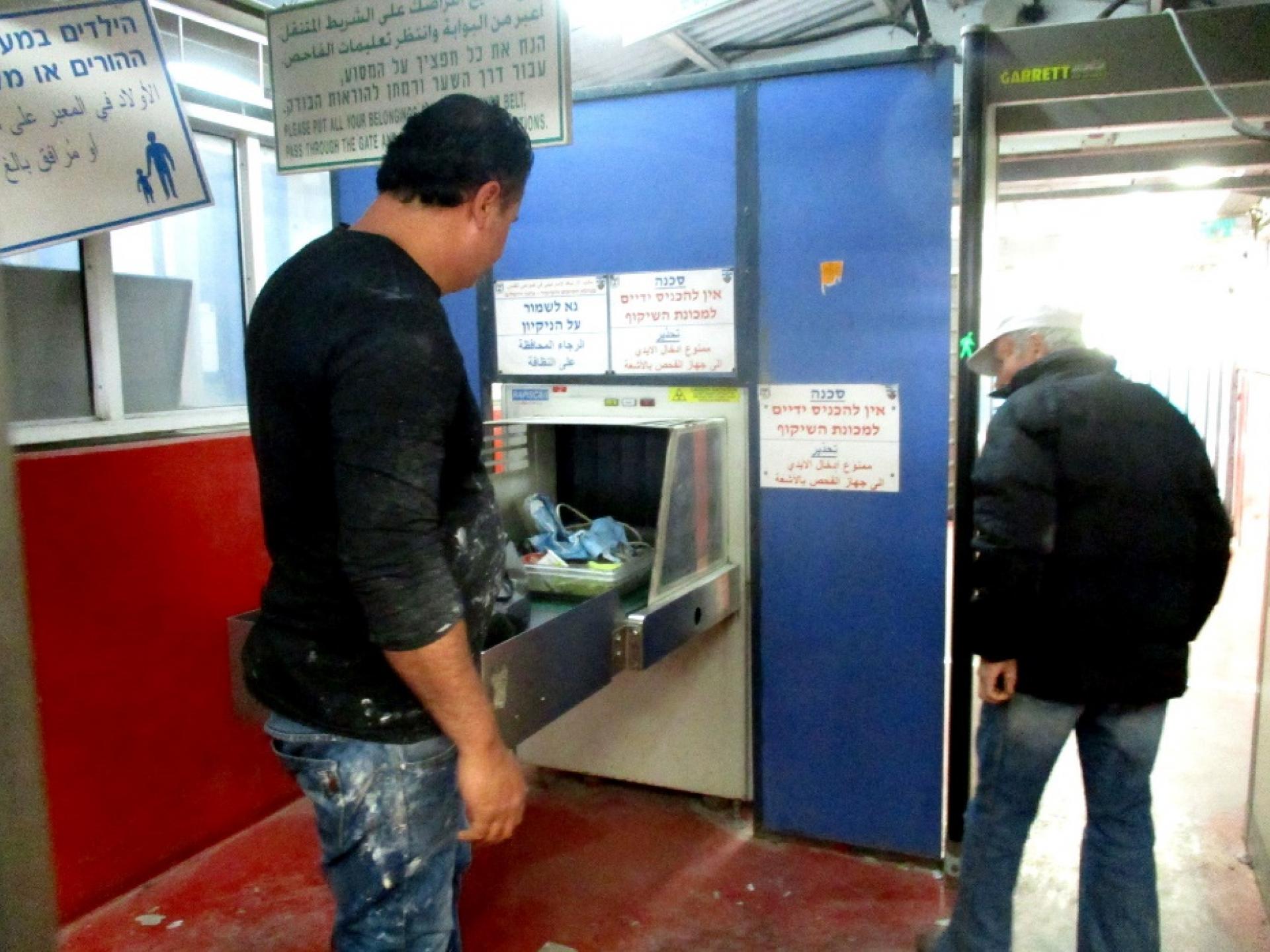
So what did we have here? A woman-soldier with no-good x-ray eyes, an audience of dozens of people delayed, two men being ordered back and forth in the inspection area, and a knife that never existed.
And had there been a knife – what then?
Qalandiya Checkpoint / Atarot Pass (Jerusalem)
See all reports for this place-
Click here to watch a video from Qalandiya checkpoint up to mid 2019 Three kilometers south of Ramallah, in the heart of Palestinian population. Integrates into "Jerusalem Envelope" as part of Wall that separates between northern suburbs that were annexed to Jerusalem in 1967: Kafr Aqab, Semiramis and Qalandiya, and the villages of Ar-Ram and Bir Nabala, also north of Jerusalem, and the city itself. Some residents of Kafr Aqab, Semiramis and Qalandiya have Jerusalem ID cards. A terminal operated by Israel Police has functioned since early 2006. As of August 2006, northbound pedestrians are not checked. Southbound Palestinians must carry Jerusalem IDs; holders of Palestinian Authority IDs cannot pass without special permits. Vehicular traffic from Ramallah to other West Bank areas runs to the north of Qalandiya. In February 2019, the new facility of the checkpoint was inaugurated aiming to make it like a "border crossing". The bars and barbed wire fences were replaced with walls of perforated metal panels. The check is now performed at multiple stations for face recognition and the transfer of an e-card. The rate of passage has improved and its density has generally decreased, but lack of manpower and malfunctions cause periods of stress. The development and paving of the roads has not yet been completed, the traffic of cars and pedestrians is dangerous, and t the entire vicinity of the checkpoint is filthy. In 2020 a huge pedestrian bridge was built over the vehicle crossing with severe mobility restrictions (steep stairs, long and winding route). The pedestrian access from public transport to the checkpoint from the north (Ramallah direction) is unclear, and there have been cases of people, especially people with disabilities, who accidentally reached the vehicle crossing and were shot by the soldiers at the checkpoint. In the summer of 2021, work began on a new, sunken entrance road from Qalandiya that will lead directly to Road 443 towards Jerusalem and Tel Aviv. At the same time, the runways of the old Atarot airport were demolished and infrastructure was prepared for a large bus terminal. (updated October 2021)
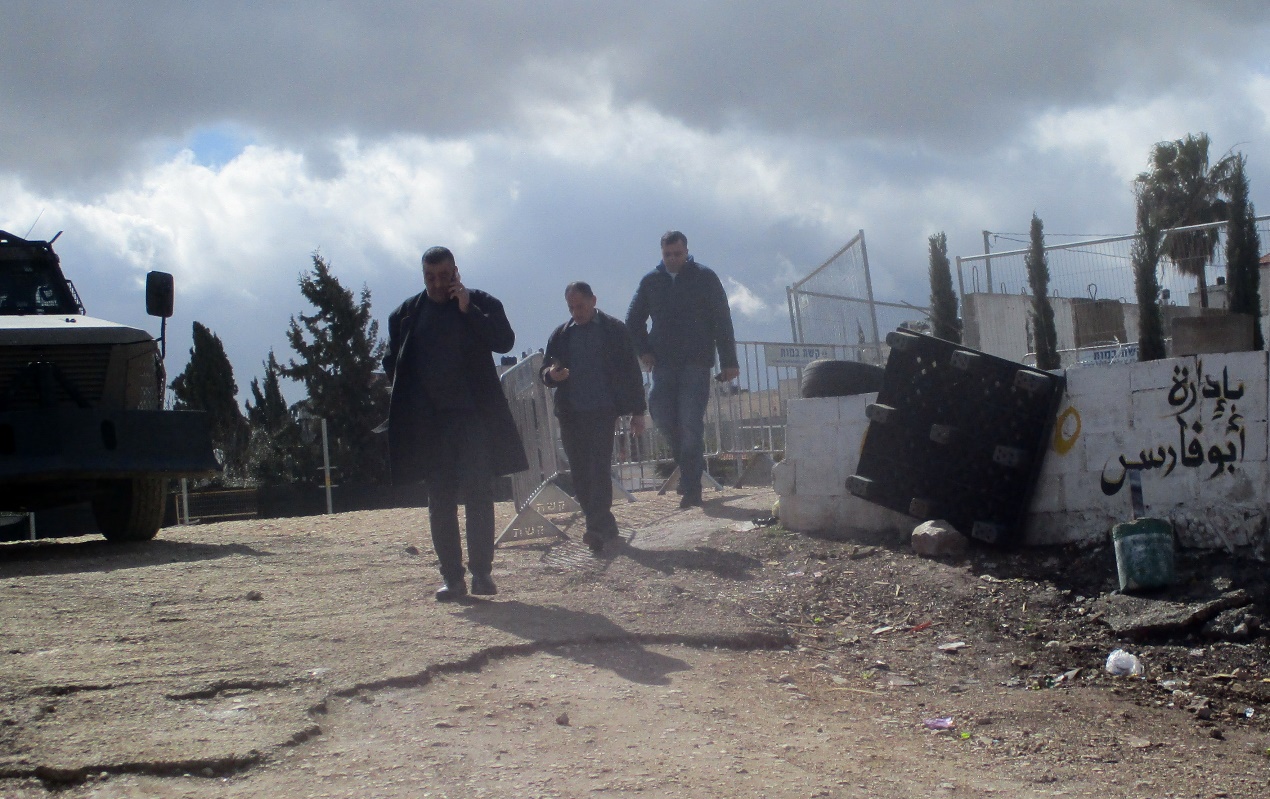 Tamar FleishmanFeb-27-2026Qalandiya: On the way to prayer
-