
Sansana (Meitar Crossing), South Hebron Hills
Following a phone call about settlers invading the Kafisha family home near Rachel and Leah House, near the Cave of the Patriarchs, we decided to go to Hebron. The days are the eve of the Feast of Sacrifice. Many cars are parked at the Meitar checkpoint and also along the road.
On Route 60 there is almost no traffic and most of the cars are Palestinian, probably due to the Feast of Sacrifice which is near. We did not see checkpoints or an army all the way to Hebron. The sheep market at the time we passed (10.45) was already coming to an end
Unlike previous years, the streets in Hebron on the eve of the holiday were deserted, as if a plague had broken out in the city. The checkpoints in the city, such as the pharmacy checkpoint and checkpoint 160, also looked abandoned. Up the road to Tel Rumeida a boy pushed an older woman sitting in a wheelchair. The right to drive on this street is for Jews only.
We tried to look for someone on the street who witnessed or knew about the invasion of the Kafisha family home. We found not far away, on a nearby street, about five minutes walk away, someone who told us that getting from his place to the area of Rachel and Leah (5 minutes walk) would take him about an hour because he had to go through so many checkpoints so he did not come and saw, but he says that the Kafisha family suffers a lot from the settlers’ children.
In Tel Rumeida, we saw the memorial plaque that the family of David Golobencic, who was killed by our own forces, placed on the fence of the home of a Palestinian family where he was killed.
Kiryat Arba is having a construction boom. The Nofei Kramim neighborhood greets us and at the exit from Kiryat Arba through the industrial area, the sign in the picture greeted us “We bought, we returned, now we are building.” When I got out of the car to take a picture of the sign, the guards came out to check on me. I told them I was just filming the sign. They did not even know what was written on the sign. They put it on to shade the guard post.
We returned via Route 317. In the woods, in front of the Susiya settlement, stand five new caravans. According to M., a month ago there was only one trailer and two months ago there was only a tent.
Work on the water line continues. It is not enough that the water line is not intended for Palestinians either, but the bulldozers in their work have destroyed a part of one of the Palestinians’ seasonal organic farming.
Back to the Meitar checkpoint. The parking lot is still full and the horrible smell that rises from the effluent of the Hebron River continues to accompany you for a long time to come.
Meitar checkpoint / Sansana
See all reports for this place-
Meitar Checkpoint / Sansana The checkpoint is located on the Green Line and serves as a border crossing between Israel and the West Bank. It is managed by the Border Crossing Authority of the Defense Ministry. It is comprised of sections for the transfer of goods as well as a vehicle checkpoint (intended for holders of blue identity cards, foreign nationals or diplomats and international organizations). Passing of Palestinians is prohibited, except for those with entry permits to Israel. Palestinians are permitted to cross on foot only. The crossing has a DCO / DCL / DCL / DCL (District Coordination Office), a customs unit, supervision, and a police unit. In the last year, a breach has been opened in the fence, not far from the crossing. This breach is known to all, including the army. There does not appear to be any interest in blocking it, probably as it permits needed Palestinian workers without the bureaucratic permits to get to work in Israel. Food stalls and a parking area economy have been created, but incidents of violent abuse by border police have also been recorded. Updated April 2022
-
South Hebron Hills
See all reports for this place-
South Hebron Hills
South Hebron Hills is a large area in the West Bank's southern part.
Yatta is a major city in this area: right in the border zone between the fertile region of Hebron and its surroundings and the desert of the Hebron Hills. Yatta has about 64,000 inhabitants.
The surrounding villages are called Masafer Yatta (Yatta's daughter villages). Their inhabitants subsist on livestock and agriculture. Agriculture is possible only in small plots, especially near streams. Most of the area consists of rocky terraces.Since the beginning of the 1980s, many settlements have been established on the agricultural land cultivated by the Palestinians in the South Hebron Hills region: Carmel, Maon, Susia, Masadot Yehuda, Othniel, and more. Since the settlements were established and Palestinians cultivation areas have been reduced; the residents of the South Hebron Hills have been suffering from harassment by the settlers. Attempts to evict and demolish houses have continued, along with withholding water and electricity. The military and police usually refrain from intervening in violent incidents between settlers and Palestinians do not enforce the law when it comes to the investigation of extensive violent Jewish settlers. The harassment in the South Hebron Hills includes attacking and attempting to burn residential tents, harassing dogs, harming herds, and preventing access to pastures.
There are several checkpoints in the South Hebron Hills, on Routes 317 and 60. In most of them, no military presence is apparent, but rather an array of pillboxes monitor the villages. Roadblocks are frequently set up according to the settlers and the army's needs. These are located at the Zif Junction, the Dura-al Fawwar crossing, and the Sheep Junction at the southern entrance to Hebron.
Updated April 2022
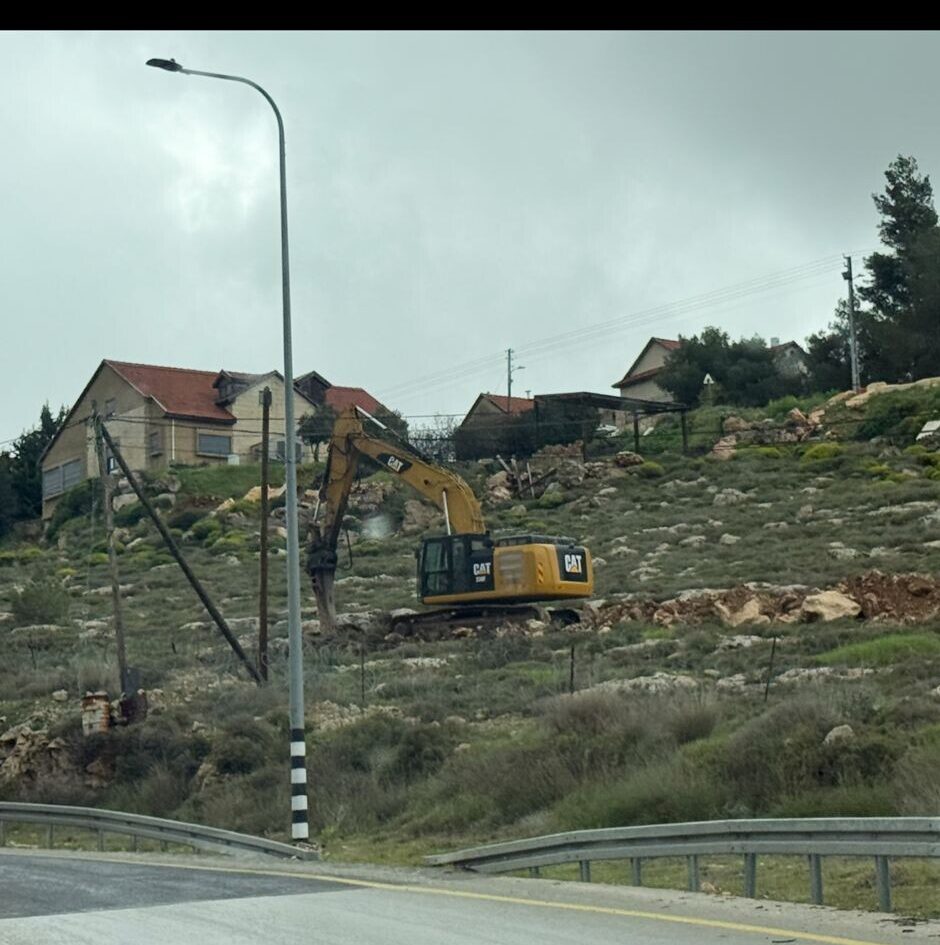 MuhammadFeb-24-2026South Hebron Hill, Beit Hagai: Paving an internal security road
-