
A breach in the gate at Habla Checkpoint

We set out in a car loaded with clothing and other items for Z.’s renovated shop in ‘Azzun. He moved to a new house because S., his wife, complained their previous apartment was insufficiently airy. The new apartment is spacious, directly across from the shop. The birds that were raised lovingly in the previous apartment are gone. Z. says they escaped…
The new shop is still being set up. The sons are helping, though at the moment the oldest is still asleep. Z. asked us to bring the goods to the apartment. He looks tired, recovering from his fall from the scaffolding which injured his back. His work permit was rescinded; his oldest son is still blacklisted.
Upgrading of ‘Azzun’s streets continues. The town is quiet.
We leave to visit A. at the plant nursery. He says the soldiers at the checkpoint are nice, but they’re consistently late opening the gate. When we reached the checkpoint we understood why: the fence is still full of gaps and people pass through on foot in both directions. Only vehicles have no choice but to wait for the gate to open.
Today the soldiers arrived on time; in fact, they were early but remained in their air-conditioned vehicle until 13:40.
Palestinians are required to pass through the barrier in the morning, but not in the afternoon. The soldiers really are friendly, willing to chat with Rony who’s curious about them. They say approximately fifty vehicles cross in the morning, but in the afternoon we saw only about ten going in either direction. Rony asks why they don’t repair the fence; the soldiers say it costs money and the Palestinians cut it again. That’s not completely true – we think the army simply doesn’t care. It’s the same at almost all the checkpoints.
People on foot don’t wait for the gate to open. We met a man who’d come from Nazareth to pick up a motor for one of his machines. He’d asked around and found the cheapest one in Qalqilya. The seller brings it to the checkpoint. At first, he said he’d wait for the gate to open in order not to get into trouble, but his patience ebbed and he crossed through the gap, returning shortly carrying the motor. He suggests we enter Habla through the gap; we politely refuse.
A young man, about twenty, smiling, friendly, arrives in his father’s car. He’s curious about us. We tell him about ourselves.
We left before the gate closed; nothing was happening anyway.
'Azzun
See all reports for this place-
Azoun (updated February 2019)
A Palestinian town situated in Area B (under civil Palestinian control and Israeli security control),
on road 5 between Nablus and Qalqiliya, east of Nabi Elias village. The inhabitants are allowed to construct and improve infrastructures. The Separation Fence has confiscated lands belonging to the town's people. In 2018 olive tree groves owned by one of its inhabitants were confiscated for the sake of paving a road to bypass Nabi Elias. Azoun population numbers 13,000, its economic state dire. Its infrastructures are poor, neglect and poverty rampant. In the meantime, the town council has completed paving an internal road for the inhabitants' welfare.
Because of its proximity to the Jewish settler-colony of Karnei Shomron and its outposts, the town suffers the intense presence of the Israeli army, especially at nighttime: soldiers enter homes, arrest suspects, trash the house and sometimes ruin it, as they do in numerous places in the West Bank. At times a checkpoint closes the entrance to the town, so no one can come in or get out.
-
Habla CP (1393)
See all reports for this place-
Habla CP (1393)
The Habla checkpoint (1393) was established on the lands of the residents of Qalqilya, on the short road that
connected it for centuries to the nearby town of Habla. The separation barrier intersects this road twice and cut off the residents of Qalqilya from their lands in the seam zone.(between the fence and the green line).
There is a passage under Road 55 that connects Qalqilya to the sabotage This agricultural barrier is used by the farmers and nursery owners established along Road 55 from the Green Line and on both sides of the kurkar road leading to the checkpoint.
This agricultural checkpoint serves the residents of Arab a-Ramadin al-Janoubi (detached from the West Bank), who pass through it to the West Bank and back to their homes. The opening hours (3 times a day) of this agricultural checkpoint are longer than usual, about an hour (recently shortened to 45 minutes), and are coordinated with the transportation hours of a-Ramadin children studying in the occupied in the West Bank.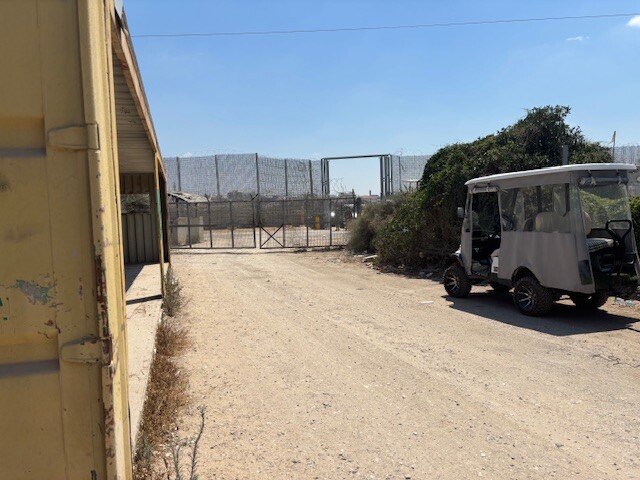 Nina SebaAug-18-2025Habla: The gate is in the process of closing
-