
Jerusalem: tour and meetings at the southern part of town Worrisome condolence visit
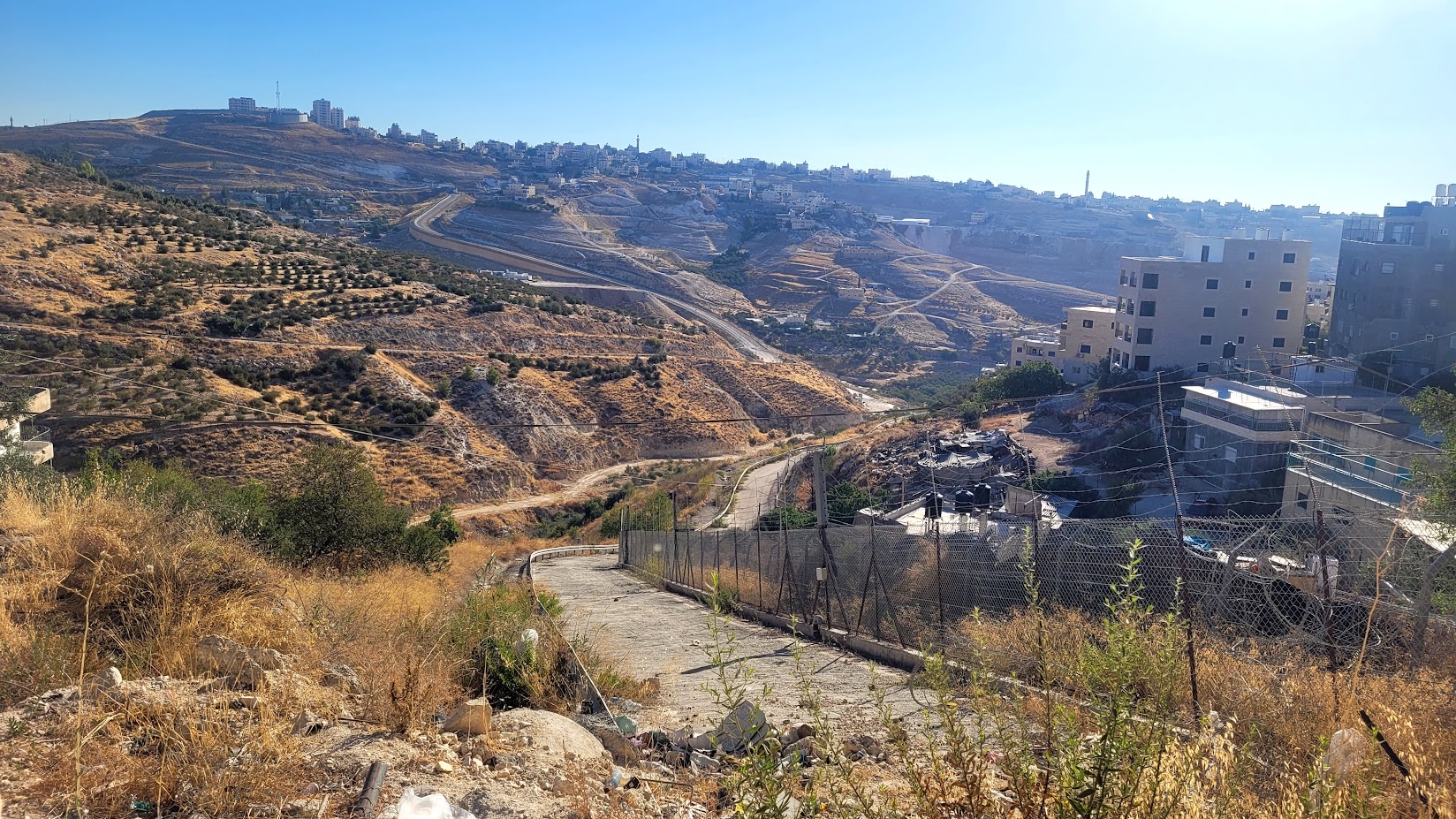

Meeting with N. at Sheikh Sa’ed Checkpoint, Nof Zion neighborhood at Jabal Mukabar, Southern American Road, Mazmoria Checkpoint, blockages on “Lieberman” Road to Tekqo’a, condolence visit with N. and her children at outskirts of Al Khader
Sheikh Sa’ed Checkpoint – Ronny, the Jerusalemite who “came down to the coastal plane”, is shocked by the gray fortress of the checkpoint she had known years ago without the concrete structure, without a closed wall and huge fences. She reminisces with N. about the trial at the District Court that ruled on closing the wall from the mother-neighborhood of Jabel Mukaber. But as we know, eventually the Supreme Court accepted the petition of the ‘security’ system about the danger awaiting the hilltop neighborhood and legitimized the route to separate the neighborhood as Area B. Sheikh Sa’ed has perhaps been the quietest checkpoint in Jerusalem for the past twenty years, unlike the mother-neighborhood of Jabel Mukaber which has produced several suicide terrorist attackers.
N. tells us about the harsh economic conditions in Sheikh Sa’ed. The only people allowed through the checkpoint towards Jabel Mukaber and Jerusalem are holders of blue (Israeli residents) IDs (about 60%) as well as school children (there is only a single elementary school in the neighborhood), teachers, physicians and workers of the health system. Only patients holding a transit permit on their way to surgery at Muqasad Hospital are allowed through. People headed for examinations and lighter procedures than surgery are not allowed through. All other services must be undergone in the West Bank and the way there is long and winding. One is not allowed to pass goods from Jerusalem through the checkpoint, they have to go through A-Za’im checkpoint on the Ma’ale Adumim Road and are more expensive because of this detour.

He tells us that another struggle is now unfolding. The Jerusalem Municipality and the water company Ha-Gichon have decided to transfer the sewage from East Talpiot to the oxidizing pools that will be constructed in the Qidron Valley right under Sheikh Sa’ed and in its farmland. He shows us the works in Qidron from afar and tells us something interesting: the Jerusalem Municipality is now legally entangled with Ha-Gichon company about the route of the sewage pipe. At present it is planned to run right under the checkpoint itself! Except for these pools, there is also the intention of passing the sewage of Meah She’arim ultraorthodox neighborhood through the Qidron, and thus Sheikh Sa’ed slope and some of the neighborhood will become a central, vibrant junction of sewage from West Jerusalem neighborhoods.
The only good piece of news we heard from N. is that the Jerusalem Envelope DCO is answering calls from Palestinians when problems arise at the checkpoint, and takes care of them. We were glad to hear that, for we are no longer entitled to answers…
Nof Zion neighborhood is right next to the Jabel Mukaber houses and expands on the slope above Silwan. It really offers a beautiful view. We were told that the apartments are sold especially to the American-Jewish public. A hotel and other constructions are already being planned.

The Southern American Road – a great road, huge bridge, amazing development. Publicity says it shortens the way from Jerusalem to the West Bank. But who uses it and where does it lead? See important destinations in the photo below.

Mazmuria Checkpoint for holders of blue IDs only.
Beyond it there is no traffic pressure on Road 398, the “Lieberman” Road that leads to Teqo’a and Noqdim settlments as well as their more southern offshoots. Before the war Palestinians driving from the northern West Bank could come from Wadi Nar Checkpoint on winding tracks and connect to the southern Road 60 to Hebron and the southern parts of the West Bank. No longer. Entrances to this road from Palestinian communities are now blocked with boulders, concrete slabs, metal gates and at times simply offensive dirt dykes. The Palestinians can drive only to Bethlehem on a narrow lower road (‘fiber of life’ road) and from there get stuck in the traffic jams of Bethlehem and exit through the only checkpoint open to them towards Nashash Junction, driving from there to the southern West Bank.


We photographed several blocked exits and entrances of Palestinian localities along Roads 398 and 356 to Teqo’a, and on 3157 from Teqo’a to Efrat. The latter passes Palestinian Tuqu’a on the main road, and includes a post with soldiers and their drawn guns, and another three unmanned posts. Later there is also a flying checkpoint checking trucks, and waiting lines form. A settlers’ bus is extracted from this jam and is parked next to the soldiers. Ronny, Kamal and I assume various explanations. Perhaps in order not to be harmed by hostile elements in the traffic jam…
A condolence visit to N. and her seven children at Al Khader/outskirts of southern Efrat, after her husband/their father died of cancer. We did not see him much, they always said he was ill and hospitalized. Naturally he did not contribute to the family’s livelihood.
It was sad. N. whom we admire looked very concerned about the future: sources of livelihood, and the demolition order, issued to the beautiful house renovated by volunteers of various associations, that might materialize surprisingly any day. We have seen it happen everywhere lately. It is frightening.
The five charming girls looked especially depressed – the oldest is 16 now. What will become of them? We saw family photos, brought refreshments and Kamal brought an olive oil jerrycan and two sacks of rice. We spoke on the phone with H., who actually represents AMOS association and others and is the acting contractor of the renovation. Perhaps he could help. We must influence the Civil Administration not to demolish this house. It would be the cruelest thing to do. How Does one go about it? Approach the Minister of Defense? Who would listen to us at this time?
Location Description
Al-Khader
See all reports for this place-
Al-Khadr served as transit from Bethlehem to Route 60. A dirt mound prevent vehicular traffic from and to Bethlehem from the west. A small market developed there. Taxi ranks were on both sides of the obstruction. It was replaced by a similar obstruction at Al Nashash which has recently been removed and thus the way from Bethlehem to Hebron through Route 60 is now free.
-
Jabel Mukaber (Jerusalem)
See all reports for this place-
Jabal Mukaber is located on the eastern and northern slopes of Mount Atz (or "Jabal Mukaber" in its Arabic name). It was founded by the Bedouin tribe of Arab a-Sawahra. Today, the village is considered one of East Jerusalem neighborhoods. It numbers about 30,000 residents living on 1,010 dunams. The village has five main clans, numbering several hundred families. During the British Mandate, the tribe moved to live in a huge complex of permanent housing that was named as-Sawahra, with the part east of the Kidron Valley called as-Sawahra a-Sharqiya (Eastern Sawahra) and the western part – Sawahra al-Gharbiyya. The separation fence currently separates Jabal Mukaber from Sawahra a-Sharqiya.
The houses of Jabal Mukaber wrap around the ridge from the north and east, along one of the tributaries of the Kidron River. In the eastern part, the village houses border the Jewish East Talpiot neighborhood. most of the residents of the village are considered residents of Jerusalem, have blue identity cards and enjoy full civil rights in Israel, except for the right to vote for the Knesset and receive an Israeli passport.
The residents of Jabel Mukaber suffer from lack of Outline Plan for the village, overcrowding and a lack of residential and public spaces. Thus, there is a phenomenon of illegal construction in the neighborhood. Demolitions of houses without building permits have been carried out over the years, but since the 7th October War, their rate has increased.
In 2010, a wall was built separating it from its sub-neighborhood A-Sheikh Sa'ed. The wall left many residents with Palestinian IDs without Jerusalem residency and they lost their freedom of movement in Jerusalem.
In the northern part of the neighborhood, construction began in 2005 of a luxury Jewish neighborhood called Nof Zion. The neighborhood was planned to have about 400 housing units, a commercial center and a hotel. However, in April 2025, it was announced that it would be expanded. The apartments were marketed mainly to the religious community in the United States. Alongside the Nof Zion neighborhood, a plan is being promoted to establish the Nof Zahav neighborhood on state land in the Jabal Mukaber neighborhood. This plan also includes residential areas and hotels for tourists, and a place has been allocated for a synagogue, but not for the construction of a mosque.
During and after the Second Intifada, several residents of the neighborhood were involved in terrorist attacks: On March 6, 2008, the attack on Merkaz HaRav Yeshiva in the Kiryat Moshe neighborhood of Jerusalem, in which eight of the yeshiva's students were murdered; On November 18, 2014, an attack on the "Kehilat Bnei Torah" synagogue during morning prayers in the Har Nof neighborhood of Jerusalem; A resident of Jabal Mukaber carried out a car bombing on the Armon Hanatziv promenade. The terrorist drove his truck into a group of cadets. Updated April 2025
-
Nu'man (Mazmuria)
See all reports for this place-
situated on the Wall route as part of "Jerusalem Envelope," in its southeastern stretch, east of Zur Baher, Um Tuba and the small Nuaman Village, on Beit Sahur road, the checkpoint will serve as the main crossing for commercial goods from the southern West Bank to Jerusalem.
-
Sheikh Sa'ed
See all reports for this place-
A checkpoint limited to pedestrians, located on Jerusalem’s municipal boundary.
The checkpoint sits on the separation fence at the entrance to Sheikh Sa’ad, dividing it from its neighbourhood of Jabel Mukkabar. It’s manned by Border Police soldiers and private security companies and operates 24 hours a day. Palestinians are forbidden to go through, other than residents of Jabel Mukkabar or Sheikh Sa'ad who have permits. Both groups are permitted through only on foot. Residents of East Jerusalem who don’t live in Jabel Mukkabar are also allowed to cross to Sheikh Sa’ad, but not in the opposite direction; they must return through the Sawahira ash Sharqiya checkpoint.
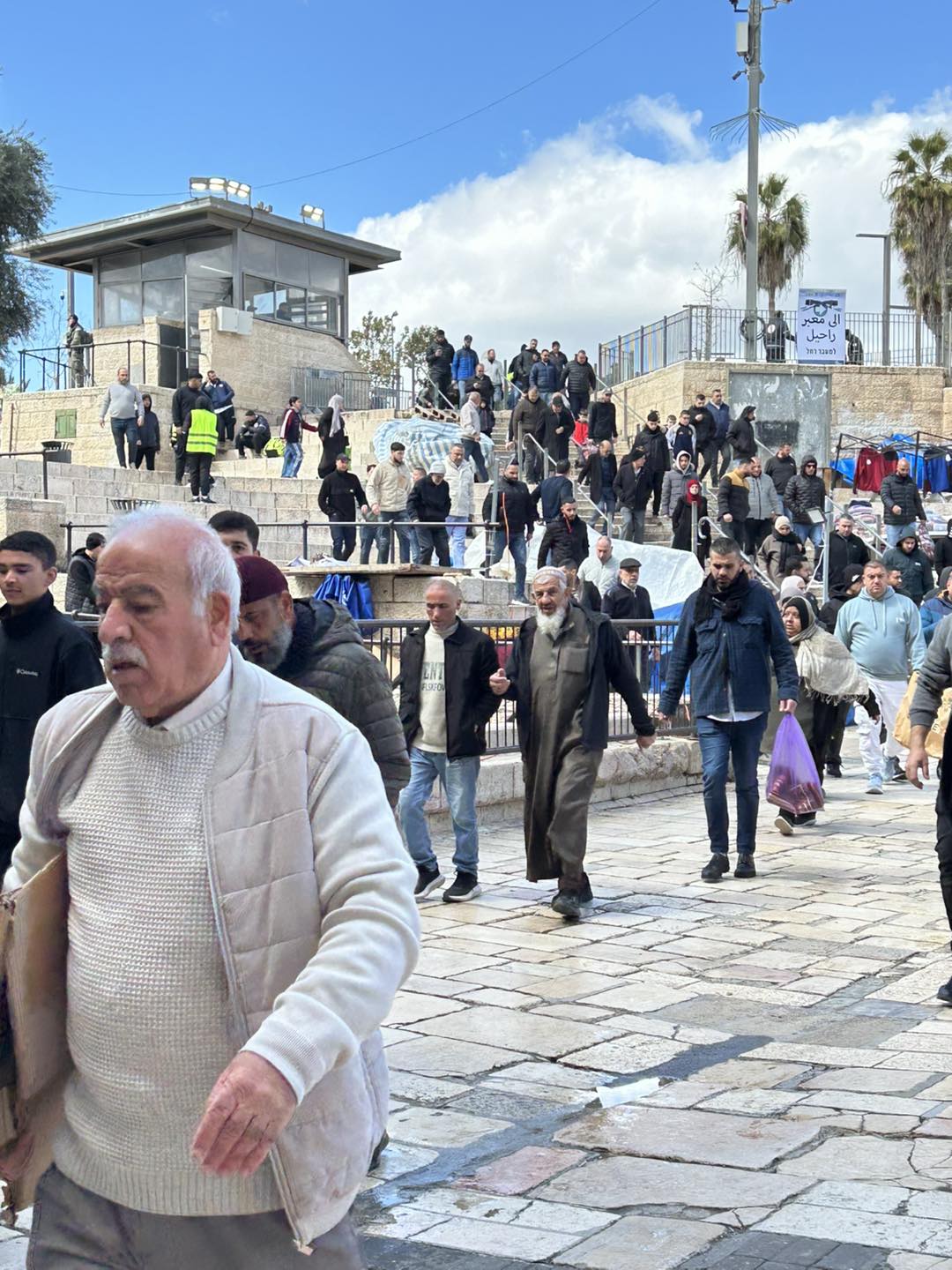 Avital CFeb-27-2026Jerusalem, Damascus Gate: Crowd rushing to prayer
-