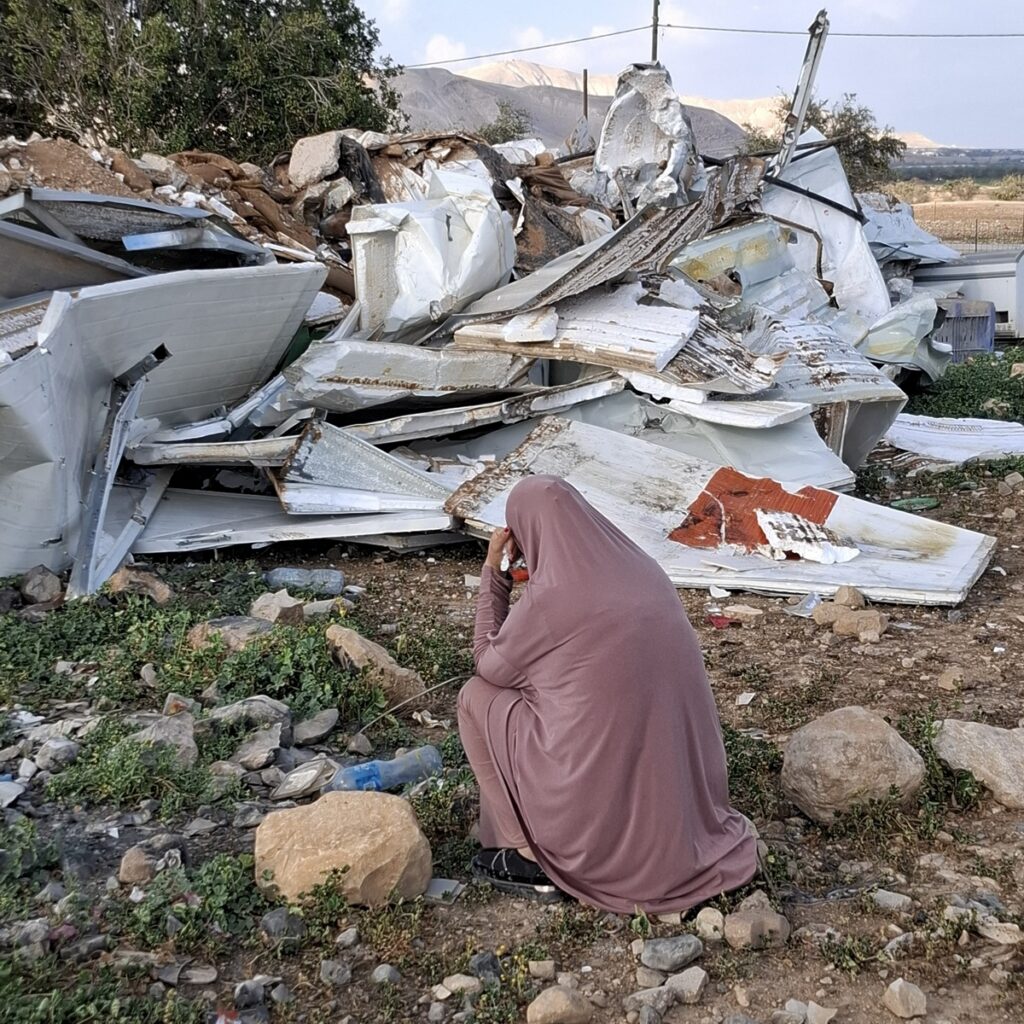
Qalandiya, Sun 2.10.11, Afternoon
Translating: Ruth Fleishman
Sharif doesn't go to school anymore
Since September has past and with it the trepidation about a "political tsunami", and the horrifying  scripts or bleak prophesies about thousands of people from throughout the West Bank marching towards Qalandiya checkpoint had been disproved, the place is once more governed by that same mundane routine and depressing grayness.
The blockages on the road leading to and from Ramallah had been diverted to the side of the road and traffic was once again free (- if jams that stretch on for hundreds of meters are a depiction of "free traffic"). The white camera balloon that hovered above during the entire month has disappeared. It has probably been stored somewhere.
Once again trash is piling up on the side of the road, children peddlers stock the passersby and the air is once again polluted by dust and gas fumes without the stinging-sweet smell of gas grenades.
Hopelessness, poverty and sorrow are permanent residents of the checkpoint, the refugee camp and the street corners, they are apparent on the faces of the children and adults and afflict us as well.
Qalandiya checkpoint is a magnet attracting all the wretched residents of the West Bank. Over there, at that site to where thousands of people a day are obligated flock towards, these paupers hope to find some sort of a living, a few shekels a day or as they put it: "To bring home bread". Many among them do not live in Qalandiya, but in cities and remote villages, places so far away that they cannot return there when evening falls. They hire an inadequate room or a bed in some stranger's house at the refugee camps or at the close by town Ar-Ram. One of these foreigners was Sharif's father who told us with his soft and sad voice:
"I pulled Sharif out of school… I need an additional person to help me provide for the family, they are ten at home… My eldest daughter is at the university, you know, she was really done for this year because she didn't have a computer. Today, even in the young ones' classes they need a computer. But how am I going to get one? Perhaps, Inshallah, next year I'll send Shraif back to school… but it's always the same, every year, it gets harder and there's less money. And everything is so expensive… perhaps in Israel you also have unfortunate people, but over here, for the Palestinians, everything is much harder… Since morning and up until now we've (he and his son Sharif) made only twenty Shekels. How can anyone live like this?… "
Sharif is Fifteen years old, a line of sadness is drawn on his face. His eyes convey the earnestness and sensibility. When he smiles only the contours of his face smile. His eyes do not smile.
Sharif knows, as his father knows and as is clear to us as well, that Sharif will not return to school. That pulling a child out of schools is an act that cannot be undone, that the phrase "Inshallah" is used to cover up reality, a mask, that it is said out of habit and cultural reference, wishing that perhaps the impossible would overcome the foretold and reality. For Sharif's future had been foretold like that of so many other teenagers, for his path presents him with no choice, during the years of his adolescence he will experience on his body and soul the rough laws of survival and their toll, until the yoke of having to provide for the family will have enslaved and consumed his body and soul.
Pain and sorrow were e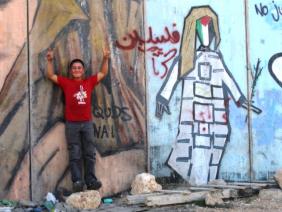 vident in the father's voice. He is a good man, a good father who has concerns for his children. He used to work in Israel, he was a hard worker and managed to provide for his family. Since the installment of checkpoints his road to breadwinning had been blocked and the slope became more slippery than ever, until the final crash when he was forced to pull his son out of school, a determining act for Sharif's future.
New on the Wall
1. :"KHAIBAR/SPACE"- In memory of Muhammad's battle at the beginning of Islam, against the Jewish tribes from the oasis Khaybar at the Arabian peninsula. The battle that had ended with the victory of Muhammad is an inspiration to Muslim warriors.
2. "Farts"- does the creator of this graffiti mean to imply that the wall is no more than hot air?
Qalandiya Checkpoint / Atarot Pass (Jerusalem)
See all reports for this place-
Click here to watch a video from Qalandiya checkpoint up to mid 2019 Three kilometers south of Ramallah, in the heart of Palestinian population. Integrates into "Jerusalem Envelope" as part of Wall that separates between northern suburbs that were annexed to Jerusalem in 1967: Kafr Aqab, Semiramis and Qalandiya, and the villages of Ar-Ram and Bir Nabala, also north of Jerusalem, and the city itself. Some residents of Kafr Aqab, Semiramis and Qalandiya have Jerusalem ID cards. A terminal operated by Israel Police has functioned since early 2006. As of August 2006, northbound pedestrians are not checked. Southbound Palestinians must carry Jerusalem IDs; holders of Palestinian Authority IDs cannot pass without special permits. Vehicular traffic from Ramallah to other West Bank areas runs to the north of Qalandiya. In February 2019, the new facility of the checkpoint was inaugurated aiming to make it like a "border crossing". The bars and barbed wire fences were replaced with walls of perforated metal panels. The check is now performed at multiple stations for face recognition and the transfer of an e-card. The rate of passage has improved and its density has generally decreased, but lack of manpower and malfunctions cause periods of stress. The development and paving of the roads has not yet been completed, the traffic of cars and pedestrians is dangerous, and t the entire vicinity of the checkpoint is filthy. In 2020 a huge pedestrian bridge was built over the vehicle crossing with severe mobility restrictions (steep stairs, long and winding route). The pedestrian access from public transport to the checkpoint from the north (Ramallah direction) is unclear, and there have been cases of people, especially people with disabilities, who accidentally reached the vehicle crossing and were shot by the soldiers at the checkpoint. In the summer of 2021, work began on a new, sunken entrance road from Qalandiya that will lead directly to Road 443 towards Jerusalem and Tel Aviv. At the same time, the runways of the old Atarot airport were demolished and infrastructure was prepared for a large bus terminal. (updated October 2021)
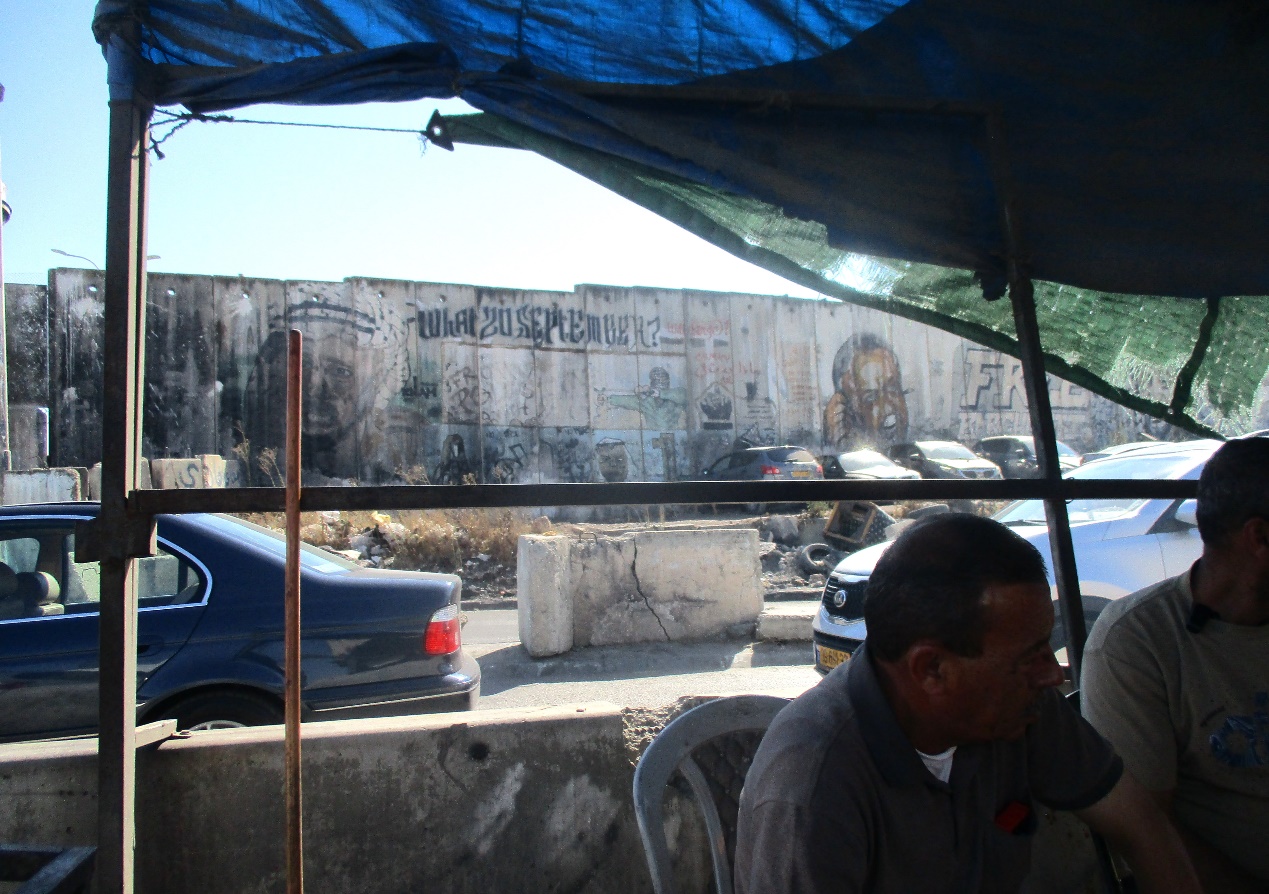 Tamar FleishmanJul-21-2026Qalandiya. Conversation in the shadow of the wall
-