Ar-Ram, Qalandiya, Mon 14.5.12, Afternoon
The road to Qalandiya was one great traffic jam, particularly along the Wall that encloses the city of Ar-Ram. It took us one-half hour to travel the last 200 m. to the southern square where we saw that traffic was once again being directed into Ar-Ram through the huge gate in the Wall, causing all the trouble. However, only when we passed through the CP and reached the northern parking lot did we understand that we had reached a "war game" arena. Groups of young men and boys (from Qalandiya Refugee Camp?) were throwing stones at the vehicle CP and retreating under an answering hail of tear gas grenades fired at them by a company of soldiers. Waves of attack and retreat continued all afternoon. We saw no one wounded and no ambulances arrived, but the smell of tear gas hung in the air, burning eyes and nostrils, while the "games" disrupted operation of the CP. When we arrived at Qalandiya there was still a line of some 30 people in the bus passenger passageway. But the buses stopped driving into the CP while the battle continued and this passageway appeared to have shut down.
Only two passageways were active in the pedestrian CP, with 20 or 30 people waiting on line in each. Those waiting complained that the soldiers were opening the turnstiles into the examination area only once every fifteen minutes, but when we made eye contact with the soldiers and then stood there observing, we saw that the intervals grew shorter. The (female) soldier in Passageway 1 kept trying to direct people from her line to the line in Passageway 3, in spite of the fact that the number of people in both lines was the same. She kept shouting in a vulgar and insulting manner into the PA system, implying that those on line were too stupid to understand. She acted in a degrading and shameful manner. Due to closure of the bus passenger passageway, conditions in the old CP rapidly became more crowded. There were lots of students coming home from their studies in Ramallah and many women with small children on their way to Jerusalem. When the internal passageways became half full, the soldier controlling the turnstile in the northern shed closed it so that shortly there was also a long line of people waiting in the shed.
We left Qalandiya at 5:30 PM and joined the huge traffic jam on the road to Lil/Jabba. Traffic in the two other CPs (Lil/Jabba and Hizmeh) was "davka" flowing freely.
A-Ram
See all reports for this place-
two kilometers south of Qalandiya and 300 metres north of Neve Yaacov Junction, in Dahiyat el-Barid Quarter. Checkpoint has operated since 1991, in a Palestinian area annexed to Jerusalem in 1967. The checkpoint has been inactive since the middle of 2009.
The wall was built on the road that led to Jerusalem. Since then the situation in the town has deteriorated. Houses are abandoned and half finished, most of the businesses have closed. Severe neglect around the fence and on the streets. Those who could left. Updated January 2024
-
Qalandiya Checkpoint / Atarot Pass (Jerusalem)
See all reports for this place-
Click here to watch a video from Qalandiya checkpoint up to mid 2019 Three kilometers south of Ramallah, in the heart of Palestinian population. Integrates into "Jerusalem Envelope" as part of Wall that separates between northern suburbs that were annexed to Jerusalem in 1967: Kafr Aqab, Semiramis and Qalandiya, and the villages of Ar-Ram and Bir Nabala, also north of Jerusalem, and the city itself. Some residents of Kafr Aqab, Semiramis and Qalandiya have Jerusalem ID cards. A terminal operated by Israel Police has functioned since early 2006. As of August 2006, northbound pedestrians are not checked. Southbound Palestinians must carry Jerusalem IDs; holders of Palestinian Authority IDs cannot pass without special permits. Vehicular traffic from Ramallah to other West Bank areas runs to the north of Qalandiya. In February 2019, the new facility of the checkpoint was inaugurated aiming to make it like a "border crossing". The bars and barbed wire fences were replaced with walls of perforated metal panels. The check is now performed at multiple stations for face recognition and the transfer of an e-card. The rate of passage has improved and its density has generally decreased, but lack of manpower and malfunctions cause periods of stress. The development and paving of the roads has not yet been completed, the traffic of cars and pedestrians is dangerous, and t the entire vicinity of the checkpoint is filthy. In 2020 a huge pedestrian bridge was built over the vehicle crossing with severe mobility restrictions (steep stairs, long and winding route). The pedestrian access from public transport to the checkpoint from the north (Ramallah direction) is unclear, and there have been cases of people, especially people with disabilities, who accidentally reached the vehicle crossing and were shot by the soldiers at the checkpoint. In the summer of 2021, work began on a new, sunken entrance road from Qalandiya that will lead directly to Road 443 towards Jerusalem and Tel Aviv. At the same time, the runways of the old Atarot airport were demolished and infrastructure was prepared for a large bus terminal. (updated October 2021)
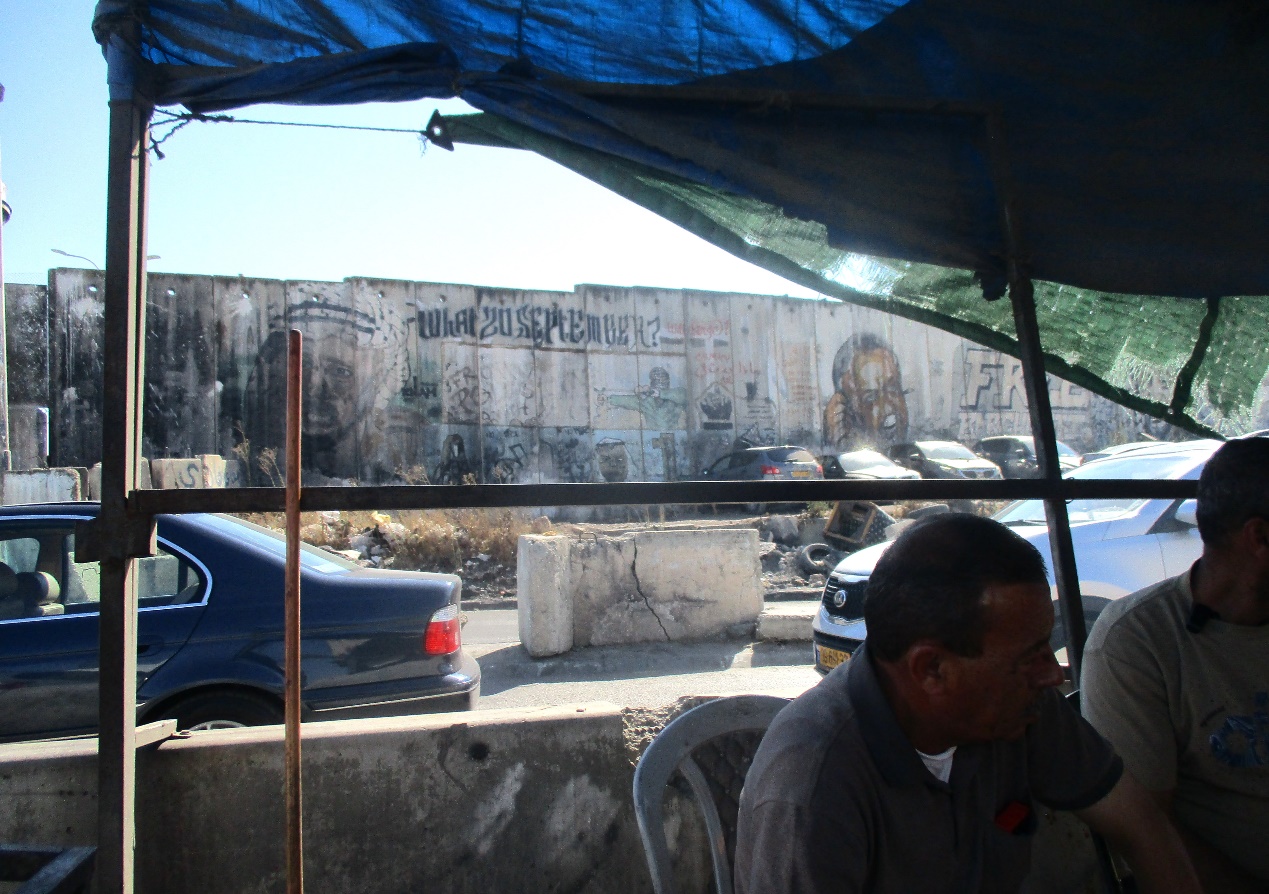 Tamar FleishmanJul-21-2026Qalandiya. Conversation in the shadow of the wall
-