Qalandiya, Tue 23.4.13, Morning
Translator: Charles K.
For the first time in the past few Tuesdays when we’ve come to the checkpoint there were long lines stretching to the parking lot as we arrived at 05:45. All five inspection lanes were open. After 06:00 we telephoned the humanitarian office because there was already also a line at the humanitarian gate. At 06:10 a DCO soldier arrived to take care of the humanitarian gate. He’s an affable soldier we haven’t seen for a long time; we said good morning and asked him to open the gate. Two young men from “Human Rights-Blue and White” introduced themselves to him (apparently because we’d said “good morning” to the soldier) and began speaking with him for what seemed to us a pretty long time, at the expense, of course of the people waiting to go through the gate.
We were uncertain whether to say anything to them – they’d come, incidentally, with a press photographer from Makor Rishon and Ma’ariv (we must give credit to Mr. Yo’az Hendel for his PR skills, how he manages to attract so much attention to an organization which has been in existence for only a few months and has but a handful of members) – that they should be more aware of the consequences of their behavior (for example, the story in Globes about the unfortunate Palestinian who had trouble walking and was made to go through the humanitarian gate, a route twice or three times as long as one he might otherwise have taken, because those young men insisted on his right to use it while at the same time everyone else freely entered through the much shorter fenced corridor). We decided it wasn’t our job (nor would we have been so pretentious) to instruct or guide them, and that they’ll have to learn from their mistakes, just like we do. It’s just too bad that the Palestinians pay the price of those mistakes.
The humanitarian gate opened after 06:15 and again at 06:25 to let through a large number of people, and then each time a group of people gathered there. The revolving gates also began opening more frequently after a policeman arrived and instructed the soldier in the “aquarium” to open them. No more long lines formed, nor did they extend beyond the three fenced corridors when we left at 07:15.
Before 07:00 we suddenly noticed at the entrance to the left-hand fenced corridor a backpack and two large bags. We mentioned this loudly, and the two guys from “Blue-White” said that the belongings had been lying there for a long time – very close, it must be said, to us, the “aquarium,” the DCO soldier and the policeman, and very far from where things are usually left (like bags of food) that people don’t want to take through the fenced corridors. I went over and asked those on line whether they know who the items belong to. They thought people left them, went to the end of the line, and would pick them up when they and the line moved forward. I said that you’re not supposed to leave “orphaned” belongings, and when I was asked (in all seriousness) what I meant, I said that there are people at the checkpoint who are likely to be sensitive to the possibility of an explosion – I said “boom” and made appropriate gestures with my hands. They burst out laughing at me, good-spiritedly. I said that an abandoned backpack is exactly what exploded last week in Boston. “Where?” they asked. “In Boston, in the United States,” I said. “But not at Qalandiya, right?” they asked. And when I admitted that it hadn’t, they laughed at me again. I found the owner at the end of the line and had the same conversation again, the “boom,” the laughter, all of it. They must have thought that all Israelis were born paranoid. Though I thought that even though both they and we have witnessed a not inconsiderable amount of evil during our lives, it didn’t occur to them that someone (an Arab or a Jew, because such things have happened) would place a bomb at the checkpoint to injure them along with us. Bottom line: a cultural conflict at the Qalandiya checkpoint , with no casualties.
Just before leaving we also talked with the duty policeman. The eternal subject: why does the situation at the checkpoint change so drastically from day to day (“Yom assal, yom basal”). We told him the Palestinians consistently report that the reason for the long lines in the morning (which the soldiers and police officers call “peak”) is the rate inspections are conducted at the five stations. The police officer replied that since everything is computerized, the checkpoint management knows that during “peak” hours it takes an average of 12.5 minutes to go through the checkpoint, of which inspection takes 3.5 minutes, and an average of 2,500 people cross during that time. What wasn’t clear is where they start counting the 12.5 minutes. Experience and common sense suggest that it begins after going through the first revolving gate (at the end of the fenced corridor), and not at the end of the line which often is located at the parking lot. Nor is it a secret that most of the irritability in these lines occurs before going through the first revolving gate.
Nevertheless, we were glad to agree with the policeman that there’s been a noticeable improvement at Qalandiya in recent months, particularly because a duty policeman is present during “peak” hours. We saw those policemen in action, most of them older and more experienced, to whom professional behavior is important, and who don’t hesitate to take the initiative and responsibility in dealing with the crossing. That’s definitely a welcome change, even if it’s not felt every morning and doesn’t always compensate for slow inspections at the booths.
Qalandiya Checkpoint / Atarot Pass (Jerusalem)
See all reports for this place-
Click here to watch a video from Qalandiya checkpoint up to mid 2019 Three kilometers south of Ramallah, in the heart of Palestinian population. Integrates into "Jerusalem Envelope" as part of Wall that separates between northern suburbs that were annexed to Jerusalem in 1967: Kafr Aqab, Semiramis and Qalandiya, and the villages of Ar-Ram and Bir Nabala, also north of Jerusalem, and the city itself. Some residents of Kafr Aqab, Semiramis and Qalandiya have Jerusalem ID cards. A terminal operated by Israel Police has functioned since early 2006. As of August 2006, northbound pedestrians are not checked. Southbound Palestinians must carry Jerusalem IDs; holders of Palestinian Authority IDs cannot pass without special permits. Vehicular traffic from Ramallah to other West Bank areas runs to the north of Qalandiya. In February 2019, the new facility of the checkpoint was inaugurated aiming to make it like a "border crossing". The bars and barbed wire fences were replaced with walls of perforated metal panels. The check is now performed at multiple stations for face recognition and the transfer of an e-card. The rate of passage has improved and its density has generally decreased, but lack of manpower and malfunctions cause periods of stress. The development and paving of the roads has not yet been completed, the traffic of cars and pedestrians is dangerous, and t the entire vicinity of the checkpoint is filthy. In 2020 a huge pedestrian bridge was built over the vehicle crossing with severe mobility restrictions (steep stairs, long and winding route). The pedestrian access from public transport to the checkpoint from the north (Ramallah direction) is unclear, and there have been cases of people, especially people with disabilities, who accidentally reached the vehicle crossing and were shot by the soldiers at the checkpoint. In the summer of 2021, work began on a new, sunken entrance road from Qalandiya that will lead directly to Road 443 towards Jerusalem and Tel Aviv. At the same time, the runways of the old Atarot airport were demolished and infrastructure was prepared for a large bus terminal. (updated October 2021)
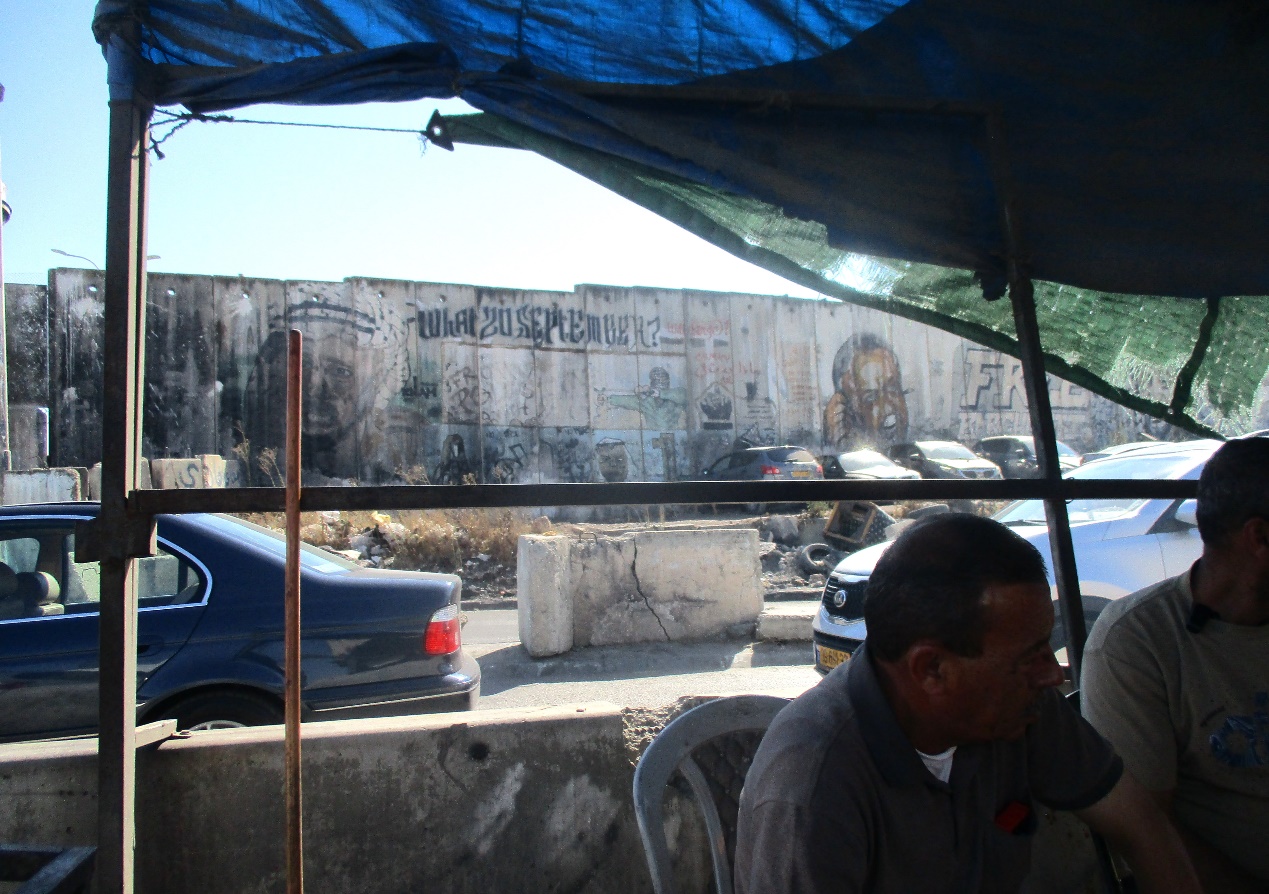 Tamar FleishmanJul-21-2026Qalandiya. Conversation in the shadow of the wall
-