
Hebron, Sansana (Meitar Crossing)
Meitar crossing – Traffic flowed at 9 AM when we crossed, no laborers, no confusion. When we return at 3:30 PM there’s a long line of cars even though four inspection lanes are open. Too bad it’s not a border crossing between two countries.
Highway 317 – Building proceeds apace in the settlements and outposts (which are all illegal). We went to Umm el Hir. We saw nothing unusual. The roof of the school has been repaired.
Highway 356 – At the village of Rafawiyya, where buildings were demolished, white tents have been erected.
Highway 60 – A new observation balloon loaded with cameras is now at the military base established above Adurayyim.
In general, we didn’t see flying checkpoints or many military vehicles.
Hebron
Equipment for the Al Ibrahamiyya boys school is going through the Pharmacy checkpoint. That’s what happens when you can’t bring cars close to the school. Ibrahim, the housemaster, has moved to the Cordova school.
The director of land registration from Ma’aleh Adumim (the Civil Administration) posted the following notice on the door of Beit HaMachpelah:


It says that the building is in fact owned by the settlers but for the time being, because of a particular regulation, it can’t be registered in their name. The purpose of the notice is to warn Palestinians against entering the building.
It’s decorated on all sides with new flags.
On the grassy area in front of the Cave of the Patriarchs Battalion 202 celebrates the end of its operations in Hebron. Golani will succeed them.
It’s always infuriating to see the symbiosis between the soldiers and the settlers.
Hebron
See all reports for this place-
According to Wye Plantation Accords (1997), Hebron is divided in two: H1 is under Palestinian Authority control, H2 is under Israeli control. In Hebron there are 170,000 Palestinian citizens, 60,000 of them in H2. Between the two areas are permanent checkpoints, manned at all hours, preventing Palestinian movement between them and controlling passage of permit holders such as teachers and schoolchildren. Some 800 Jews live in Avraham Avinu Quarter and Tel Rumeida, on Givat HaAvot and in the wholesale market.
Checkpoints observed in H2:
- Bet Hameriva CP- manned with a pillbox
- Kapisha quarter CP (the northern side of Zion axis) - manned with a pillbox
- The 160 turn CP (the southern side of Zion axis) - manned with a pillbox
- Avraham Avinu quarter - watch station
- The pharmacy CP - checking inside a caravan with a magnometer
- Tarpat (1929) CP - checking inside a caravan with a magnometer
- Tel Rumeida CP - guarding station
- Beit Hadassah CP - guarding station
Three checkpoints around the Tomb of the Patriarchs
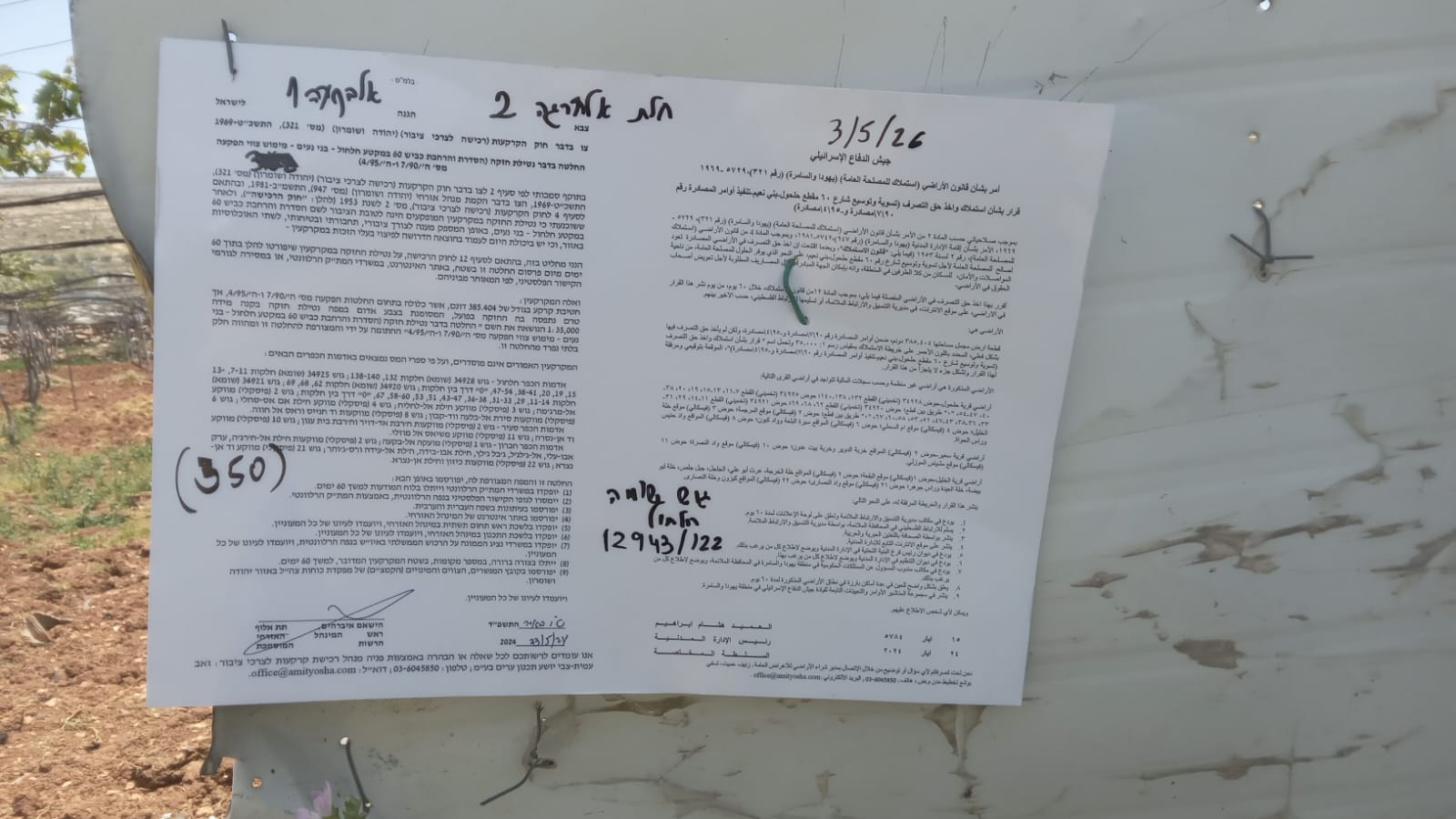 Muhammad D.May-13-2026Hebron - Request for compensation for land expropriation
-
Meitar checkpoint / Sansana
See all reports for this place-
Meitar Checkpoint / Sansana The checkpoint is located on the Green Line and serves as a border crossing between Israel and the West Bank. It is managed by the Border Crossing Authority of the Defense Ministry. It is comprised of sections for the transfer of goods as well as a vehicle checkpoint (intended for holders of blue identity cards, foreign nationals or diplomats and international organizations). Passing of Palestinians is prohibited, except for those with entry permits to Israel. Palestinians are permitted to cross on foot only. The crossing has a DCO / DCL / DCL / DCL (District Coordination Office), a customs unit, supervision, and a police unit. In the last year, a breach has been opened in the fence, not far from the crossing. This breach is known to all, including the army. There does not appear to be any interest in blocking it, probably as it permits needed Palestinian workers without the bureaucratic permits to get to work in Israel. Food stalls and a parking area economy have been created, but incidents of violent abuse by border police have also been recorded. Updated April 2022
-
