
Al Jib (Givat Zeev), Qalandiya
5:00
We saw that the line was very long and we also felt a certain fatigue and quiet in the air. Right away we understood that this feeling was caused by a soldier who directed people very quickly and other soldiers who also did their work at the checking booths quickly. At 6:00, the Humanitarian Gate had still not opened and, when we asked the policeman, we didn't get an answer but rather the statement that, since he was already characterized by us as "not nice", he was refusing to talk to us. We can only hope that this principle doesn't include all the policemen. Of course, our sign says clearly "women against the occupation and for human rights", and not "women against policemen"!
Since we felt that all the workers would go through within half an hour, we left before the hall was empty and traveled to the checkpoint at J'ib.
Jib checkpoint
6:30
At the entrance we were already aware of the disorder and that people had been pushing and being pushed since 4:00 and had still not gone through. Inside, we saw a very long line moving very slowly. Since there was only one turnstile operating, the women stood on the side, because they couldn't be shoved in among the men. For a while now, we have been meeting groups of women who work in the garment workshops in Givat Zeev; today they were sitting on the side. We asked them and the men what was happening and they reported that for 2 weeks the situation has been intolerable. We reported this to the DCO and the soldier at the office said that Jib doesn't even belong to the "Jerusalem Envelope" jurisdiction.
We also stood in line and everyone let us in, in the hope that we would be able to help. We discovered that a single soldier, who opened the turnstile, checked documents next to the window and also carried out the whole procedure of electronic security inspection! They told us that a jeep of the DCO was in the area but they didn't do anything. It was so difficult to watch the people, who were so exhausted, that we thought that perhaps their employers could help to "upgrade" the treatment, because certainly workers who aren't exhausted are preferable,aren't they? It was sad to be at the most pastoral checkpoint in the Jerusalem envelope, and face the crowding in the inspection lines of all kinds of people who actually have proper work permits in their hands. They asked our help and we promised that we would come frequently to Jib.
Al-Jib CP Givat Zeev (Jerusalem)
See all reports for this place-
Al-Jib CP GivatZeev (Jerusalem)
It is located on the separation fence, west of the al-Jib enclave. The checkpoint is regularly manned by Border Police and private security companies. Palestinians are not allowed to cross except for residents of the al-Khalaila neighborhood of the village of al-Jib, residents of al-Jib who own land on the western side of the fence, residents of a-Nabi Samuel, which is their only access road to Ramallah and the villages in northwest Jerusalem, as well as Palestinians with work permits in the Givat Zeev settlement and UN workers passing through UN vehicles.
(Updated January 2020)
-
Qalandiya Checkpoint / Atarot Pass (Jerusalem)
See all reports for this place-
Click here to watch a video from Qalandiya checkpoint up to mid 2019 Three kilometers south of Ramallah, in the heart of Palestinian population. Integrates into "Jerusalem Envelope" as part of Wall that separates between northern suburbs that were annexed to Jerusalem in 1967: Kafr Aqab, Semiramis and Qalandiya, and the villages of Ar-Ram and Bir Nabala, also north of Jerusalem, and the city itself. Some residents of Kafr Aqab, Semiramis and Qalandiya have Jerusalem ID cards. A terminal operated by Israel Police has functioned since early 2006. As of August 2006, northbound pedestrians are not checked. Southbound Palestinians must carry Jerusalem IDs; holders of Palestinian Authority IDs cannot pass without special permits. Vehicular traffic from Ramallah to other West Bank areas runs to the north of Qalandiya. In February 2019, the new facility of the checkpoint was inaugurated aiming to make it like a "border crossing". The bars and barbed wire fences were replaced with walls of perforated metal panels. The check is now performed at multiple stations for face recognition and the transfer of an e-card. The rate of passage has improved and its density has generally decreased, but lack of manpower and malfunctions cause periods of stress. The development and paving of the roads has not yet been completed, the traffic of cars and pedestrians is dangerous, and t the entire vicinity of the checkpoint is filthy. In 2020 a huge pedestrian bridge was built over the vehicle crossing with severe mobility restrictions (steep stairs, long and winding route). The pedestrian access from public transport to the checkpoint from the north (Ramallah direction) is unclear, and there have been cases of people, especially people with disabilities, who accidentally reached the vehicle crossing and were shot by the soldiers at the checkpoint. In the summer of 2021, work began on a new, sunken entrance road from Qalandiya that will lead directly to Road 443 towards Jerusalem and Tel Aviv. At the same time, the runways of the old Atarot airport were demolished and infrastructure was prepared for a large bus terminal. (updated October 2021)
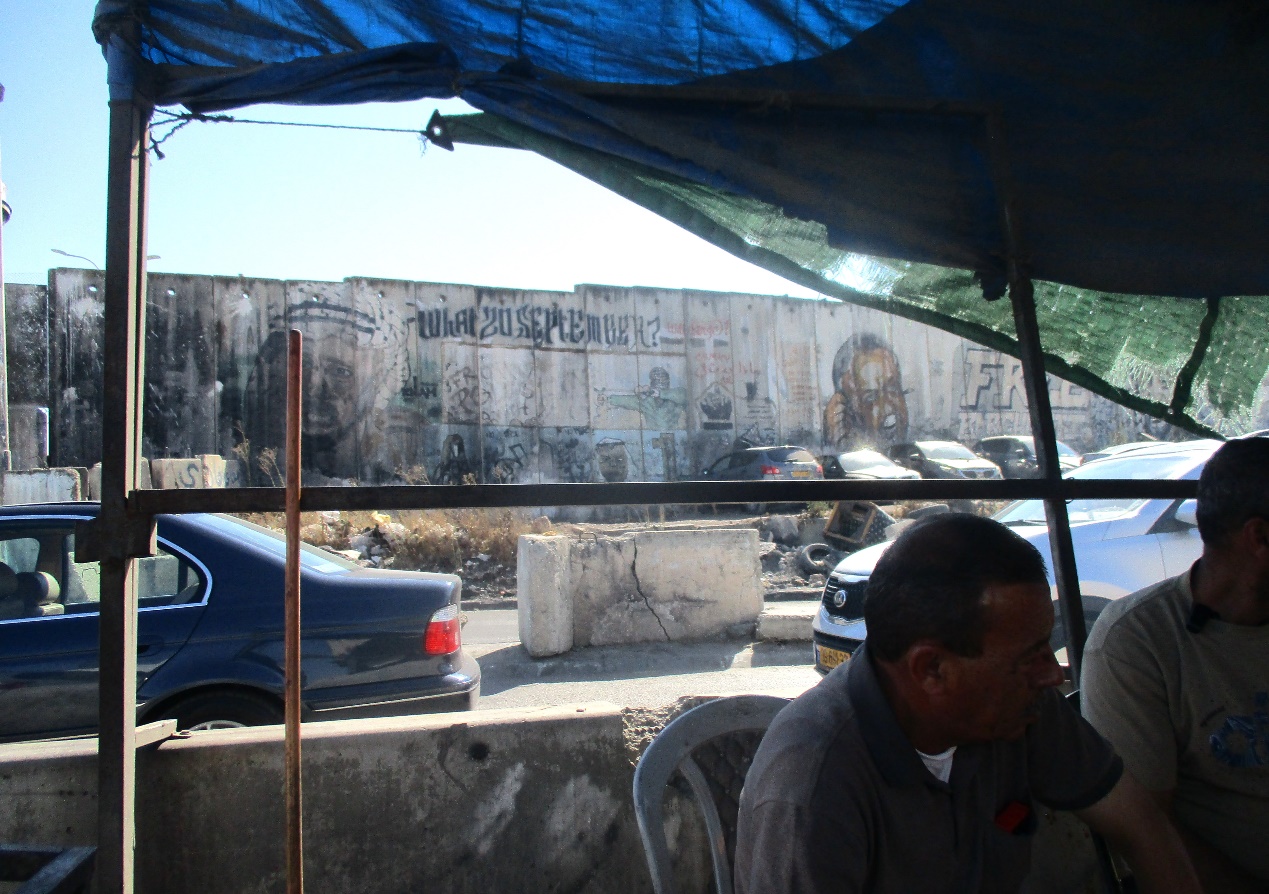 Tamar FleishmanJul-21-2026Qalandiya. Conversation in the shadow of the wall
-
