Qalandiya, Issawiya
A Plausible morning at the Qalandiya CP. The humanitarian gate was opened, albeit with a delay. At the western entrances of Issawiya there are blockades but there is no pressure.
Qalandiya
We arrived at approximately 5:15, after we parked at the Israeli side and went over on foot. It is still dark, and it begins already to be cool in the mornings. Outside there is already a tumult of people and vehicles – especially transportation cars and busses from East Jerusalem. We saw some busses of East Jerusalem (green-white) which were completely new, glistening white. At the entrance to the CP there are some who pray morning prayers, in small groups or singly.
Inside the 5 posts are already open, there are 2 not too long queues at the entrance to the enclosures. (later another queue was opened to the third enclosure).At this stage the queues are under a shed, and do not exceed beyond it. The beigele and cake vendors are already here, but the coffee stand outside remained closed during all our stay here. Women were allowed to become integrated in the queue at the entrance to the enclosures. When we arrived the cake vendor was in the middle of the morning prayer, and the beigele vendor watched over his stand. Further on they lend, from time to time, the prayer carpet to people who want to pray before joining the queue. There are some who don't take risks as far as the queue is concerned. First they pass by the turnstile at the end of one of the enclosures and then they pray on the side, before they go to one of the checking posts. We timed the passage of a young man wearing a sweatshirt brightly colored. It took him less than a quarter of an hour to pass.
H. our acquaintance arrives and we go to talk to him. H. works at a bakery at the Mahane Yahuda market. He is a veteran at the market and everybody knows him. He tells us that there are no buyers and tourists at the market. When they began returning, they disappeared again following the terrorist act which occurred on Monday, when 2 girls aged 14 used scissors to stab at Yaffa Road, near the Market. H. says that the policeman who shot the girls is called Gershon, and he is a veteran customer of his. After the event he came to the bakery to buy a pastry and boasted about having shot them. He tells H. that he wouldn't hesitate to shoot him too, if he saw him holding a knife. H. says that the same policeman is the one who shot the young boys (aged 11 and 13) who tried not long ago to perform a stabbing act at the light train.
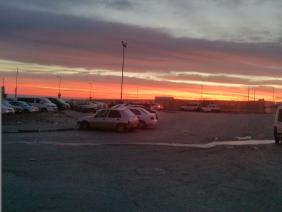
In order to relax from H.'s sad story, we went out for some time to watch the sunrise (see photos). At the vehicle CP angry hooting can already be heard. When we return we hear from time to time announcements on the loudspeakers from the checking posts (especially of one girl soldier) which we had difficulty in understanding. We understood that elderly people who enter without authorization, are requested to wait till 8 o'clock. In one case we heard a soldier instruct somebody to return at 7 o'clock, he probably had an authorization from 7 o'clock on.
At 6 o'clock a soldier with a soldier arrived to replace the soldier in the aquarium. Women began waiting near the humanitarian passage in the hope that it would be opened, and began asking us whether they would open it, but we had no answer. Some of them despaired and went to the regular queue which was acceptable, even when it overflowed from time to time from the shed. At 6:10 a security guard arrived and at 6:15 two other. We know one of the guards, and we talked to him in the past too. We asked him whether the humanitarian passage was about to be opened, but he had no answer. He said it was the responsibility of the DCO. We asked him whether the arrangement, which had begun before the holidays, and within the framework of which some busses of Off Tov passed from Atarot by the vehicle CP, would continue. According to him that was a trial arrangement which lasted a week only. He couldn't say whether "the situation" caused the cessation of this experiment.
At a certain stage there were already 4 security guards in addition to the policeman and the soldier in the aquarium. "Our forces" were busy mainly at feeding the cats. Then some of them left and only the policeman, one security guards and one soldier remained. Exactly when we decided to phone and to try and find out whether they intended opening the humanitarian passage, a soldier from the DCO arrived with the key. After preliminaries (the opening the gate of the passage and the closing of another gate) and the checking of the authorizations of the men the gate was opened a little after 6:20. Later we saw that the security guard indicated to the women who arrived, that they should come to the humanitarian passage. One of the women whom we know told us that during the whole week the situation was acceptable. Again we timed the passage of somebody who wore a conspicuous shirt, by the regular queue. It took him about 20 minutes, which is absolutely acceptable at the peak hours a Qalandiya . At 6:50 we joined the queue, and it took us about a quarter of an hour to pass.
Issawiya
7:35 – we arrived at the entrance to Issawiya from the direction of the French Hill, near the petrol station. There is a manned post there and concrete barricades which force the cars to do slaloms, and do not enable driving in both directions simultaneously. There were relatively few cars, especially those leaving Issawiya. None was checked. We talked with an elderly man who passed on foot (he too wasn't checked). The man said that although now they do not check the cars and the pedestrians, the mere existence of the CP and the presence of the border policemen, is a nuisance and induces an uncomfortable feeling. When there is more pressure in both directions cars have to wait to pass between the concrete barricades. We parted from him with a mutual hope for better days.
We continued to the exit from Issawiya, near the entrance to Mount Scopus University campus. We saw that there is a permanent blockage for cars there – half circles of concrete block the road. They are already a long time there. Now there is also a police ribbon stretched on them and a manned temporary post. Pedestrians can pass, and we saw some passing without being checked. Everything seemed calm. We left.
Qalandiya Checkpoint / Atarot Pass (Jerusalem)
See all reports for this place-
Click here to watch a video from Qalandiya checkpoint up to mid 2019 Three kilometers south of Ramallah, in the heart of Palestinian population. Integrates into "Jerusalem Envelope" as part of Wall that separates between northern suburbs that were annexed to Jerusalem in 1967: Kafr Aqab, Semiramis and Qalandiya, and the villages of Ar-Ram and Bir Nabala, also north of Jerusalem, and the city itself. Some residents of Kafr Aqab, Semiramis and Qalandiya have Jerusalem ID cards. A terminal operated by Israel Police has functioned since early 2006. As of August 2006, northbound pedestrians are not checked. Southbound Palestinians must carry Jerusalem IDs; holders of Palestinian Authority IDs cannot pass without special permits. Vehicular traffic from Ramallah to other West Bank areas runs to the north of Qalandiya. In February 2019, the new facility of the checkpoint was inaugurated aiming to make it like a "border crossing". The bars and barbed wire fences were replaced with walls of perforated metal panels. The check is now performed at multiple stations for face recognition and the transfer of an e-card. The rate of passage has improved and its density has generally decreased, but lack of manpower and malfunctions cause periods of stress. The development and paving of the roads has not yet been completed, the traffic of cars and pedestrians is dangerous, and t the entire vicinity of the checkpoint is filthy. In 2020 a huge pedestrian bridge was built over the vehicle crossing with severe mobility restrictions (steep stairs, long and winding route). The pedestrian access from public transport to the checkpoint from the north (Ramallah direction) is unclear, and there have been cases of people, especially people with disabilities, who accidentally reached the vehicle crossing and were shot by the soldiers at the checkpoint. In the summer of 2021, work began on a new, sunken entrance road from Qalandiya that will lead directly to Road 443 towards Jerusalem and Tel Aviv. At the same time, the runways of the old Atarot airport were demolished and infrastructure was prepared for a large bus terminal. (updated October 2021)
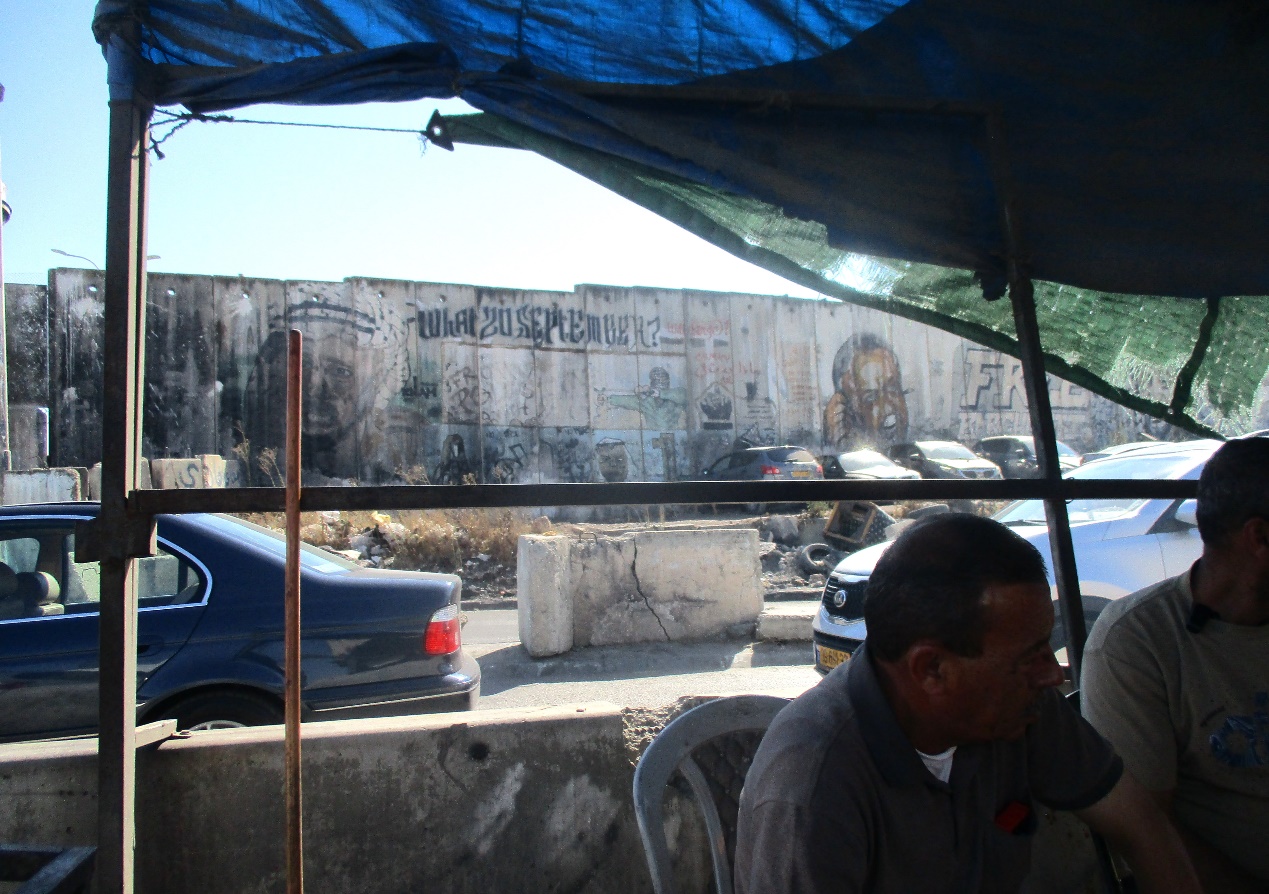 Tamar FleishmanJul-21-2026Qalandiya. Conversation in the shadow of the wall
-