
PM
Huwwara, Saturday 20 March 2004Observers: Amalia W., Chava H., Sara A. colour=red>When we got to the petrol station at Eli, we called one of the drivers whose cabs were confiscated last Saturday at Salem checkpoint to find out if their vehicles had been returned to them as promised. In fact, they were returned yesterday.There were soldiers at the Tapuach junction checkpoint, where there were almost no pedestrians, but around 20 cars waiting in line.Our first glimpse of the southern end of the Huwwara checkpoint (the side for those wanting to go to Nablus) showed just how bad the situation was. Masses of people waiting, all one on top of another, a line of waiting cars and trucks , and over 50 detainees. We counted seven soldiers (some of them weren’t checking or letting people pass, but were instead busy with “security” which means that they stood there with their weapons aimed at those in the line). The place was in turmoil, with a lot of shouting going on and a sense that things were out of control. Most of those we tried to reach by phone aren’t available on Saturday [the sabbath] and that is a serious problem. Finally, Hadass from the Physicians for Human Rights, as well as the soldier on duty in the army’s Humanitarian Centre helped us get through to the Nablus DCO, and then we began to see some order emerging.Because the child Mohamed Koura’an was caught with a bomb at Huwwara checkpoint (or so the army says), and also because the army had apparently received many warnings [of impending terror attacks], the procedures for going through the checkpoint had been made more stringent. About a third of those between the ages of 16 to 35 were turned down. Al Najah University students were able to come through because their university coordinates with the army , but other students were turned back. We could not figure out just how consistent was the “rule” that one of them cited: “on Saturdays trucks are not allowed in Nablus”, or “on Saturdays there is no unloading of goods in Nablus”. It is also not clear just when this “enlightened” order was issued. Some of the trucks were sent with their loads to the so-called “back to back” checkpoint [where goods are off-loaded from the back of one lorry on to the back of a waiting lorry for the onward journey], but later on, trucks were allowed to pass. There was no problem with ambulances, or with the elderly and the handicapped. An old man and his wife approached a soldier checking at the checkpoint. The soldier opened the man’s identity card and found inside a NIS100 note.. He closed the I.D. and returned it to its owner, signalled him to continued and said: “Take the money. I don’t need your bribe.”Hardest of all was the problem of the detainees. Some of the dozens waiting on the checkpoint slopes (Get down,down! Get down,down! Yallah, Yallah!!! [shouted the soldiers]) burst out in fury and started yelling at the soldiers and for a moment it seemed they were going to lose control of themselves. Even our efforts to calm the atmosphere were met with anger. Some of the detainees were being held as a punishment or, rather, an “educational measure”, because they had tried to evade the checkpoint, to jump the line in some way before their turn came, or because they had yelled at or argued with the soldiers. Two or three of the detainees were on their knees and had their hands tied behind their backs. One of them , who was particularly “obstinate”, was led away to the far end of the field by two soldiers to “have a talk”.On the northern side of the checkpoint (for those coming from Nablus ) we encountered two women detainees, Israeli Arabs, one a Jerusalem resident and the other a Bedouin from Rahat. Both had two-year-old toddlers with them . The woman from Jerusalem had waited almost five hours for the Shin Bet to finish checking her and was almost in tears.Both women told us that they had had no problems going into Nablus, but that when they left the town the soldiers had stopped them suspecting that they had come in illegally. It was only after a series of telephone calls and a lot of talking and sincere efforts by the checkpoint commander and the DCO officer that they were eventually released together with many others. The commander told us that the Shin Bet worked very slowly (“they don’t hurry over there”) and that he too had more than once drawn attention to the problem. At the end of the shift we were presented with an unbelievable new concept: those on duty at the southern side of the checkpoint told us that because of the behaviour of the soldiers, the Palestinians call this “The Merciful Checkpoint”. Personally, I must say that the soldiers do indeed do this cruel job with restraint and do demonstrate that they understand that they are dealing with human beings. It is all relative!
Huwwara
See all reports for this place-
The Huwwara checkpoint is an internal checkpoint south of the city of Nablus, at the intersection of Roads 60 and 5077 (between the settlements of Bracha and Itamar). This checkpoint was one of the four permanent checkpoints that closed on Nablus (Beit Furik and Awarta checkpoints to the east and the Beit Iba checkpoint to the west). It was a pedestrian-only barrier. As MachsomWatch volunteers, we watched therre since 2001 two shifts a day - morning and noon, the thousands of Palestinians leaving Nablus and waiting for hours in queues to reach anywhere else in the West Bank, from the other side of the checkpoint the destination could only be reached by public transport. In early June 2009, as part of the easing of Palestinian traffic in the West Bank, the checkpoint was opened to vehicular traffic. The passage was free, with occasional military presence in the guard tower. Also, there were vehicle inspections from time to time. Since the massacre on 7.10.2023, the checkpoint has been closed to Palestinians.
On February 26, 2023, about 400 settlers attacked the town's residents for 5 hours and set fire to property, such as houses and cars. Disturbances occurred in response to a shooting of two Jewish residents of Har Bracha by a Palestinian Terrorist. The soldiers stationed in the town did not prevent the arson and rescued Palestinian families from their homes only after they were set on fire. No one was punished and Finance Minister Smotrich stated that "the State of Israel should wipe out Hawara." Left and center organizations organized solidarity demonstrations and support actions for the residents of Hawara.Hawara continued to be in the headlines in all the months that followed: more pogroms by the settlers, attacks by Palestinians and a massive presence of the army in the town. It amounted to a de facto curfew of commerce and life in the center of the city. On October 5, 2023, MK Zvi established a Sukkah in the center of Hawara and hundreds of settlers backed the army blocked the main road and held prayers in the heart of the town all night and the next day. On Saturday, October 7, 23 The "Swords of Iron" war began with an attack by Hamas on settlements surrounding Gaza in the face of a poor presence of the IDF. Much criticism has been made of the withdrawal of military forces from the area surrounding Gaza and their placement in the West Bank, and in the Hawara and Samaria region in particular, as a shield for the settlers who were taking over and rioting.
On November 12, 2023, the first section of the Hawara bypass road intended for Israeli traffic only was opened. In this way, the settlers can bypass the road that goes through the center of Hawara, which is the main artery for traffic from the Nablus area to Ramallah and the south of the West Bank. For the construction of the road, the Civil Administration expropriated 406 dunams of private land belonging to Palestinians from the nearby villages. The settlers are not satisfied with this at the moment, and demand to also travel through Hawara itself in order to demonstrate presence and control.(updated November 2023)
.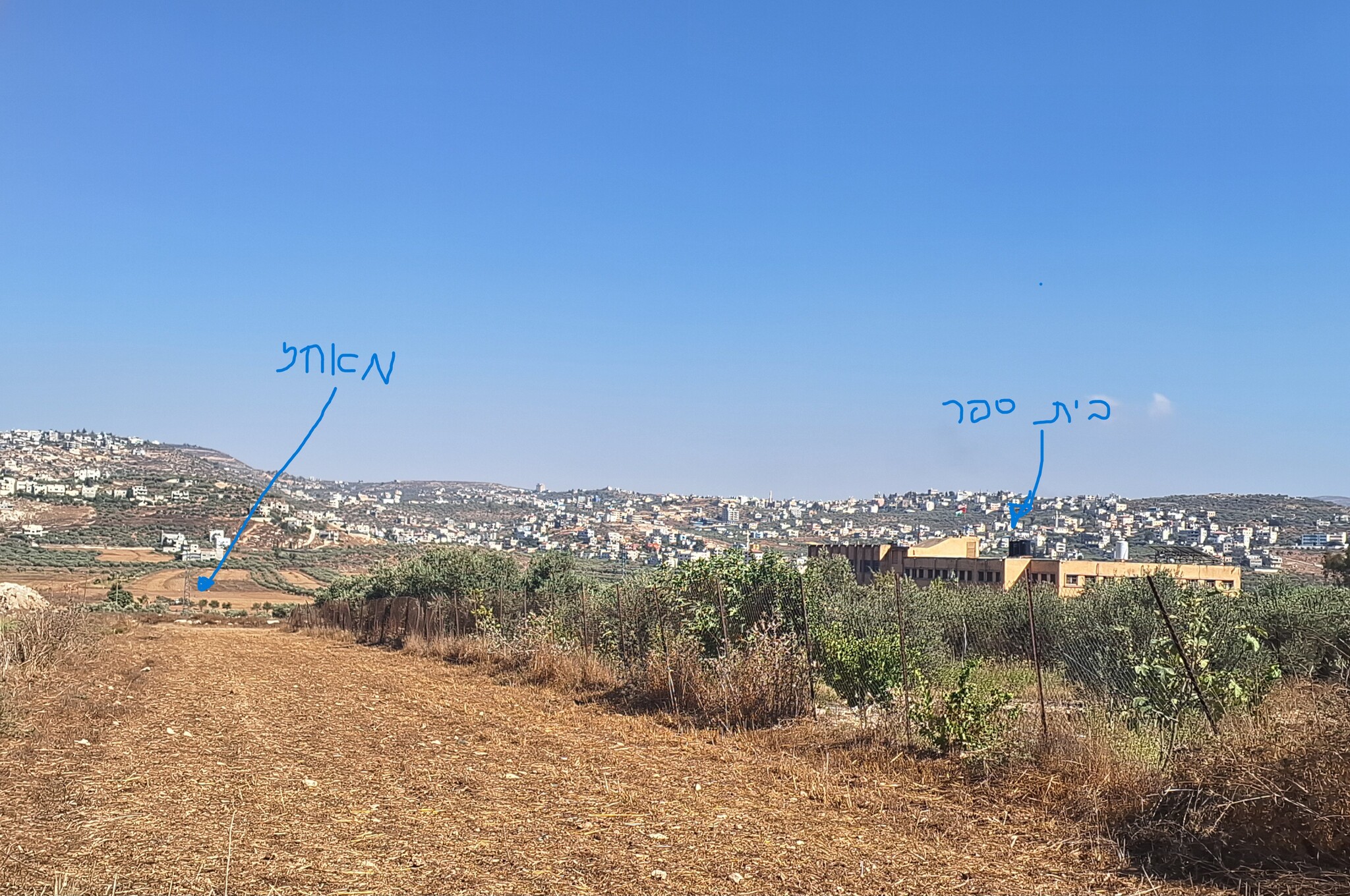 Ronit Dahan-RamatiAug-24-2026Huwara: The school on the outskirts of town and an outpost hidden among the trees
-
