
AM
HUWWARA, Thursday 27 May 2004 AMObservers: Shira S., Dina A., Ofra C., Yudit A/D (reporting) color=red>08:00 — Huwwara South (Ofra and Yudit) As soon as we arrived, the checkpoint commander came over, introduced himself by name and asked that we approach him only, and not the soldiers on duty. During our watch, there was a line of between 30-60 people, who waited a reasonable length of time, as did the vehicles that went through. There were some 10 detainees, kept there for an hour-and-a-half or more, baking in the sun, and shoved into a narrow strip of ground next to the checkpoint [ they are detained so that their ID card details can be cross-checked against a list compiled and maintained by the General Security Services (GSS) — also known by the Hebrew acronym Shabak or Shin Bet — a process that can take anywhere between 20 minutes and several hours]. A bulldozer was working in the ditch where the detainees usually wait, levelling the ground and extending the checkpoint area [it is to be “upgraded” to become the “Huwwara Terminal”]. All the detainees had claimed to be en route to hospitals which, according to the prevailing regulations, now offers the only prospect of entering the town for men under 35. When we tried to speed up the checks, the commander explained that irrespective of whether confirmation had arrived from the GSS, the policy was to detain them for three hours, even in the case of those who the soldiers know in advance are banned from entry. No concessions are made, we were told, so that ‘they’ will learn. “Otherwise ‘they’ will come all the time.”After three hours, six of the detainees were allowed through, while four were sent back to the village. One of the young men said he had an appointment for hospital tests, but he didn’t produce a referral or documents of any kind. The commander said he was lying. He apparently keeps coming with different stories ( but what choice does he have?) The young man tried to talk to him, but the commander said: “Instructions are that he can only go through on a stretcher in an ambulance!”A [Jewish Israeli] settler arrived and followed us around like a leech. We ignored him. He asked the commander to throw us out. The commander told him that he acted according to his own judgement and wasn’t influenced by either side. A “settler-watcher” arrived at the northern checkpoint as well, took out a video camera and aimed it at Shira and Dina. The commander immediately informed him that photography was forbidden at checkpoints.A patient with cardiac problems and heavy bleeding, who seemed to be in critical condition, arrived in a taxi. An ambulance came up to the checkpoint from the Nablus hospital, but the taxi-driver was forbidden to cross the line for taxis. After our intervention, the patient went through, but his two sons who were accompanying him were not let through.A father arrived with a sick child who hadn’t slept or eaten for two days, only vomited. Another patient had fierce stomach pains. Both were banned from crossing. The commander was totally unresponsive. Ofra summoned R., from the District Coordinating Office (DCO), who let them through [the DCO is the army unit that attends to civilian matters and usually has representatives at the checkpoints ostensibly to alleviate the lot of the Palestinians].Huwwara North — (Shira and Dina) There was almost no line, and most people went through quickly and easily. The procedure was efficient, but the commander answered us only in monosyllables. Of the eight detainees we found there, all but two had been released when we left. A taxi driver said that a month ago his ID card had been taken and now his car had been confiscated because he had driven over the line. At Shira and Dina’s intervention, the commander gave the man a note to pick up the car in three days time. R., who was still around, was sceptical about the confiscated ID card story , but said he would talk to K. the local DCO commander. We shall follow up. Several Palestinian students studying in Jordan were not even allowed out of Nablus.
Huwwara
See all reports for this place-
The Huwwara checkpoint is an internal checkpoint south of the city of Nablus, at the intersection of Roads 60 and 5077 (between the settlements of Bracha and Itamar). This checkpoint was one of the four permanent checkpoints that closed on Nablus (Beit Furik and Awarta checkpoints to the east and the Beit Iba checkpoint to the west). It was a pedestrian-only barrier. As MachsomWatch volunteers, we watched therre since 2001 two shifts a day - morning and noon, the thousands of Palestinians leaving Nablus and waiting for hours in queues to reach anywhere else in the West Bank, from the other side of the checkpoint the destination could only be reached by public transport. In early June 2009, as part of the easing of Palestinian traffic in the West Bank, the checkpoint was opened to vehicular traffic. The passage was free, with occasional military presence in the guard tower. Also, there were vehicle inspections from time to time. Since the massacre on 7.10.2023, the checkpoint has been closed to Palestinians.
On February 26, 2023, about 400 settlers attacked the town's residents for 5 hours and set fire to property, such as houses and cars. Disturbances occurred in response to a shooting of two Jewish residents of Har Bracha by a Palestinian Terrorist. The soldiers stationed in the town did not prevent the arson and rescued Palestinian families from their homes only after they were set on fire. No one was punished and Finance Minister Smotrich stated that "the State of Israel should wipe out Hawara." Left and center organizations organized solidarity demonstrations and support actions for the residents of Hawara.Hawara continued to be in the headlines in all the months that followed: more pogroms by the settlers, attacks by Palestinians and a massive presence of the army in the town. It amounted to a de facto curfew of commerce and life in the center of the city. On October 5, 2023, MK Zvi established a Sukkah in the center of Hawara and hundreds of settlers backed the army blocked the main road and held prayers in the heart of the town all night and the next day. On Saturday, October 7, 23 The "Swords of Iron" war began with an attack by Hamas on settlements surrounding Gaza in the face of a poor presence of the IDF. Much criticism has been made of the withdrawal of military forces from the area surrounding Gaza and their placement in the West Bank, and in the Hawara and Samaria region in particular, as a shield for the settlers who were taking over and rioting.
On November 12, 2023, the first section of the Hawara bypass road intended for Israeli traffic only was opened. In this way, the settlers can bypass the road that goes through the center of Hawara, which is the main artery for traffic from the Nablus area to Ramallah and the south of the West Bank. For the construction of the road, the Civil Administration expropriated 406 dunams of private land belonging to Palestinians from the nearby villages. The settlers are not satisfied with this at the moment, and demand to also travel through Hawara itself in order to demonstrate presence and control.(updated November 2023)
.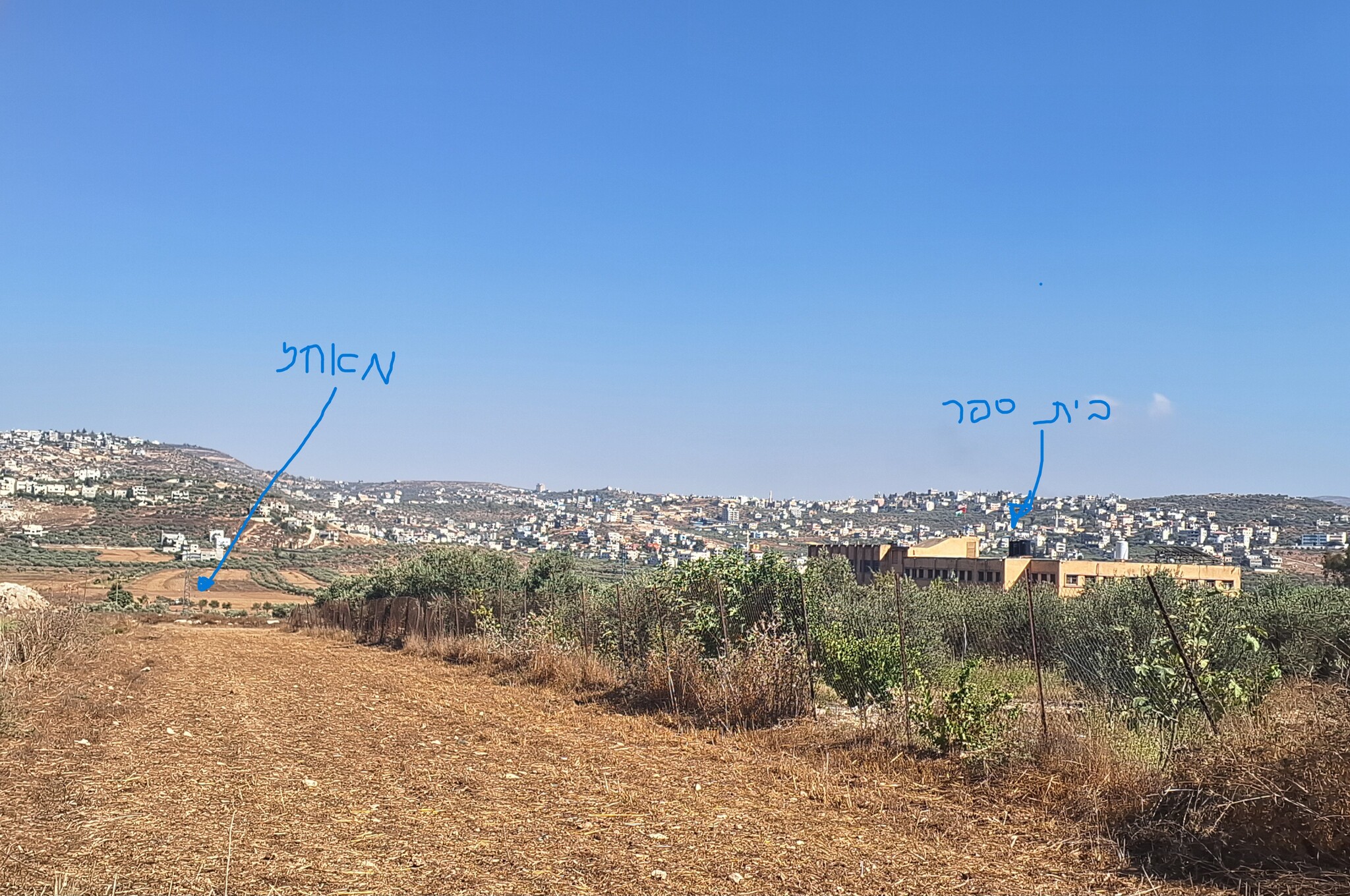 Ronit Dahan-RamatiAug-24-2026Huwara: The school on the outskirts of town and an outpost hidden among the trees
-
