
Huwwara PM
.HUWWARA, Thursday 1 July 2004 PMObservers: North: Ofra T., Sara H. (reporting): south: Ella H. (reporting) colour=red>We arrived at the north side at 14:00; there was only sparse traffic. The checkpoint is changing from a provisional installation to a terminal filled with concrete barriers . The detainees’ area was totally exposed to the sun and the detainees tried to improvise shade with whatever means were available.As we arrived, the ceremony of returning ID cards to the detainees was taking place, accompanied by a lecture from the soldier: “This is the last time! Without a permit, you can’t come in again, and if you get out some other way, you can’t come back!”There were some four or five detainees. The officer told us that soldiers had gone to the family of one of them and demanded that he come to the checkpoint. He had arrived there at 07:00 and had already been there seven hours!15:40: At least 50 people were waiting at the north gate, and the checking was slow and inefficient. The distance between the checking point to the hut where the Palestinians waited was at least 50 metres, with no contact between them. We asked a woman soldier why one of the soldiers didn’t go over and call people for checking, to which she replied: “And what if they blow themselves up on top of us?”We decided to start recording the time each detainee spent [waiting for security clearance] in detention. We asked the officer from time to time when they’d be released. He explained the long process and said he had to wait till at least four ID cards had accumulated before forwarding them [the checkpoint soldiers send the ID details of those they detain — mostly men between the ages of 16 and 30, sometimes even those who do have permits — to the General Security Services (GSS, or, in Hebrew, Shabak or Shin Bet) where the details are cross-checked against a list of security suspects. The check can take a considerable time — usually hours — and meanwhile the ID cards are held by the checkpoint soldiers, which makes the detainees virtually prisoners until clearance is phoned through by the GSS].16:00 – An Israeli Arab arrived with a passage permit from the army’s Civil Administration. He explained that G. had given it to him . The officer decided that the man was shouting and started “educating” him: “Don’t you dare talk to me like that!” etc. The man then called G. who talked to the officer who then let him through, but not before he had reproached the man: “Why didn’t you tell me…. Why did you talk to me like that?”.Meanwhile an answer came back from the GSS about the young man who’d been waiting since 07:00. The soldiers went over to him with rifles at the ready , handcuffed him, blindfolded him and pushed him onto a command car which took off for a destination unknown to us. 16:30 – A soldier with a rifle at the ready went over to the detainees and ordered them to sit with their backs to the checkpoint. We asked the officer why and he explained that he didn’t want them to observe the checkpoint. We’d better find out whether the detainees’ area can be run like a detention cell without officially being declared to be such.Huwwara South At 14:00, traffic at the entrance to Nablus was sparse, and there were almost no vehicles. Six detainees sat under the hot the sun, backs to the checkpoint. Every now and then, they “forgot” and turned round till the soldiers shouted at them. Sergeant A., the commander,greeted me warmly and wanted to know my motives for being there. I told him about the photographic exhibition [Breaking the Silence] arranged by several soldiers who’d served in Hebron, and their feelings about being there . He was attentive and tried to behave humanely.Instructions today were that whoever wasn’t a resident of Nablus or had no entrance permit to Nablus – couldn’t go in.Two young Palestinian women with US passports were not allowed in and asked my help. They’d come from Ramallah with their aunt and cousin from Nablus. R. from the District Co-ordinating Office (DCO) [the army section that handles civilian matters] didn’t answer when I tried phoning him. Sergeant A. gave me the number of A. from the DCO who promised to come within 45 minutes. I tried the Consular Section of the Foreign Ministry but they sent me back to the army. A. finally arrived and did let them through. The detainees were now dealt with relatively rapidly, and were released after not more than 45 minutes; they even got a drink of cold water from A. M., who replaced A., tried to be helpful but the line grew longer. When a woman appeared carrying a sick child back from a long stay in hospital, A. sent a soldier to check the cart loaded with her cases so as to speed up her passage..Along came a minibus with celebrants: a bridegroom, male guests, women of all ages, and children on their way to a [pre-nuptial] “hinna” ceremony. The wedding was to be tomorrow. The passage permit had discrepancies and the bride’s name, as it appeared on the document, wasn’t quite the same as thename given by the celebrants. A. agreed to my suggestion that the soldiers check them all, including the minibus, and finally he let them through.A woman member of the Palestinian parliament in her late 30s was not allowed through with her car because she didn’t have a permit for it. When approached, the DCO refused to let her through. Surprisingly enough, she took it well and expressed understanding for the soldiers, and interest in Machsomwatch. She then tried to arrange passage through the Palestinian DCO, and when we left after 17:00 she was still waiting. The pressure grew and the situation became more tense. The number of detainees increased and the soldiers couldn’t keep up with forwarding the details to the GSS for checking . There were separate lines for examining the documents and baggage of women, old people and over thirties and these categories went through first.A Border Police jeep suddenly stopped, and the Border Policemen created yet another group of detainees by taking the ID cards of people from all categories who’d already passed through the soldiers’ examination. They wrote down on a special form the ID numbers of thos detained in this new line. I couldn’t understand why they did it and why they created a further delay and yet more sense of frustration among the Palestinians. The watchers from Beit Iba and Huwwara North arrived and none of us succeeded in understanding this further delay, this post-checkpoint checkpoint. The Border Police, for their part, were “not prepared to go into details” with us. A donkey belonging to M., a lad who sells soft drinks at the checkpoint , escaped and was caught and taken away by two [Israeli Jewish] settlers. I called U.Z. who said it wasn’t his business; I should contact the police, he said. But the police number was constantly engaged. Our driver thinks the settlers were making for Har Bracha. The detainees were all released after some two hours at most. But throughout that time, they had no shade and no water — why should this be so?
Huwwara
See all reports for this place-
The Huwwara checkpoint is an internal checkpoint south of the city of Nablus, at the intersection of Roads 60 and 5077 (between the settlements of Bracha and Itamar). This checkpoint was one of the four permanent checkpoints that closed on Nablus (Beit Furik and Awarta checkpoints to the east and the Beit Iba checkpoint to the west). It was a pedestrian-only barrier. As MachsomWatch volunteers, we watched therre since 2001 two shifts a day - morning and noon, the thousands of Palestinians leaving Nablus and waiting for hours in queues to reach anywhere else in the West Bank, from the other side of the checkpoint the destination could only be reached by public transport. In early June 2009, as part of the easing of Palestinian traffic in the West Bank, the checkpoint was opened to vehicular traffic. The passage was free, with occasional military presence in the guard tower. Also, there were vehicle inspections from time to time. Since the massacre on 7.10.2023, the checkpoint has been closed to Palestinians.
On February 26, 2023, about 400 settlers attacked the town's residents for 5 hours and set fire to property, such as houses and cars. Disturbances occurred in response to a shooting of two Jewish residents of Har Bracha by a Palestinian Terrorist. The soldiers stationed in the town did not prevent the arson and rescued Palestinian families from their homes only after they were set on fire. No one was punished and Finance Minister Smotrich stated that "the State of Israel should wipe out Hawara." Left and center organizations organized solidarity demonstrations and support actions for the residents of Hawara.Hawara continued to be in the headlines in all the months that followed: more pogroms by the settlers, attacks by Palestinians and a massive presence of the army in the town. It amounted to a de facto curfew of commerce and life in the center of the city. On October 5, 2023, MK Zvi established a Sukkah in the center of Hawara and hundreds of settlers backed the army blocked the main road and held prayers in the heart of the town all night and the next day. On Saturday, October 7, 23 The "Swords of Iron" war began with an attack by Hamas on settlements surrounding Gaza in the face of a poor presence of the IDF. Much criticism has been made of the withdrawal of military forces from the area surrounding Gaza and their placement in the West Bank, and in the Hawara and Samaria region in particular, as a shield for the settlers who were taking over and rioting.
On November 12, 2023, the first section of the Hawara bypass road intended for Israeli traffic only was opened. In this way, the settlers can bypass the road that goes through the center of Hawara, which is the main artery for traffic from the Nablus area to Ramallah and the south of the West Bank. For the construction of the road, the Civil Administration expropriated 406 dunams of private land belonging to Palestinians from the nearby villages. The settlers are not satisfied with this at the moment, and demand to also travel through Hawara itself in order to demonstrate presence and control.(updated November 2023)
.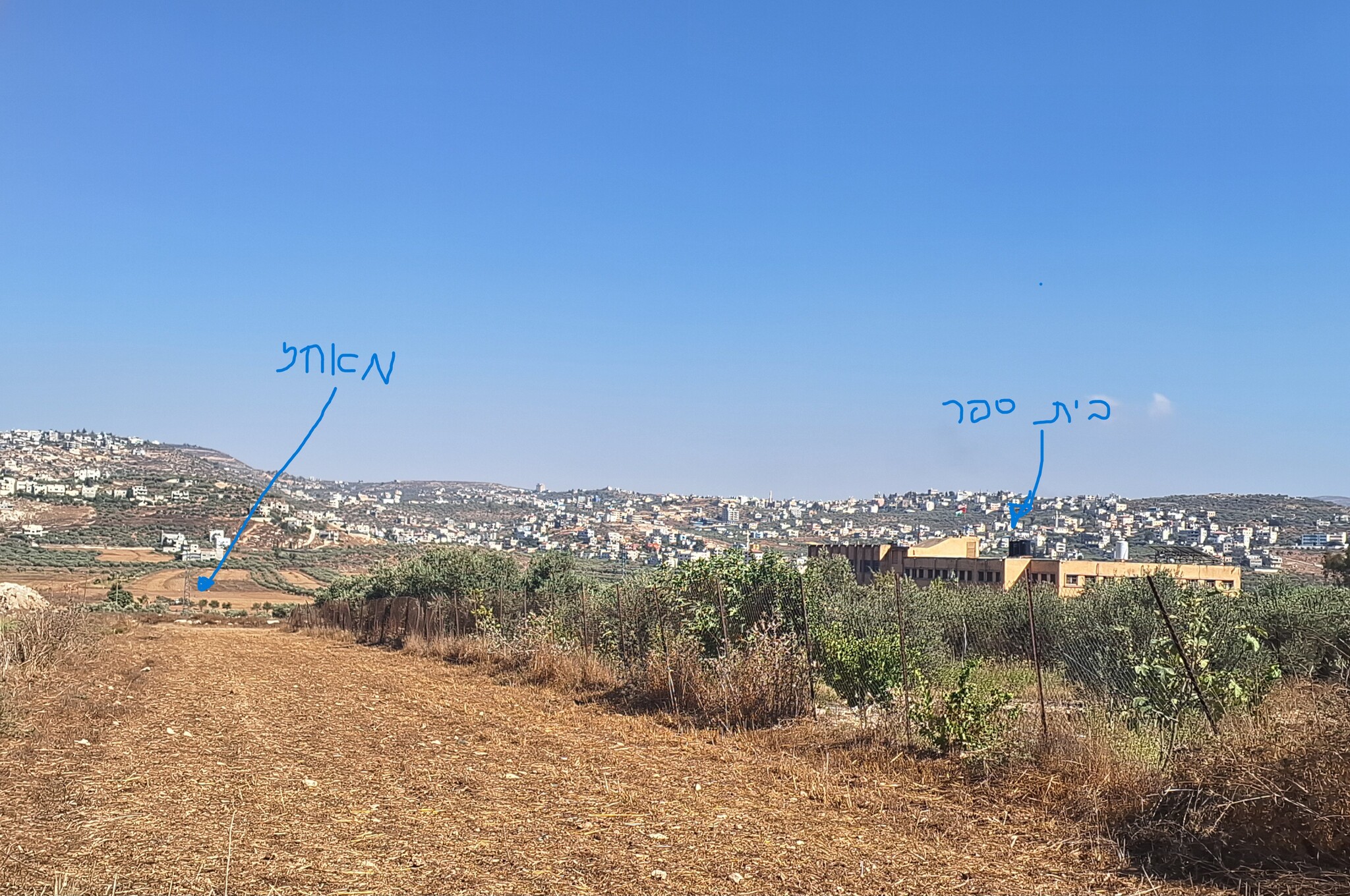 Ronit Dahan-RamatiAug-24-2026Huwara: The school on the outskirts of town and an outpost hidden among the trees
-
