
Huwwara AM
HUWWARA, Saturday 7 August 2004 AM Observers: Hedva A., Hanna B., Hava H., Neta (a guest from the USAwhere she is a student ) and Nina M. (reporting) colour=red>Summary: The commander of Huwwara South, U., behaved outrageously and caused much suffering to passing Palestinians; but Huwwara North checkpoint had a sensible commander, Sh. The contrast between the two checkpoints provides yet another object lesson in the extent to which the conduct of the checkpoint depends on the individual soldiers on duty. It is important to point that the soldiers appeared to be very much constrained by being ordered to make sensible concessions towards the Palestinians, but unfortunately appeared far less inhibited by any orders that somehow gave them scope to take revenge, to humiliate or to be violent. Huwwara South: When we arrived, we found about 10 detainees , some of whom had already been there for two hours [they are held pending the cross-checking of their ID details by the General Security Services (GSS — aka the Shabak or the Shin Bet ) against a central list of security suspects. The check can take a long time, especially if the checkpoint soldiers are dilatory in sending the details to the GSS or, once the check is completed, if they are equally slow to release the detainees who are virtually held captive all this time since the soldiers hold their IDs until clearance arrives]. The commander, U., refused to communicate with us and forbade both the other soldiers and the District Co-ordinating Office (DCO) representatives to speak to us [the DCO is the army section handles civilian matters; it usually has representatives at the checkpoints, ostensibly to alleviate the lot of the Palestinians]. He introduced a hysterical and violent atmosphere without any objective reason, for there were no big crowds at the checkpoint. One soldier in particular cooperated to the full in all this. Thus, one man with a indisputably valid permit to enter Nablus wasn’t even given a chance to show his permit, but was simply turned back quite arbitrarily. The same happened with an 18-year-old man accompanied by his father as he went to register for studies at the Nablus An- Najah University. U. shouted brutally at an old man with Israeli ID who wished to enter Nablus, and U.’s close associate shouted at very sick old lady who was being helped by her young son (this particular episode ended in the soldier agreeing to put her into a passing ambulance; he then turned to us to ask “Is that good enough for you?” A UN worker whose documents had expired one month ago and who was on his way to renew them had the documents confiscated and was given a hefty push by U., just to underline the point. When the man tried to move away from U., he shouted at him “”Heh! Are you try to hit me!” Altogether, U. lost no opportunity in trying to pin accusations on to the Palestinians: There was, for example, the instance of the two men (a Palestinian with Israeli citizenship and a Palestinian with a Jordanian passport), both holding proper papers, who’d given a Palestinian family a lift from the Tapuach junction to Huwwara. The head of the family had a permit to move around the West Bank. U. tried to prevent the release of all three men by inventing accusations that the Israeli and the Jordanian had tried to evade the checkpoint and drive straight through, and, further, that they had been transporting persons who had been in Israel illegally.U. and his fellow soldier shouted and pushed people around so violently, creating so much tension that every now and then we feared shots must follow. We called Y. and M. from the Israel army spokesperson’s office, E. from the army’s “humanitarian” hotline and the DCO at Beit El. One of the local senior army personnel arrived and we told him that we couldn’t understand why such a sensitive place as Huwwara South checkpoint should be under the supervision of a man like U. How many reports must the press publish to effect a change? U. who, as we have reported, refused to speak to us, heard these complaints of ours and came over to ask : “What moral basis have you got for talking like that?” After the arrival of the senior office the atmosphere calmed down.It is perhaps worth adding that the behaviour of the DCO representatives was also very problematic. One, whom we met on our arrival, said he did not want to speak with us , because one of our Machsomwatch colleagues had called him a fascist. Another was very much influenced by U., although he did show some good will. When we asked a third DCO officer, G., to help with a student who had an exam at An-Najah university at 09:00, he replied: “So what! So he won’t get there on time! I hate Palestinians, I wish they’d all just disappear!” And that was the end of it: we couldn’t help. The student had arrived at the checkpoint at 06:00 and had been detained ever since. When we left at 11:00 he was still there — nobody would listen. Huwwara North: The running of this checkpoint was the absolute opposite! There was no sign of verbal or physical violence. The commander, Sh., was polite to everybody, and showed lots of common in managing the situation. That applied equally to his soldiers although they implemented the restrictive orders to the last letter.
Huwwara
See all reports for this place-
The Huwwara checkpoint is an internal checkpoint south of the city of Nablus, at the intersection of Roads 60 and 5077 (between the settlements of Bracha and Itamar). This checkpoint was one of the four permanent checkpoints that closed on Nablus (Beit Furik and Awarta checkpoints to the east and the Beit Iba checkpoint to the west). It was a pedestrian-only barrier. As MachsomWatch volunteers, we watched therre since 2001 two shifts a day - morning and noon, the thousands of Palestinians leaving Nablus and waiting for hours in queues to reach anywhere else in the West Bank, from the other side of the checkpoint the destination could only be reached by public transport. In early June 2009, as part of the easing of Palestinian traffic in the West Bank, the checkpoint was opened to vehicular traffic. The passage was free, with occasional military presence in the guard tower. Also, there were vehicle inspections from time to time. Since the massacre on 7.10.2023, the checkpoint has been closed to Palestinians.
On February 26, 2023, about 400 settlers attacked the town's residents for 5 hours and set fire to property, such as houses and cars. Disturbances occurred in response to a shooting of two Jewish residents of Har Bracha by a Palestinian Terrorist. The soldiers stationed in the town did not prevent the arson and rescued Palestinian families from their homes only after they were set on fire. No one was punished and Finance Minister Smotrich stated that "the State of Israel should wipe out Hawara." Left and center organizations organized solidarity demonstrations and support actions for the residents of Hawara.Hawara continued to be in the headlines in all the months that followed: more pogroms by the settlers, attacks by Palestinians and a massive presence of the army in the town. It amounted to a de facto curfew of commerce and life in the center of the city. On October 5, 2023, MK Zvi established a Sukkah in the center of Hawara and hundreds of settlers backed the army blocked the main road and held prayers in the heart of the town all night and the next day. On Saturday, October 7, 23 The "Swords of Iron" war began with an attack by Hamas on settlements surrounding Gaza in the face of a poor presence of the IDF. Much criticism has been made of the withdrawal of military forces from the area surrounding Gaza and their placement in the West Bank, and in the Hawara and Samaria region in particular, as a shield for the settlers who were taking over and rioting.
On November 12, 2023, the first section of the Hawara bypass road intended for Israeli traffic only was opened. In this way, the settlers can bypass the road that goes through the center of Hawara, which is the main artery for traffic from the Nablus area to Ramallah and the south of the West Bank. For the construction of the road, the Civil Administration expropriated 406 dunams of private land belonging to Palestinians from the nearby villages. The settlers are not satisfied with this at the moment, and demand to also travel through Hawara itself in order to demonstrate presence and control.(updated November 2023)
.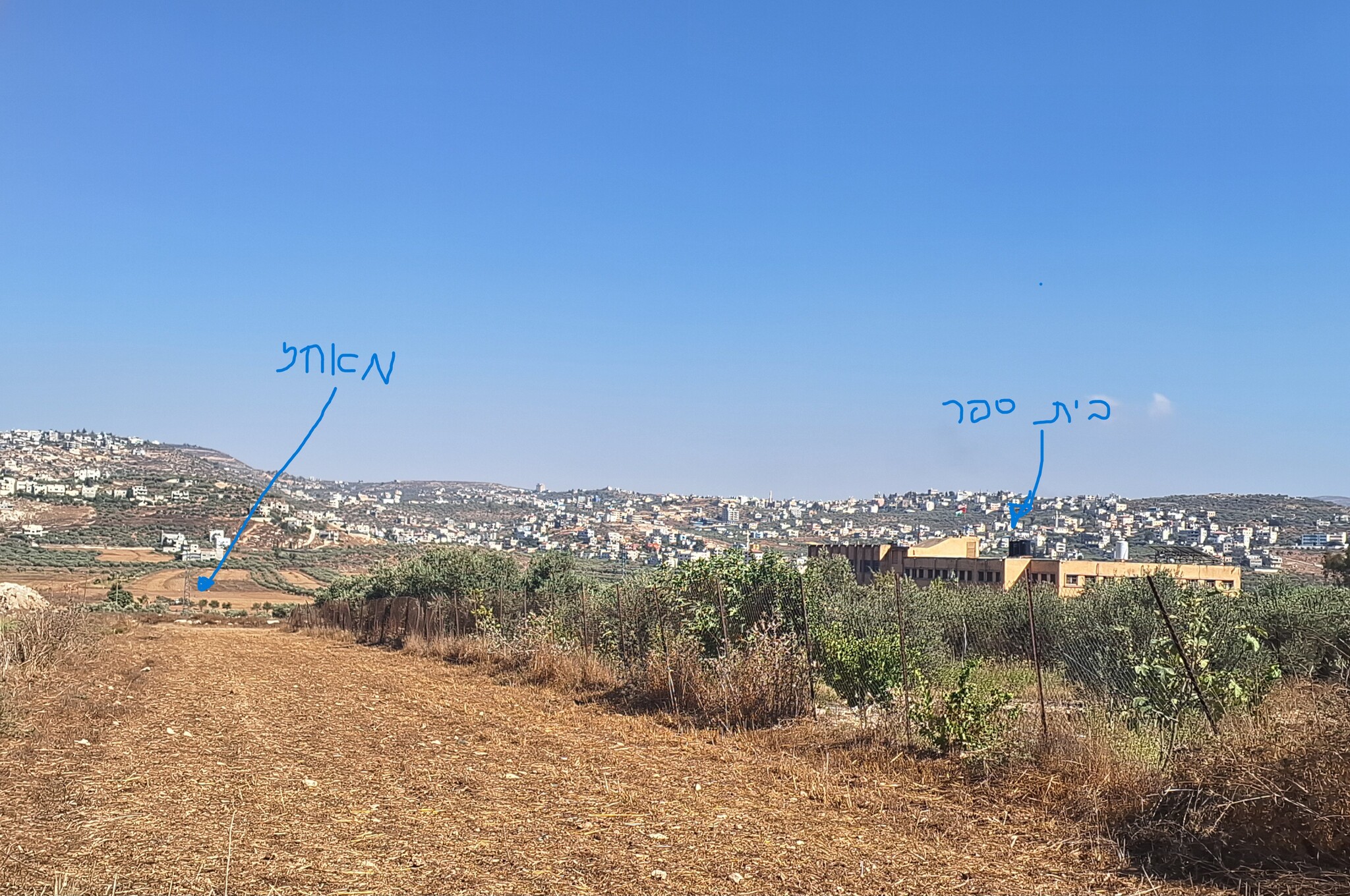 Ronit Dahan-RamatiAug-24-2026Huwara: The school on the outskirts of town and an outpost hidden among the trees
-
