
Huwwara
Huwara South Monday 20.9.04 noonObservers: Ora (guest), Tal H., Aya K. (reporting)Huwwara is still, the streets are empty, all the shops are closed. A ghost town.We see a man walking by, N. asks him what happened, and he says that soldiers ordered all the shops closed. We called the “Humanitarian” hotline of the army, as well as the army spokesperson’s bureau – both, in my opinion, the Occupation’s PR agencies… Anyway, as a part of our protest we demand answers, for the record. And it seems that at times our calls, even when answered by tiring, transparent lies as a part of the system, tickle the soul of the Occupation into giving in (there are plenty of other arenas for cruelty, so once in a while such surrender is no big deal). When Jewish women are eye-witnesses. Or when too many questions are asked… This time, incidentally, it didn’t work.The army spokesperson didn’t answer our query, and one of the hotline operators, after much pressure on our part, answered that this was “shop-shutting procedure”. Another several calls as to “why?” and he answered that there was rioting the day before so… “Is this a punishment?” I asked.“No way…”Another touch of Occupation lore: a well-known radio reporter called, asking to verify the rumor that the wife of I.(important Civil Administration person) is a Machsomwatch member. We took the opportunity to tell him about the shut shop routine in Huwara, where a whole town has been denied its livelihood, schools etc. and added what we had found out in the meantime, that both Huwara and Beit Furik CPs were under total “life halt” and are closed.This (unlike the rumor), he explained, is not news.Huwara South. The checkpoint has been closed for about an hour. Dozens of people crowd behind the infamous turnstiles. Unbearable stench everywhere. The two toilets placed right next to the waiting line, already mentioned in previous reports, are not connected to any sewage pipes, and the feces just hang outthe pipe openings in the rear, pouring out onto the CP ground, a meter or two away from the waiting line of people. I have no words to describe this. Suffice it to say breathing was a challenge. Looking was revolting. If this innovation is intentional, it is one of the most sophisticated methods of humiliation invented by the army. If not intentional, this is one of the worst symptoms of brute persecution. What does the occupier assume? That “they” are not disgusted with the stench so close? That they do not have hygienic needs, even minimal? That “their” sense of smell is any different than “ours”?What has whoever did this been thinking, or rather what has not occurred to him? It has not occurred to him that these are literally human beings! But why am I surprised? The basis for it all… Could such normal soldiers maintain this degrading regime faced with real human beings? No. In order to keep doing this, they must not be regarded as human beings. Not like us. Not really. So why do I wonder at these toilets, really?According to army sources, the checkpoints were closed because of some secret intelligence, some serious top-security stuff. One soldier said there was shooting in Nablus. Another person standing in line said Mofaz (Defense Minister) had crossed the CP earlier and that’s why it was closed. Nor did the soldiers seem to know why. Soldiers are not cruel, they only manifest all that is inherent in a soldier of an occupying army. One of them, E. merits favorable mention here (despite my sweeping view that nothing positive is to be said of any soldier since differences of degree are irrelevant, anyone there has crossed a line and the rest is marginal) – still I mention him here for the sake of other vigils. He is open to conversation. Doesn’t seem to see Palestinians as “people”, not quite, but still seems to feel better when he is helpful. And our appeals were met. He agreed to let a woman and her newborn baby pass despite the “ceasing of life” procedures, and let women with babies wait in the shade of the detainee shed. He agreed to hurry the ID check of a boy accompanying his mother to Nablus, and allowed and recommended a woman accompanying her sick mother to summon an ambulance, since ambulances were allowed through. Which, in itself, is outrageous because if an ambulance is allowed through, why can’t a sick person just be let through, period? It has to cost money which is lacking…Tal commented to soldier E. that the soldiers both address women as “girls” which is disrespectful, and even that is pronounced wrong, and that they should be addressed as women, “nisuan”. Although his first reaction was sardonic and defensive, he began to seriously apply this and addressed the women’s line properly from that point on.At 12:20 the CP was opened, or rather went back to its usual function, many prevented from crossing, some allowed along the known criteria.
Huwwara
See all reports for this place-
The Huwwara checkpoint is an internal checkpoint south of the city of Nablus, at the intersection of Roads 60 and 5077 (between the settlements of Bracha and Itamar). This checkpoint was one of the four permanent checkpoints that closed on Nablus (Beit Furik and Awarta checkpoints to the east and the Beit Iba checkpoint to the west). It was a pedestrian-only barrier. As MachsomWatch volunteers, we watched therre since 2001 two shifts a day - morning and noon, the thousands of Palestinians leaving Nablus and waiting for hours in queues to reach anywhere else in the West Bank, from the other side of the checkpoint the destination could only be reached by public transport. In early June 2009, as part of the easing of Palestinian traffic in the West Bank, the checkpoint was opened to vehicular traffic. The passage was free, with occasional military presence in the guard tower. Also, there were vehicle inspections from time to time. Since the massacre on 7.10.2023, the checkpoint has been closed to Palestinians.
On February 26, 2023, about 400 settlers attacked the town's residents for 5 hours and set fire to property, such as houses and cars. Disturbances occurred in response to a shooting of two Jewish residents of Har Bracha by a Palestinian Terrorist. The soldiers stationed in the town did not prevent the arson and rescued Palestinian families from their homes only after they were set on fire. No one was punished and Finance Minister Smotrich stated that "the State of Israel should wipe out Hawara." Left and center organizations organized solidarity demonstrations and support actions for the residents of Hawara.Hawara continued to be in the headlines in all the months that followed: more pogroms by the settlers, attacks by Palestinians and a massive presence of the army in the town. It amounted to a de facto curfew of commerce and life in the center of the city. On October 5, 2023, MK Zvi established a Sukkah in the center of Hawara and hundreds of settlers backed the army blocked the main road and held prayers in the heart of the town all night and the next day. On Saturday, October 7, 23 The "Swords of Iron" war began with an attack by Hamas on settlements surrounding Gaza in the face of a poor presence of the IDF. Much criticism has been made of the withdrawal of military forces from the area surrounding Gaza and their placement in the West Bank, and in the Hawara and Samaria region in particular, as a shield for the settlers who were taking over and rioting.
On November 12, 2023, the first section of the Hawara bypass road intended for Israeli traffic only was opened. In this way, the settlers can bypass the road that goes through the center of Hawara, which is the main artery for traffic from the Nablus area to Ramallah and the south of the West Bank. For the construction of the road, the Civil Administration expropriated 406 dunams of private land belonging to Palestinians from the nearby villages. The settlers are not satisfied with this at the moment, and demand to also travel through Hawara itself in order to demonstrate presence and control.(updated November 2023)
.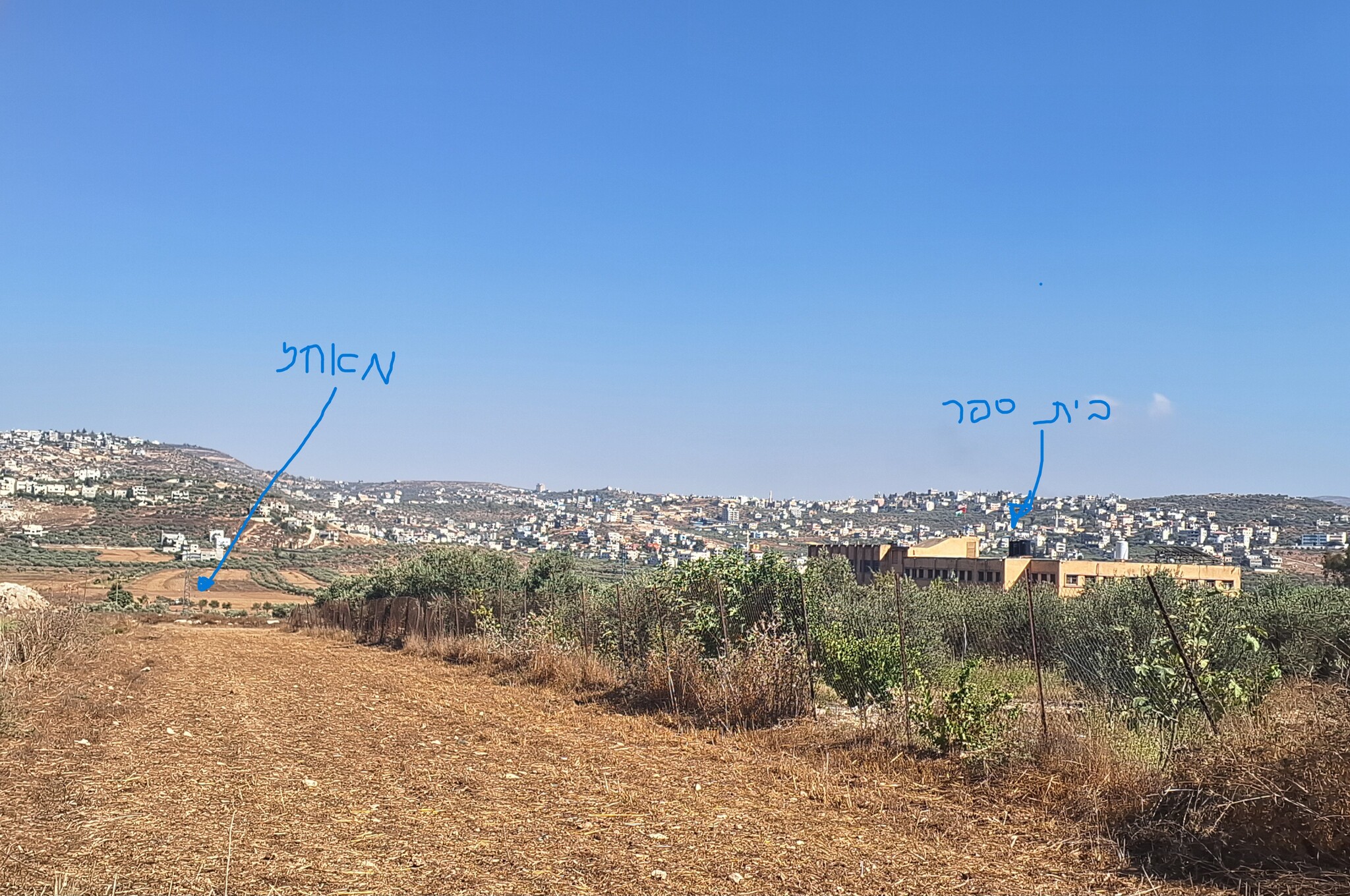 Ronit Dahan-RamatiAug-24-2026Huwara: The school on the outskirts of town and an outpost hidden among the trees
-
