
Huwwara
Huwwara Monday 27.9.04 noon (10:50-13:50)Observers: Esti T., Gal K., Tal H., Aya K. (reporting)Guests: Shani W., Panela (Swedish journalist)Huwara South15 people detained in the pen for the “routine” ID check, another several people turned back without the “privilege” of having their IDs checked. They appeal to us for help. Students (not of Al Najah Univ. in Nablus, which has complied with the Occupation Government’s conditions not to enable any political organization and therefore its students are permitted to reach their studies) from Al Kuds Univ., one student of the Nursing College, were refused, one hour before their examination. We could do nothing.A man from Ramallah seeks permission to visit his father, hospitalized in Rafidiya Hospital in Nablus, and is refused. He begs us, we tell the soldier he promises to come back and wants to leave his ID at the CP as a guarantee. But there is no criterion to this effect, even among the so-called “humanitarian” criteria. Visiting your sick father in a city that is not your place of residence is not even forbidden, it just isn’t included in any possible wording. And of course he is waved away from the CP without any explanation. What is there to explain to a man whose father is ill, and perhaps alone without a family, and perhaps it is terminal, what is there to explain to a Palestinian who has no proper name, no proper identity or face, who is just wasting the time of Israeli rhinoceroses, officials of the Occupation monster, and all for a nameless problem.The toilets next to the waiting line are not connected to any sewer. The stench is as unbearable and unchanging, feces and urine dripping out the plastic piping hardly a yard away from the people standing in line, and pile up.We spotted the soldier with the tell-tale antenna, the CP commander. Are you the commander here? No response. Sealed face. Sealed soul. All through our vigil he does nothing but block. Both within his duty, to block people’s way to their lives, by all means – and beyond the call of duty, blocking any attempt on the part of DCO representatives who occasionally recommend certain alleviation, rare cases that would later serve as fig leaves… Fitting of his post, again and again he prevented all and any from passing. No, we wouldn’t see him ever yielding, influenced, affected. Not he, not the tight-lipped hero of Israel.A couple, she with a Jordanian passport, he Palestinian, live in Nablus, on their way to a doctor’s appointment. They applied for ID 5 years ago and were refused. (Issuing a Palestinian ID is a matter dependent on Israeli approval. Israel almost never approves such steps. Why? The winds of transfer, perhaps. Or just the usual, constructed meanness). We arrived after the DCO officer had spoken with them, contradicting the soldiers’ demands. She is a liar, one of the soldier scolds the DCO officer. She ran. Not like the sick woman she pretends to be. And maybe she ran because she has learned to run of fear of soldiers because he is a soldier, has this occurred to you?We thought, in silence. For at least 2 hours, the DCO officers looked into the matter and contrary to the soldiers’ demand not to let the couple through, concluded that they are cleared. But by the time this conclusion had been reached, the doctor’s appointment was long missed, and they left.An elderly man, looking quite ill, on his way to Nablus for a medical examination at a private clinic, suffers of chronic digestive tract problems. Resides in Hebron. His medical form is dated but the summons is open, not limited to any special date. He explains that he has not been able to reach it, we all know how difficult it is to move around. But now he must, he is ill again, and he repeatedly begs to let him through. We tried our luck with the DCO officer who said he has no way of knowing whether this is the truth… And what about the terror attack in Jerusalem… We protest – can’t claim all and everyone are guilty until proven innocent, one can’t prove anything…“What am I supposed to do, you tell me!” he says. “Shall I believe him and let him pass, or check him?” “You can call the clinic and ask if they know him”, I suggest. “Call the clinic?” “Yes.” “How would I know they’re not lying?”“Well, you admit that you wouldn’t believe any Palestinian since he is a Palestinian”… “Yes”, he says, without the least bit of irony.So I said, unfortunately sounding my thought instead of just thinking it: “Well, no doubt you are fit to be an occupier”. We appealed to the Center for the Protection of the Individual, who called the Nablus clinic, who sent a fax confirming they knew him, to what is called the “humanitarian” hotline. The fax did not arrive at the right place, more time went by, finally it did arrive, more time passed, and finally after hours spent at the CP, the man passed.One of us called R of the DCO to complain about the many problems that even the officer, when he does comply, cannot handle alone, and eventually another officer was sent to the CP.A male (not young) volunteer with the Palestinian Rescue Organization is not permitted to enter Nablus because the soldiers are not familiar with this organization. Which means that such an organization does not exist, according to them. Nor did the DCO representative know it, so that was that. Nothing to do about it. At the fig leaf a.k.a. the “humanitarian hotline”, the soldier answered that this was a very well-known organization, certainly he knows it. But the problem is not the organization, the problem is that this man has no special permit. He needs one.A boy from Nablus with a brand new “magnetic” card is sent back for not having a special permit. But he can’t get a special permit right away, and to get to the DCO where the permit would be applied for, he needs to cross the CP and for that he needs a permit… Well, okay, said the soldier, but first go wait in the detainee pen. “Sit another three hours?” The boy gave me a sad look, and off he went.A man with a medical summons for today is sent back without any explanation. We pressured, the DCO officer checked. It’s a dilemma. He calls the CP commander over and, discreetly (male pride? occupation savvy?) hints that all’s well and why should the man not be allowed through? Then there were whispers out of our earshot. He comes back. The CP commander said the fellow needs an ambulance and he knows it, says the DCO officer. Are these the instruction? we ask. Does that mean that anyone who has a valid summons for a medical examination must order an ambulance (which costs money)? Okay, I’ll ask, concedes the DCO officer and goes once again, whispering with the CP commander. I turned my back, knowing the rules of the game and thus, without my looking, without anything happening, with the slightest finger-gesture, he was signaled to pass. He, knowing their rules, did not thank us but, facing forward, hurried away as fast as he could.A young couple, the wife pregnant and holding a year old baby girl, on their way home to Nablus. He, like everyone else, holding an ID that confirms he lives in Nablus but because he is of the “wrong” age group, must still spend those long hours as a detainee on that ever-fluctuating but always lengthy axis of time that is the so-called ID check wait (whose mere existence is built-in harassment). The wife is allowed passage but she wouldn’t move, wouldn’t even consider proceeding without her spouse. We appealed to the DCO officers 3 times, who were convinced that hurrying up his procedures might be considered. But the soldier, the authority, said no.And we wonder if this is not just another sophisticated way to make sure thatnearly no one is considered eligible for passage.Are the DCO and the army intertwined, on the one hand, to create the fitting fig leaf for the sake of those who are shocked at the checkpoint horror stories, and on the other hand, to make sure that such harassment will persist legally and properly, and without obstacles?Because, contrary to the army’s claim that it gives proper answer to what it calls “humanitarian cases”, it positions at the CPs DCO officers who, as Arabic speakers and occasionally older personnel, but are not entitled to determine but only to recommend to the soldiers. And why should the soldier take the advice of whoever tells him to reconsider his decision to send a person away and deny him his right to his own life, at times literally? Why should he reconsider? He’s no sucker…Thus, even when the DCO proves to be more humane, hierarchy (intentional?) makes sure the army balances him out and still, nearly no one is allowed through and the system prevails.T., a 28-year old man who lives in Nablus is on his way home. His ID is taken for the check automatically conducted for all 16-35 year olds living in Nablus (those not living in Nablus are rejected without any check). At the point when we met him he had already been detained for 2.5 hours. And then he was ordered to sit. Just like that. And he wouldn’t. His back hurt, he had a herniated disk. 4 soldiers pounced on him, shackling his hands behind his back. The man was tall, upright, confident and good-looking, and was obviously not fearful or cowering. He looked at his occupiers in the face, eyes level, and spoke from there. Why are you acting like this, he asked politely. He sounded poised, manly, proud. His only sin, we think, besides being Palestinian, was that he wouldn’t take upon himself any of the roles that the soldiers allow Palestinian men to take up in this context: he was neither servile nor raging. He gazed at them simply, uncompromisingly. He saw them just as they were. And this, of all things, was unbearable for them. He was ordered roughly to get back in the pen, and refused. Then he entered. One of the other detainees freed his hands of the shackle. So the soldiers shackled him again, more tightly this time. The plastic shackle burrowed in his wrists,hands swelling. Esti spoke to him about her son Daniel, a draft resister recently released from months in jail. Her words amazed and thrilled him.After 4 hours of being detained, and over an hour with shackles, he was to be taken elsewhere by an officer who showed up. We told this officer that this was a punishment for nothing he had done. We had been there and seen and heard it all. The officer ignored us, face sealed and self-important. Esti with her video camera was there all the time, close up, didn’t miss a thing, repeating again and again for all the soldiers to hear, that we are witnesses that he had not done a thing. She got his name, ID number and cell phone number, stuck a note with her own number in his pocket, and added while filming that if anything happens to him, we’ll be in the know, we’re his witnesses. Less than 20 minutes later, while we were already driving back, he called to say he’d been released. “Tell your friends I’m free, and tell your son I respect him very much.”Huwara NorthMany detainees. A man over 35 years of age can’t understand why he’s being detained. Tells us he always passes without any problems. Why today? Why for such a long time? A soldier whispers – the man’s cousin committed suicide 2 weeks ago. He doesn’t understand the connection, but that’s the reason. He’s going to be taken in for questioning.The CP commander paces around with his rifle pointing up in the air. Several women who took time out of the detainee pen and leaned upon the concrete wall are ordered back in. Order is order.A girl-soldier directs an old lady into the small holding cell with the blue metal door, another girl-soldier guards the entrance with a drawn rifle. Shani asks her why. She doesn’t know, she barks: it’s none of our business.All rifles drawn, but carelessly.More and more people are not allowed to move on, more detainees, elderly, women, children, dozens of people. No one is let through.A man from Hares who’s been working at the Barkan settlement for 7 years, a foreman, came into Nablus to draw some money and on his way back is held up. Can’t understand this – he’s been working “for us”, he’ll be late for work, why him? he works in Barkan, here’s his paper. The settlement is a good place, they don’t discriminate between Jews and Arabs. We should tell this to the officer. We did. “What has that got to do with anything?” said the officer, shrugging.A soldier tells an old man, “have a nice day” and means it. The man stops, startled, then continues, hurriedly, not grateful nor saying anything. The soldier doesn’t realize he’s wearing a helmet and holding a rifle, and that there’s no way that the man whose life is thus on hold would appreciate the greeting, understand it as such. Asking why the general delay and the unusual age groups, we were told by the soldier that they got these strange orders. That all Awarta residents were detained. And not just Awarta. And children between 12 and 16, and all persons of a certain name, and other such strange orders.I am ashamed to get back to the pen, know that all eyes are looking at me for I had spoken to the officer. What shall I tell them, that all Palestinians are now detained? Why?A 45-year old man with a fractured leg was in Nablus for treatment, no cast, just a sort of nail inside. He can’t stand the pain any longer and asks us to appeal to the officer again. I went over, asked. No news. All are detained.Shouldn’t at least the worst cases be checked right away? The guy with the fracture. “You yourself said there was no time limit now”, I remind the officer. “No, it’s problematic. That’s just the way it is”, he explains, turning away.I drop away from him as from an overfilled cup.After people are allowed to pass the turnstiles (if they are), they go to the x-ray machine van, the last stop. They load their belongings in on one side, the bags cross a short distance and very rapidly reappear on the other side, to a chute whose tip is about one meter in the air. The bags get there and fall to the dusty ground. Some people try to run, usually to no avail, Others don’t even try, some don’t believe this could be, breathless old and young rush to try and catch at least some of the load.Gal started this: she stood at the other end and kept the bags from falling to the ground until the people managed to make the whole round. At some point we joined her, for that was the only thing we could do on that horrible day at Huwara. To prevent at least as long as we were there some bags from falling on the ground, getting torn and scattering.On our way home, we called the army spokesperson to complain about a whole village being detained, with little children, until further notice.“Haven’t you heard? scolded the soldier, unbelieving. “Don’t you listen to the news?”Arriving as usual at Kfar Qassem for coffee and sharing our reports, taking a breath together, we heard the news: a settler from Itamar killed a Palestinian (not murdered. Jews are murdered. Palestinians are – at the most – killed, usually not even that) who did not obey him on the road. That was on the news. So he was right, the soldier from the Occupation Army’s PR office a.k.a spokesperson. A Jewish settler murdered a Palestinian from Salem village (the soldiers hadn’t yet known it was Salem for they detained Awarta villagers as well as residents of all other villages around including Salem). What could be more logical?Around 3:30 p.m. people began to be let through. At least 4 hours after they were first detained.
Huwwara
See all reports for this place-
The Huwwara checkpoint is an internal checkpoint south of the city of Nablus, at the intersection of Roads 60 and 5077 (between the settlements of Bracha and Itamar). This checkpoint was one of the four permanent checkpoints that closed on Nablus (Beit Furik and Awarta checkpoints to the east and the Beit Iba checkpoint to the west). It was a pedestrian-only barrier. As MachsomWatch volunteers, we watched therre since 2001 two shifts a day - morning and noon, the thousands of Palestinians leaving Nablus and waiting for hours in queues to reach anywhere else in the West Bank, from the other side of the checkpoint the destination could only be reached by public transport. In early June 2009, as part of the easing of Palestinian traffic in the West Bank, the checkpoint was opened to vehicular traffic. The passage was free, with occasional military presence in the guard tower. Also, there were vehicle inspections from time to time. Since the massacre on 7.10.2023, the checkpoint has been closed to Palestinians.
On February 26, 2023, about 400 settlers attacked the town's residents for 5 hours and set fire to property, such as houses and cars. Disturbances occurred in response to a shooting of two Jewish residents of Har Bracha by a Palestinian Terrorist. The soldiers stationed in the town did not prevent the arson and rescued Palestinian families from their homes only after they were set on fire. No one was punished and Finance Minister Smotrich stated that "the State of Israel should wipe out Hawara." Left and center organizations organized solidarity demonstrations and support actions for the residents of Hawara.Hawara continued to be in the headlines in all the months that followed: more pogroms by the settlers, attacks by Palestinians and a massive presence of the army in the town. It amounted to a de facto curfew of commerce and life in the center of the city. On October 5, 2023, MK Zvi established a Sukkah in the center of Hawara and hundreds of settlers backed the army blocked the main road and held prayers in the heart of the town all night and the next day. On Saturday, October 7, 23 The "Swords of Iron" war began with an attack by Hamas on settlements surrounding Gaza in the face of a poor presence of the IDF. Much criticism has been made of the withdrawal of military forces from the area surrounding Gaza and their placement in the West Bank, and in the Hawara and Samaria region in particular, as a shield for the settlers who were taking over and rioting.
On November 12, 2023, the first section of the Hawara bypass road intended for Israeli traffic only was opened. In this way, the settlers can bypass the road that goes through the center of Hawara, which is the main artery for traffic from the Nablus area to Ramallah and the south of the West Bank. For the construction of the road, the Civil Administration expropriated 406 dunams of private land belonging to Palestinians from the nearby villages. The settlers are not satisfied with this at the moment, and demand to also travel through Hawara itself in order to demonstrate presence and control.(updated November 2023)
.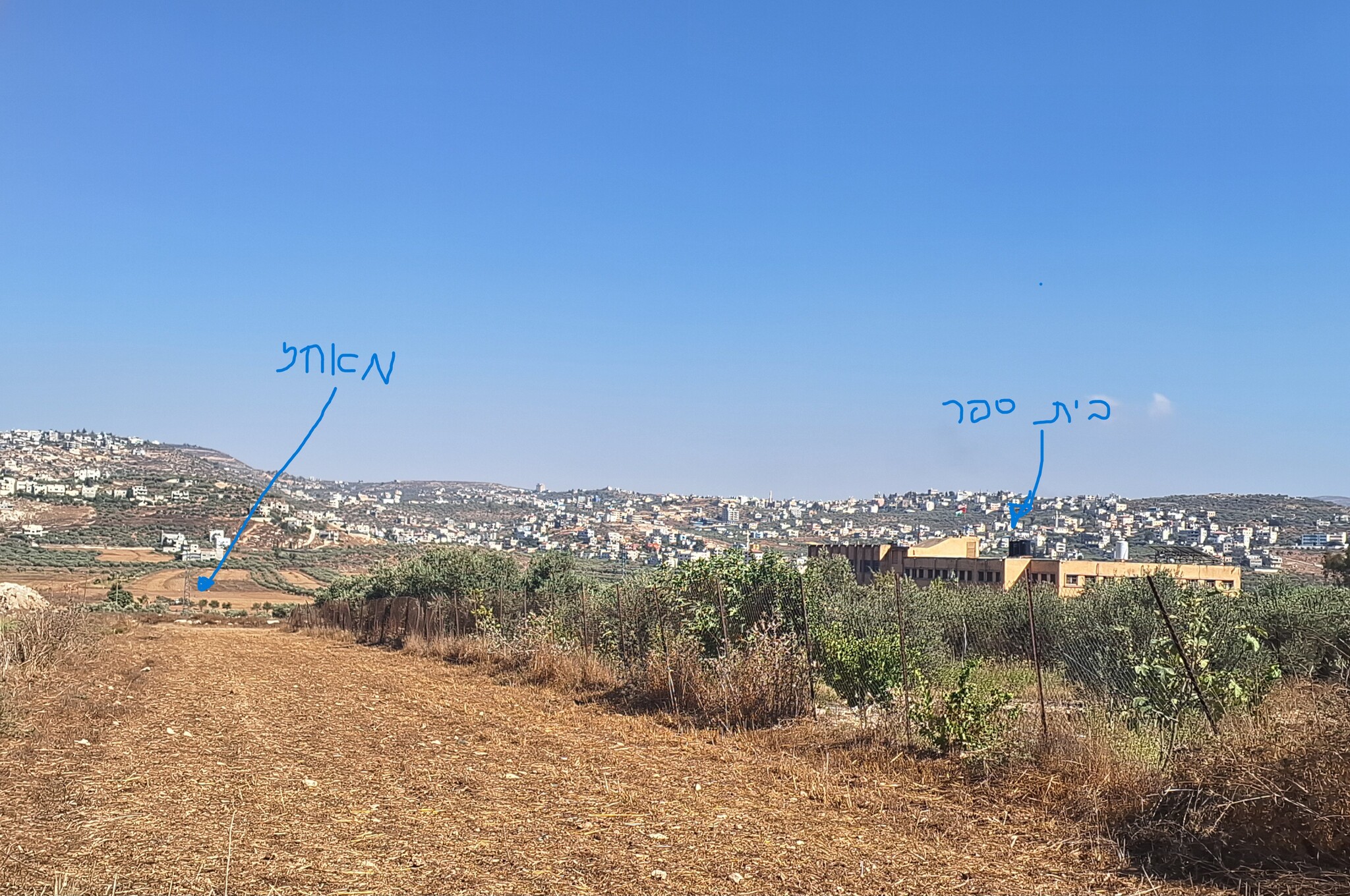 Ronit Dahan-RamatiAug-24-2026Huwara: The school on the outskirts of town and an outpost hidden among the trees
-
