
Shavei Shomron, Beit Iba, Huwwara
Shavei Shomron, Beit Iba, Huwwara, Sunday 3 October 2004 PMObservers: Elia Sh., Sarah K., Noa P., Naomi L. (reporting)colour=red>Because of the small number of participants in the shift, we divided the time between Shavei Shomron, Beit Iba and, finally, Huwwara. At Shavei Shomron, detainees were held from 08:00 until 18:00.At Beit Iba, a woman was detained although she was in an advanced stage of pregnancy with twins, and was in serious danger. At Huwwara, the winter schedule had been introduced and the checkpoint was closed at 17:30, leaving about 100 who wanted to go through and could not, because of the early closure. Shavei Shomron At 14:20 we saw people who’d been detained since 08:00 [detainees are, typically, men aged from 16 to 30 or 35 who have no passage permits; their ID details are phoned through to the General Security Services (GSS, also known as the Shabak or the Shin Bet, the Hebrew acronym for the GSS) for checking against a central list of security suspects and the answers are then relayed back to the checkpoints. This cumbersome process can take considerable time, and that can be prolonged even more if the soldiers wait to accumulate a batch of ID cards before passing them on to the GSS , or if they behave in a similarly tardy manner at the end of the process, waiting until they have a batch of GSS clearances before they release individual detainees. Meanwhile, the detainees are virtually prisoners at the checkpoint where the soldiers retain the ID cards until the entire process is completed]. Among those detained was a boy of three-and-a-half with his father. The soldier who stopped them told them he hated them, and that he’d volunteered for the checkpoint for the express purpose of killing them. He also said that they’d be detained until 18:00! According to the father, after many hours of detention, he’d asked the soldier for a piece of bread and some water for his boy, and the soldier had told him to go to Arafat for that. To us, the soldier said:” I don’t have to give them water, it isn’t my job.” Since they had the telephone number of Hamoked — The Centre for the Defence of the Individual — the incident was known to the army authorities. We phoned R., the officer at the District Coordinating Office [the army section that handles civilian matters; it generally has representatives at the checkpoints ostensibly to alleviate the lot of the Palestinians], and he promised to take care of it.15:17 – The detainees told us that the soldiers who had confiscated the documents had arrived at the checkpoint (with the documents), had gone through to their base and had totally ignored the detainees. 16:00 – All the detainees were released and allowed to go on their way.Meanwhile, we found a woman with a baby there, plus a boy of about five and the woman’s young daughter. They had been taken out of the car in which they’d been travelling in order to have the young woman’s documents checked. We seated them in our car so they wouldn’t have to stand in the sun. When the representative of the DCO arrived, he released them.Beit IbaAt 14:40 there was a long line of cars that had been waiting for around an hour to enter Nablus. Twelve men at the Qusin entrance to the checkpoint had been waiting for an hour. The checking station was manned by only two soldiers and they took turns checking the cars entering and leaving and also those coming from Qusin, so that there were lines in every direction. Sometimes, they even halted passage in every direction. At the exit, there was a line of about 80 men and a similar number of women, all packed beyond the turnstile. The checkpoint commander stood next to the women’s gate, helping them pass and speeding the progress of the line. There were 11 young detainees: including two pregnant women, one carrying twins; she had a medical certificate attesting to the fact that hers was a high risk pregnancy and she had been told to go to Tulkarm for the birth. To avoid the unpleasantness and risk of being shoved in the packed line, both women had made their way around it and were being punished for “avoiding the checkpoint”. We phoned R. who instructed the checkpoint commander to let them through after they had been waiting, so they claimed, for an hour ( the commander claimed it was 10 minutes). Also among the detainees was a young man with a medical referral for an ECG exam, leaning on crutches. We asked the DCO representative to speed up his release.Huwwara The checkpoint closed at 17:30, leaving about 100 people who had wanted to go through and were now strandedAt 16:30, there were 14 detainees, including two women who the soldier decided had avoided the checkpoint since they hadn’t immediately produced their documents at the checking station. “They’ve apparently got something to hide.” Their tardiness cost them a delay of several hours, for even when their situation became known, it was impossible to release them because the GSS checking couldn’t be stopped in the middle. A neighbour with a baby in his arms waited for them the whole time because they were afraid to continue alone. There also two residents of Beit Furik and another from Til village – asking to be released so they could reach the next checkpoint before it closed, which meant they would not be able to get home ! We asked the army’s “humanitarian” hotline to take care of them and they eventually promised to do so . But we don’t know the end of the story.At 17:30, 14 people, woman and children included, were gathered at the checkpoint, wanting to enter Nablus. (There were also people at that side of the checkpoint where the traffic is of those leaving Nablus, and these included a couple with a sick baby coming from the hospital). The Huwwara South checkpoint commander, Y., told them that the checkpoint was closed and moved them back about 100 metres, putting up a metal barrier to keep them back (explanations that they’d been delayed at other checkpoints cut no ice.) Within 15 minutes, about 100 people had gathered at the entrance to Nablus: there were people who’d arrived from Jordan with suitcases, parents and young children, nurses who had to get to their shifts in the hospital, men who’d finished a day’s work and wanted only to get home. None of that interested the soldiers in the least, the checkpoint was closed, winter clock was winter clock, an order was an order. We embarked on a massive series of phone calls starting at the top and working down: and it was effectyive !! The order to re-open was not long in coming through, and the checkpoint was opened for business , in the dark – the only illumination being provided by flashlights carried by youngsters in the Scouts (shouldn’t someone have thought about the need for normal lighting?). The soldiers checked the documents, the huge suitcases of those coming from abroad, every vehicle that was waiting patiently in line. We waited until everyone on both sides of this checkpoint had gone through. We didn’t want to think about what might have happened had we not remained until the checkpoint finally closed at 20:00. But we were didn’t manage to help a man from Hebron who worked for an ice cream company and had arrived for a festive conference of all the company’s agents. He had with him his 17-year-old son, who was detained for four hours, found “clean” by the GSS , and then was nevertheless denied entry to Nablus by the checkpoint commander [!] . In the absolute dark they went off in the direction of Huwwara village: there were no longer any taxis there, and we have no idea where they spent the night or if they succeeded in getting back home to Hebron.
Beit Iba
See all reports for this place-
A perimeter checkpoint west of the city of Nablus. Operated from 2001 to 2009 as one of the four permanent checkpoints closing on Nablus: Beit Furik and Awarta to the east and Hawara to the south. A pedestrian-only checkpoint, where MachsomWatch volunteers were present daily for several hours in the morning and afternoon to document the thousands of Palestinians waiting for hours in long queues with no shelter in the heat or rain, to leave the district city for anywhere else in the West Bank. From March 2009, as part of the easing of the Palestinian movement in the West Bank, it was abolished, without a trace, and without any adverse change in the security situation.
 Jun-4-2014Beit-Iba checkpoint 22.04.04
-
Huwwara
See all reports for this place-
The Huwwara checkpoint is an internal checkpoint south of the city of Nablus, at the intersection of Roads 60 and 5077 (between the settlements of Bracha and Itamar). This checkpoint was one of the four permanent checkpoints that closed on Nablus (Beit Furik and Awarta checkpoints to the east and the Beit Iba checkpoint to the west). It was a pedestrian-only barrier. As MachsomWatch volunteers, we watched therre since 2001 two shifts a day - morning and noon, the thousands of Palestinians leaving Nablus and waiting for hours in queues to reach anywhere else in the West Bank, from the other side of the checkpoint the destination could only be reached by public transport. In early June 2009, as part of the easing of Palestinian traffic in the West Bank, the checkpoint was opened to vehicular traffic. The passage was free, with occasional military presence in the guard tower. Also, there were vehicle inspections from time to time. Since the massacre on 7.10.2023, the checkpoint has been closed to Palestinians.
On February 26, 2023, about 400 settlers attacked the town's residents for 5 hours and set fire to property, such as houses and cars. Disturbances occurred in response to a shooting of two Jewish residents of Har Bracha by a Palestinian Terrorist. The soldiers stationed in the town did not prevent the arson and rescued Palestinian families from their homes only after they were set on fire. No one was punished and Finance Minister Smotrich stated that "the State of Israel should wipe out Hawara." Left and center organizations organized solidarity demonstrations and support actions for the residents of Hawara.Hawara continued to be in the headlines in all the months that followed: more pogroms by the settlers, attacks by Palestinians and a massive presence of the army in the town. It amounted to a de facto curfew of commerce and life in the center of the city. On October 5, 2023, MK Zvi established a Sukkah in the center of Hawara and hundreds of settlers backed the army blocked the main road and held prayers in the heart of the town all night and the next day. On Saturday, October 7, 23 The "Swords of Iron" war began with an attack by Hamas on settlements surrounding Gaza in the face of a poor presence of the IDF. Much criticism has been made of the withdrawal of military forces from the area surrounding Gaza and their placement in the West Bank, and in the Hawara and Samaria region in particular, as a shield for the settlers who were taking over and rioting.
On November 12, 2023, the first section of the Hawara bypass road intended for Israeli traffic only was opened. In this way, the settlers can bypass the road that goes through the center of Hawara, which is the main artery for traffic from the Nablus area to Ramallah and the south of the West Bank. For the construction of the road, the Civil Administration expropriated 406 dunams of private land belonging to Palestinians from the nearby villages. The settlers are not satisfied with this at the moment, and demand to also travel through Hawara itself in order to demonstrate presence and control.(updated November 2023)
.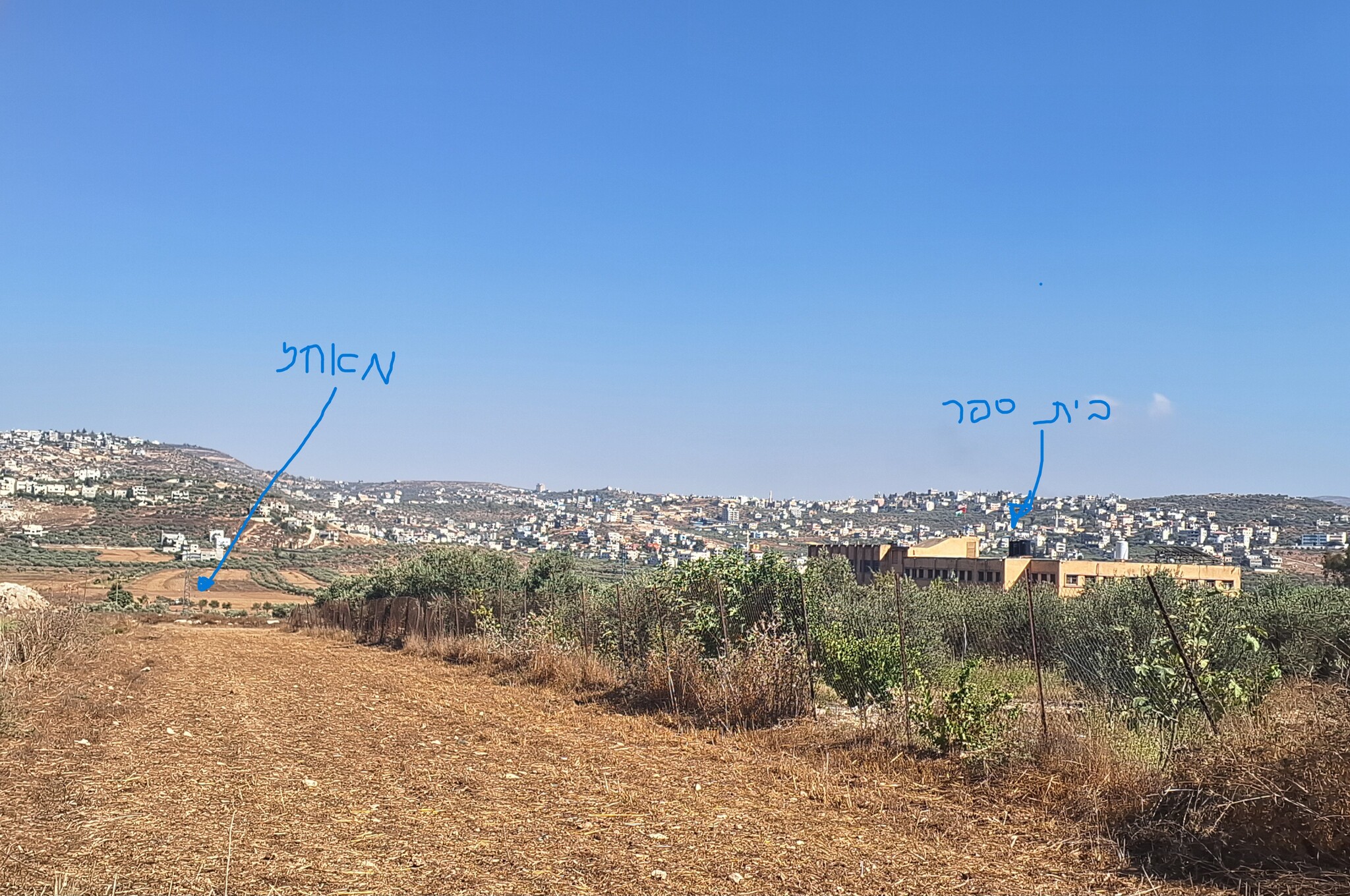 Ronit Dahan-RamatiAug-24-2026Huwara: The school on the outskirts of town and an outpost hidden among the trees
-
