
South Hebron Hills
South Hebron Thursday morning, 11 November 2004 Watchers: Edna S., Judy A., Elena L (reporting)We left Shoket at 6:35 and returned at 9:00.Summary: Arafat’s death was announced on the radio at 6:00. Closure has been imposed and we were forbidden to enter Area B [PA civil control and Israeli security]. Children were sent back home from school- apparently there will be no school during the first week of mourning. A soldier foresaw stone- throwing by kids because they were not at school. Sansana CP –we were told that closure had just been imposed and we were ordered not to enter Area B. There were 7 cars on the way to Beersheba waiting to be checked. There was no car besides our van going in the other direction.7:00 Shim’a (former CP): A humvee stood on the rise watching the road. This humvee later patrolled road 60 because we saw it returning to its post at Shim’a at 8:45 when we passed on the way back.There are fresh dirt and rock mounds on both sides of route 60, at the turn off to Samoa (Ishtama), 7:05 Dahariya turn-off: there was a humvee parked there.Dura –al Fawwar Crossing: open to vehicles; no soldiers; few pedestrians.Sheep’s Crossing (Yatta- Hebron : a humvee and soldiers are on the Hebron side. 9 detainees- all of them young men. Shortly after we drew up, all their IDs were retuned to them. We got the impression that our presence had helped, even though we had not got out of the van. One of the ex-detainees told us that they had been waiting for about 15 minutes.The southern approach to Bani Na’im was open. Shuyukh –Hebron Crossing (the girls’ school): no army presence. We were told that the police had been there earlier. The girls we talked to had been sent home from school. They told us that there would be no school for the first week of mourning after Arafat’s death. There were only 2 taxis on the Shuyukh side and one driver told us that the others had already gone home since there were almost no clients, because of the mourning.Humanitarian CP (Ras al Jura) [so called for its being the passage for ambulances and health care materiel)]: an armored lorry was stationary near the closed gate. There were no cars on either side of the gate and no soldiers on the ground. When we passed the CP again at 7:50 on our way back nothing had changed. Halhul – Hebron bridge: open to traffic including cars. This explains why there were no pedestrians on the alternative dirt road, although a military jeep was stationed on the Hebron side of the alternative road. Route 3536 under route 35 was open.7:45 Idhna CP: It was open; no soldiers present on the ground. 8:00 Halhul East –Sa’ir crossroads and CP the crossing is open to motor vehicles. Soldiers on the Sa’ir side were checking the papers of the drivers of 3 buses, but the IDs were returned as we drew up.8:10 Ash Shuyukh –Hebron Crossing : Just before the crossing we saw a settler’s car parked by the roadside and two men standing by the car. As we approached the crossing we saw stones on route 60 and a youth running very fast across it. We assumed there had been a stone-throwing incident just before we had arrived. But apart from the running youth we saw no other Palestinians.On route 60 there were quite a lot of military and police vehicles and only a few Palestinian taxis8:15 Sheeps’ Crossing: One detainee (a young man). His ID was in the process of being given to the GSS [“Shin Bet”; Israeli Security Service] when we arrived. We heard the soldiers telling the GSS that the detainee had once been a policeman. The soldiers spoke to him afterwards in a friendly manner. And after 15 minutes he got his ID back and went on his way, i.e. he had been detained probably for 15-30 minutes. When we asked what were the criteria for checking, the CO said, “We stop whomever we think we ought to”. While we were there no other Palestinian was detained even though other young crossed to Hebron. 3 heavily bearded men carrying a big kitbag as well as other parcels were asked to open the bags, but the checking took no more than a minute.The rider of a motor scooter with an Israeli license plate was also stopped and his scooter was checked. One of the soldiers told us that there had been a security alert –apparently involving scooter-riders. This soldier also expressed anxiety about possible “problems” arising, because children would not be at school during the coming week.
Hebron
See all reports for this place-
According to Wye Plantation Accords (1997), Hebron is divided in two: H1 is under Palestinian Authority control, H2 is under Israeli control. In Hebron there are 170,000 Palestinian citizens, 60,000 of them in H2. Between the two areas are permanent checkpoints, manned at all hours, preventing Palestinian movement between them and controlling passage of permit holders such as teachers and schoolchildren. Some 800 Jews live in Avraham Avinu Quarter and Tel Rumeida, on Givat HaAvot and in the wholesale market.
Checkpoints observed in H2:
- Bet Hameriva CP- manned with a pillbox
- Kapisha quarter CP (the northern side of Zion axis) - manned with a pillbox
- The 160 turn CP (the southern side of Zion axis) - manned with a pillbox
- Avraham Avinu quarter - watch station
- The pharmacy CP - checking inside a caravan with a magnometer
- Tarpat (1929) CP - checking inside a caravan with a magnometer
- Tel Rumeida CP - guarding station
- Beit Hadassah CP - guarding station
Three checkpoints around the Tomb of the Patriarchs
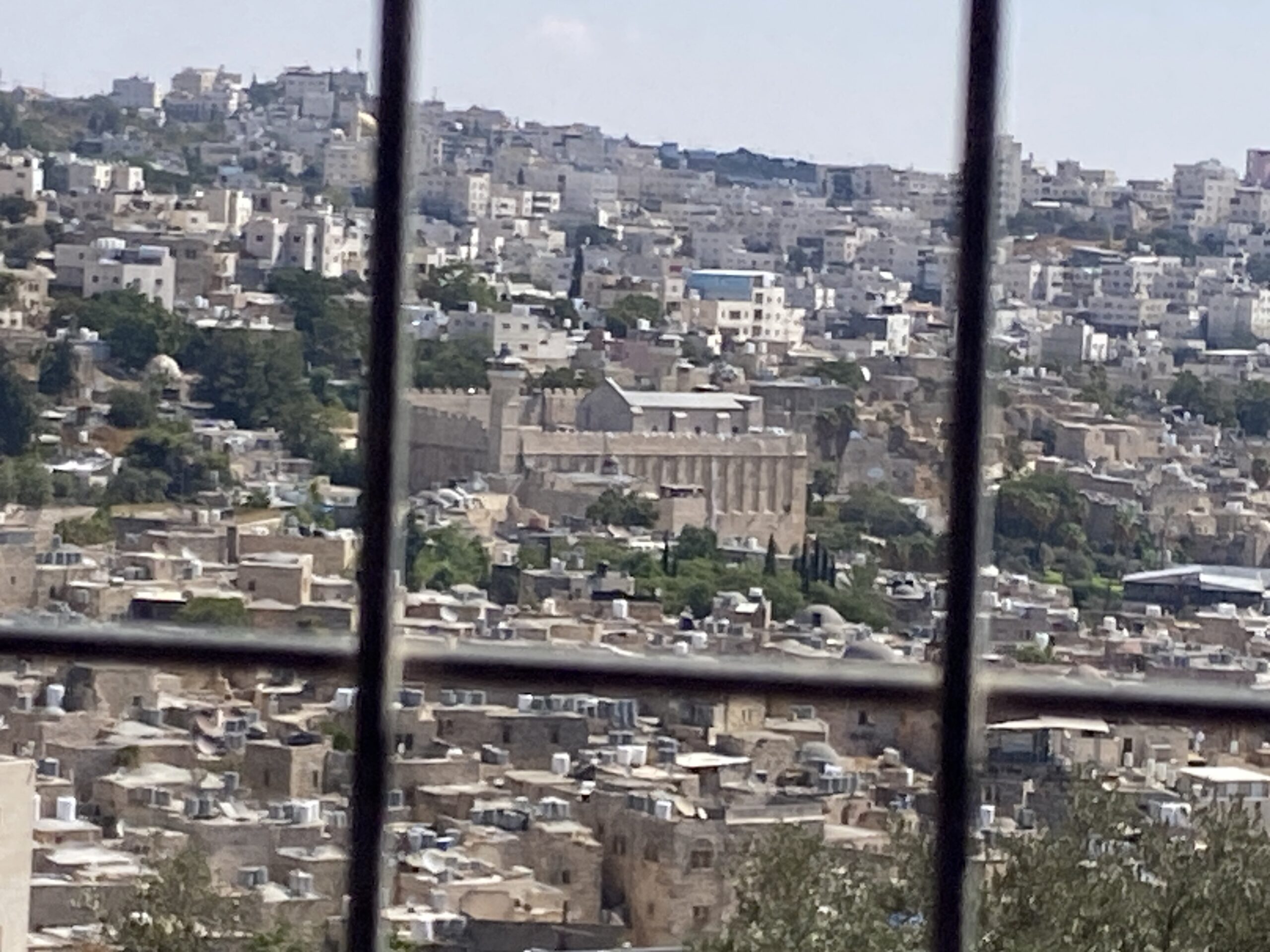 Yael ZoranSep-24-2026Hebron and the Cave of the Patriarchs from Beit Hashalom
-
