
South Hebron
The Southern Hills of Hebron, 17.10.05Observers: Michal Z., Hagit B. (reporting)06:30 – 12:00It was a long and depressing shift, which we carried out after the lethal shooting attack at the Gush Etzion junction. Army and police was everywhere, and no Palestinian vehicle was seen on the roads.Our presence, especially in such times, was essential.We did not enter Hebron. Frightening.Actually the shift began already on yester eve. As soon as I heard that one of the funerals would take place in Soussia, in that notorious settlement, where harassment of Palestinians is a daily practice, I phoned S, Head of the Tawani District to suggest to him not to send the children from the neighboring villages to Tawani school the next day. I called Adam from the Civilian Administration to alert him of possible attacks by the settlers on the unprotected Palestinian population. I also called the Head of the Brigade of Yehuda. On our way we encountered military from various units: anti aircraft, engineering units, Golani, lavie, the Border Police and others. Sansana: Was very quiet. Even Israeli Arabs, who are usually detained for some time, were absent. There were no works on the fence, due to the holiday, probably.Road 317: This is the road that leads to Carmel and Ma’on. There are new, fresh dirt mounds. The industrial zone of Meitarim is expanding. Kongo CP: At the turn to Yatir 10 laborers, who work for a contractor on the construction of the fence, are detained. Usually they arrive on a tractor. Today it was forbidden. They were ordered from afar to take off their shirts, raise their pants, to turn around – all this in order to get into the detention hut. The unit is from Golani. We went to the soldiers to talk to them, and to hand them the document stating that it is forbidden to detain a person as a means for punishment. One of the soldiers goes over to the commander, and the Palestinians are released immediately.Soussia: No passers by. We see the tractor with the cart, and relieved to know that the children did not go to school today.Between the CPs of Kongo and Sousia there were two more rolling roadblocks.Tawani: We spoke with G. He told us that he kept watch the whole night over the village. Yesterday two settlers – Gadi, the brigand and his American fellow – slaughtered 2 sheep. There are no pictures of the act, so no ocular proof. What can be done?Carmel: A flying roadblock and some five transit cars loaded with policemen have come to guard the order and the passage of the funerals. Route 356: Near the pillbox there is a flying roadblock. 10 people are detained. They are teachers from the Um-Dareg’ school. They pass here everyday without any problem. Today, because of the curfew, they are kept there. We call the commander, and the people are released to return home to Yatta. They ask us what will happen tomorrow. I call the Civilian Administration and receive the answer that tomorrow they will be allowed to teach. Why were they kept for 4 hours and why had they to wait for our intervention, and on the Ramadan??Zif junction: The gate is locked, but near it is a flying roadblock and soldiers. A bulldozer heaps up the dirt mounds. Two Palestinian, not young, approach the commander and beseech him not to block the entrance to their house. After some negotiations, the soldiers with the bulldozer remove the heap. The road is packed with vehicles of settlers, decorated with slogans: “Won’t forgive – won’t forget” on their way to the funerals. No Palestinian vehicle or pedestrian can pass the roadblock. Curfew on this part of the road. People cannot leave their homes. Bnei Hever: There is no roadblock but a hummer parks by the side of the road and soldiers lookout on the top of the hills. Road 60 and 356 Junction: A flying roadblock. No cars. Turn toward Bnei-Naim: Boulders block the way that was open before.Shiuch – Hebron Junction: Many pedestrians and many taxis from both sides. A policeman calls with a loud megaphone to stop crossing the road. We stop. The policeman assures us that as soon as the funeral cortege passes toward Olive Mountain, we will be able to pass.Halhoul Sair – Halhoul East: Curly wire is stretched on the road at the entrance to Halhoul. Entrance is forbidden. Curfew.Pedestrians that come from Halhoul are inspected with a meganometer. They lift their shirts. They take out everything from their bags on the ground. Their ID-s checked, in the middle of the day! Some Palestinian cameramen from press agencies come to photograph. A soldier yells: No photographing! I take out my camera and say to them to come and take pictures together with me. Now they are allowed. Two ambulances and a car (with blood donation) from the Red Crescent are detained, “for inspection” I am told. I insist that they be released immediately. Two officers arrive and again I ask why the vehicles are detained. Suddenly they are released and afterwards three others pass by without checking and delay. The queue of the pedestrians is long, not less than 30 people, but no detentions.Junction road 35 and 60: The Humanitarian barrier: This is the only entrance to Hebron for vehicles that come from Jerusalem, now that the entrance via Halhoul is blocked. The gate is open and soldiers check. At the junction the blue police monitors, as is the custom whenever there is a closure on Hebron. Merchants are not allowed through. Only an ambulance, A UN convoy and a school principal (Who warned us friendly: “Don’t get into Hebron, for they will kill you!”) went through. Road 35: Fresh high dirt mounds along the way and 4 flying roadblocks. No vehicles.Halhoul-Hebron bridge: Open! The soldiers, instead of keeping in the pillbox, got down to the parking lot of Coca Cola. Beit Kahil: Two hummers, no roadblock. Adora: Works on the expansion of the fence, on the expense of whose lands?Idna-Tarqumia: The gates between the two villages are open. A flying roadblock but no passers by.Kiryat Arba turn: 5 transit cars of the police park by the side of the road and some “orange” girls shout. Good that they are protected. Sheep junction: There are no soldiers, and a few people cross the road.Dura el Pawar: The closure is kept. Soldiers check the ID-s. A vehicle from the EU carrying medical equipment was allowed into Dura, and this created a jam. They were glad to see us and encouraged us by saying that our work was most valuable. Karame: The yellow gate is open but instead of it are high mounds of boulders. There are flying roadblocks. People who did not know of the closure try to reach home. We helped a man to return. The soldier contacted another one in Dura, gave him the license number of the vehicle. It was a simple idea, and we wondered, why the man had to wait 2 hours before we came and found the solution.Dahariyya and Samoa: No traffic. Soldiers at the entrance to the town.To Ramadin, because of the late hour, we did not go.
Hebron
See all reports for this place-
According to Wye Plantation Accords (1997), Hebron is divided in two: H1 is under Palestinian Authority control, H2 is under Israeli control. In Hebron there are 170,000 Palestinian citizens, 60,000 of them in H2. Between the two areas are permanent checkpoints, manned at all hours, preventing Palestinian movement between them and controlling passage of permit holders such as teachers and schoolchildren. Some 800 Jews live in Avraham Avinu Quarter and Tel Rumeida, on Givat HaAvot and in the wholesale market.
Checkpoints observed in H2:
- Bet Hameriva CP- manned with a pillbox
- Kapisha quarter CP (the northern side of Zion axis) - manned with a pillbox
- The 160 turn CP (the southern side of Zion axis) - manned with a pillbox
- Avraham Avinu quarter - watch station
- The pharmacy CP - checking inside a caravan with a magnometer
- Tarpat (1929) CP - checking inside a caravan with a magnometer
- Tel Rumeida CP - guarding station
- Beit Hadassah CP - guarding station
Three checkpoints around the Tomb of the Patriarchs
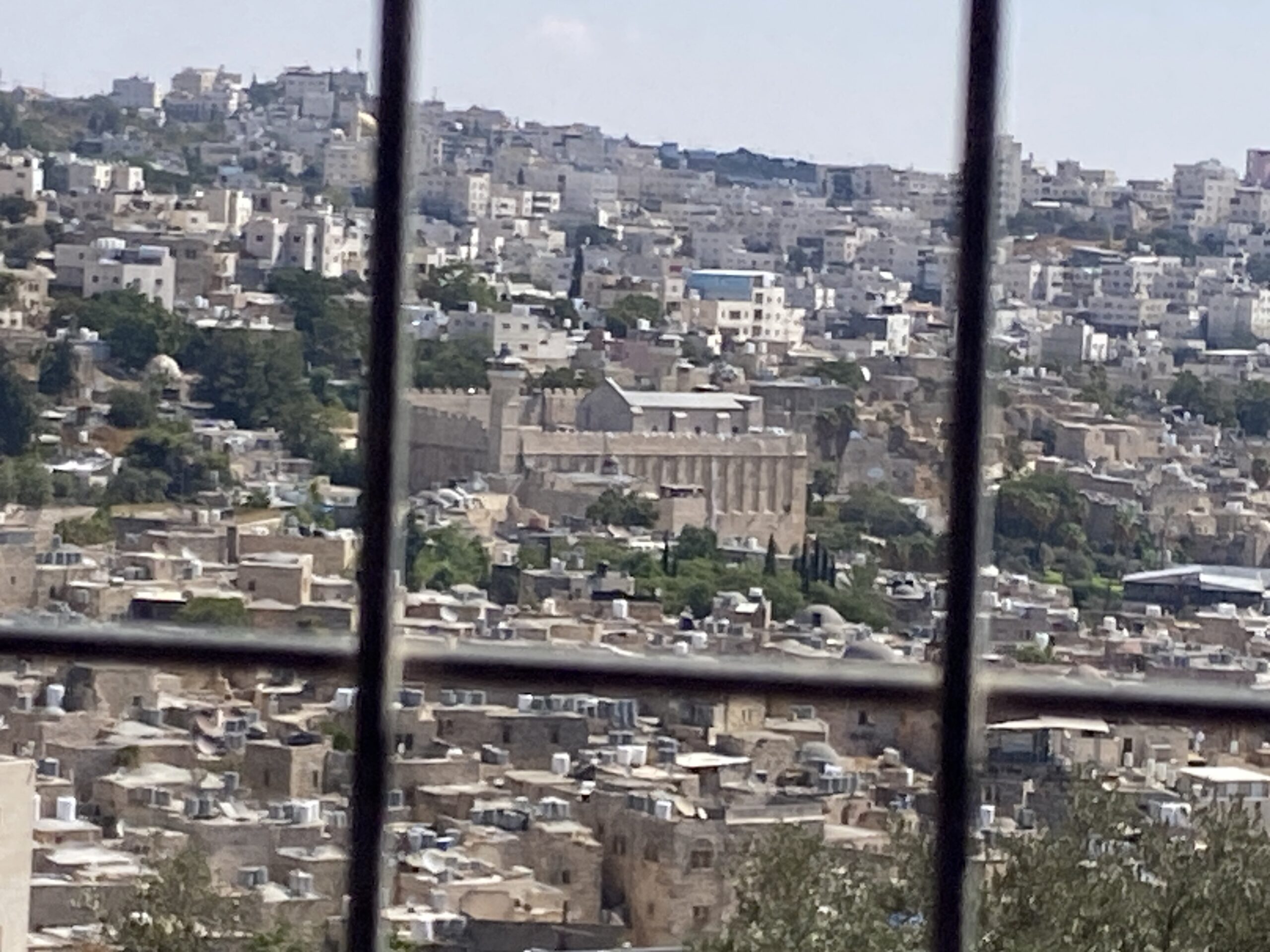 Yael ZoranSep-24-2026Hebron and the Cave of the Patriarchs from Beit Hashalom
-
