
Beit Ummar, Etzion DCL, El Khadr, Tunnel CP and CP 300
Bethlehem. Tuesday PM, 14-2-06 Observers: Ruth O. and Ilana D. (reporting) From 2:00 till 6:00 PMA dreary afternoon with an occasional shower. We first went to Beit Ummar and encountered a big crowd and some yellow cabs at the entrance to Al Aroub next to a ‘hummer’ and a few soldiers. The commander asked us whether he could help us and when we answered that we were only interested in Checkpoints, he said that this is just the regular crowd after the end of school and that the army presence is only to protect the citizens (i.e. settlers). We left. Abu Nassim welcomed us with a big smile; his entire shop was stacked full with eggs, which he was guarding for a neighbor. He is looking forward to to-morrow’s snow.The yellow sign at the Ezyon CP has been removed. All along Road 60 there was massive army presence.At the Ezyon DCL one young man needed help from the police. We called Maher who came out in the rain and after having told the young man, that he was unwilling to deal with the fines of his uncle (he has to go to Hebron after already having been to Ras el-Amud where he had been told to go to Etzion – the usual hassle!), he invited us to his office and made us tea. He complained of too much work and no facilities. He told us of the grandiose plans of yet another terminal across the road from El Khadr and wonders where the money comes from if there are no funds for ink for his fax machine. The DCL renovations are only temporary because the office will eventually move to the new facilities at the entrance to Hussan. He said that he had put up a note near the entrance of the former waiting area, which must have blown off, notifying people that he would deal with their police problems. When we suggested he renew it and put his telephone number and office hours, he thought that was a big joke! At 4:00 PM he had invited a man who had been shot in the leg by soldiers to testify to the Military Police. Indeed we saw three men waiting for him in the rain outside the gate at 4:00 and when we called Maher ten minutes later he said he would ‘soon’ go up and bring an investigator. We inspected the renovations and noted that in the three weeks since their start only two tiny roofless vestibules in front of the first two windows had been set up as well as a concrete floor and new turnstiles. Needless to say the waiting area has not been touched. In Al Khadr we gave a man who told us his cousin writes Hebrew a form to complete and send to Sylvia with a photocopy of his documents. Another man who has been in contact with Sylvia and has completed a course for tourist guide wants to enter Israel to tour the country. He has no need for a magnetic card because he works for the Tourist Police and can move around freely, but of course entering Israel is another matter and he might have to go to court to obtain permission. In the mud and the rain the place looks even filthier and sadder than usual. We drove up to the Beit Jalla DCO and noticed a steady flow of many vehicles in both directions.At the Tunnel CP (the right lane for Palestinians) we spotted the yellow sign and copied the Hebrew text which reads:Welcome to the Tunnel Passage / Road of the PatriarchsThe Passage is Intended Only for Traffic of Israelis A non-Israeli is Prohibited from Passing or being Transported via this Passage!“Israeli” – Resident of Israel, Resident of the Region who is an Israeli Citizenor Eligible to Immigrate to Israel under the Law of Return of 1950 as Valid in Israelas well as Whoever does not Reside in the Region but is in Possession of an Entry Visa Valid in Israel.A curious soldier came up to us and agreed that the wording sounded offensive, but he had not been consulted.A line of busses waited at the CP 300 terminal for passengers exiting. All the workers complained about the long procedure in the morning (from 5:00 till 7:00 AM) when people start queuing at 4:00 AM. Going into Bethlehem is fast, only papers are checked. However even at this late hour going into Jerusalem takes about half an hour and involves three different ‘procedures’ including taking off shoes, coats, belts, etc. A young tourist complained to us about the behavior of a ‘nasty’ policewoman who shouts into a loudspeaker something incomprehensible and behaves very rudely, demanding ‘in this cold weather’ to take off coats and shoes. A man from Beit Tzefafa on his way to the eye-doctor in Bethlehem with his young daughter had been sent back to take the route via Beit Jalla. He was furious, since until last week he had been allowed to cross via CP 300, which is so close to his home. It is not clear which vehicles can cross via the terminal and which have to make the detour and enter Bethlehem (without any checking) via Beit Jalla.
Beit Ummar
See all reports for this place-
Beit Ummar
The Gush Etzion-Hebron road - which is the main axis of the southern Hebron Mountains - passes through the boundaries of the village. Many incidents of stone throwing occurred on this section of road. There is a checkpoint at the entrance to the village.
In March 2006, a 25-dunam land seizure order was issued around the settlement for the purpose of establishing a "special security area" (SHBM) and a warning fence around the nearby settlement, Carmei Tzur. In April 2019, 401 dunams of the land of the villages of Beit Omer and Halhul were expropriated for the purpose of paving a road that bypasses the house of Omer to the east. Demonstrations are held by the villagers against the seizure of land with the participation of Palestinian, Israeli and international activists.
-
Hebron
See all reports for this place-
According to Wye Plantation Accords (1997), Hebron is divided in two: H1 is under Palestinian Authority control, H2 is under Israeli control. In Hebron there are 170,000 Palestinian citizens, 60,000 of them in H2. Between the two areas are permanent checkpoints, manned at all hours, preventing Palestinian movement between them and controlling passage of permit holders such as teachers and schoolchildren. Some 800 Jews live in Avraham Avinu Quarter and Tel Rumeida, on Givat HaAvot and in the wholesale market.
Checkpoints observed in H2:
- Bet Hameriva CP- manned with a pillbox
- Kapisha quarter CP (the northern side of Zion axis) - manned with a pillbox
- The 160 turn CP (the southern side of Zion axis) - manned with a pillbox
- Avraham Avinu quarter - watch station
- The pharmacy CP - checking inside a caravan with a magnometer
- Tarpat (1929) CP - checking inside a caravan with a magnometer
- Tel Rumeida CP - guarding station
- Beit Hadassah CP - guarding station
Three checkpoints around the Tomb of the Patriarchs
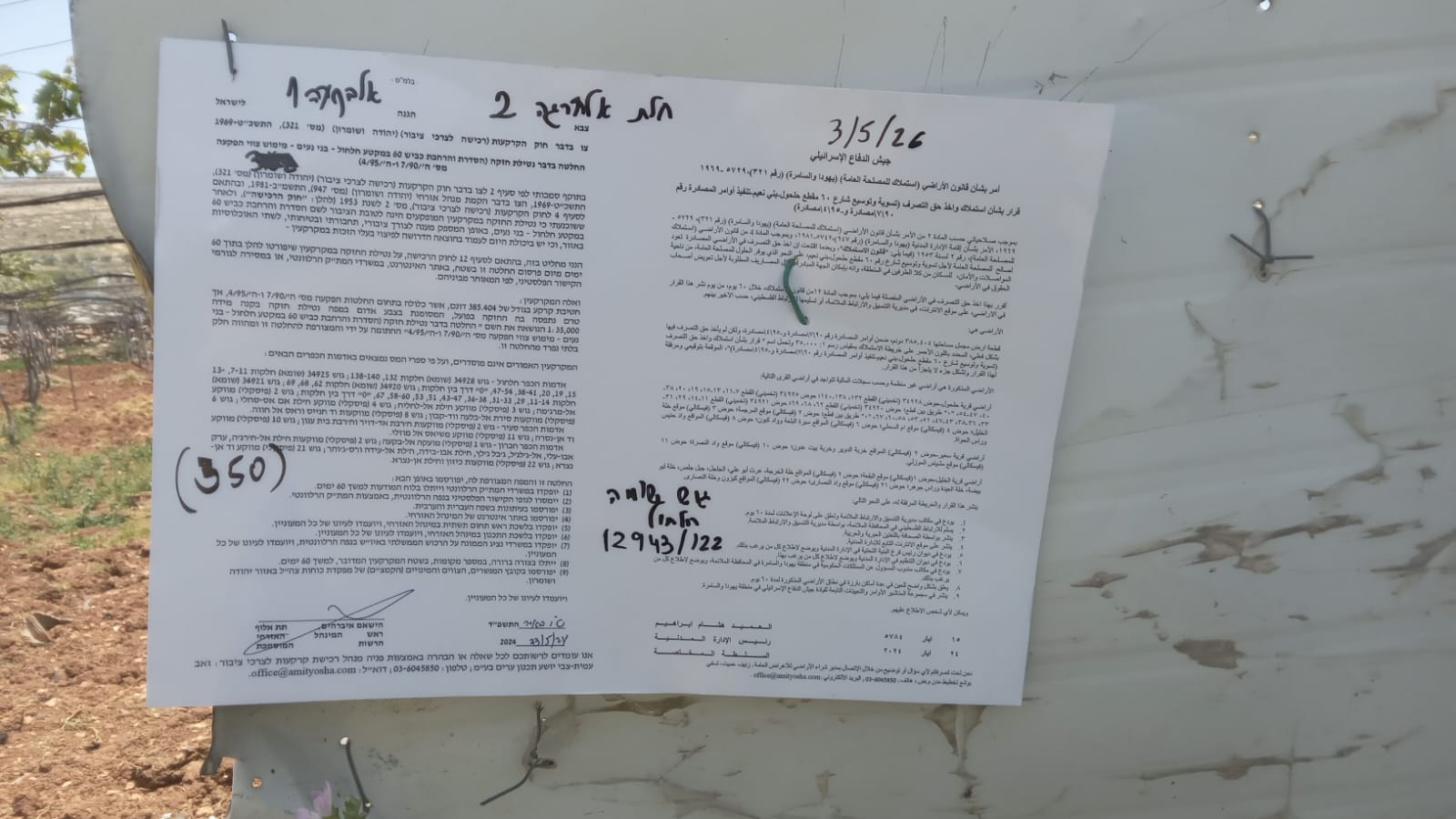 Muhammad D.May-13-2026Hebron - Request for compensation for land expropriation
-